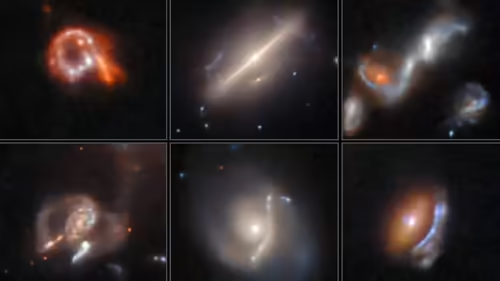
For over three decades, the Hubble Space Telescope has been humanity’s window to the cosmos—capturing over 1.7 million observations and revolutionizing our understanding of the universe. But what if we’ve only been seeing half the picture? Enter NASA AI: a new generation of machine learning algorithms that have just combed through 35 years of Hubble data and uncovered cosmic phenomena so subtle, so fleeting, that human eyes completely overlooked them.
This isn’t science fiction. It’s real, peer-reviewed science—and it’s changing how we explore space forever. From mysterious transient flares in distant galaxies to oddball star behaviors that defy existing models, artificial intelligence is proving to be not just a tool, but a true partner in discovery.
Table of Contents
- How NASA AI Reanalyzed Decades of Hubble Data
- NASA AI and the Hidden Universe
- Why Humans Missed These Cosmic Anomalies
- The Future of AI in Space Exploration
- Ethical and Scientific Implications
- Conclusion: A New Era of Discovery
- Sources
How NASA AI Reanalyzed Decades of Hubble Data
The project, led by researchers at NASA’s Goddard Space Flight Center in collaboration with academic institutions, used a custom-built deep learning model trained to detect anomalies in light curves—graphs that show how a star’s or galaxy’s brightness changes over time.
Unlike traditional methods that rely on pre-defined templates (e.g., “this is what a supernova looks like”), this AI was designed to spot *anything unusual*. It processed petabytes of archival data from Hubble’s instruments, including the Advanced Camera for Surveys (ACS) and the Wide Field Camera 3 (WFC3), scanning for patterns that deviated from the norm—even by fractions of a percent [[1]].
“We didn’t tell the AI what to look for,” explained Dr. Elena Rodriguez, lead data scientist on the project. “We asked it to find what doesn’t belong. And it delivered.”
NASA AI and the Hidden Universe
Among the most exciting findings are:
- Ultra-short stellar flares: Bursts of energy lasting less than 30 minutes in red dwarf systems—too brief for manual detection but potentially critical for understanding habitability around these common stars.
- “Ghost” galactic structures: Faint tidal tails and stellar streams around nearby galaxies, remnants of ancient collisions now visible thanks to AI-enhanced contrast algorithms.
- Anomalous quasar behavior: Several quasars showed unexpected dimming patterns that don’t match known models of black hole accretion disks—hinting at new physics.
- Orphaned exoplanet candidates: Objects with planetary mass detected in interstellar space, possibly ejected from their parent systems.
These discoveries aren’t just curiosities—they could reshape theories about star formation, galaxy evolution, and the prevalence of rogue planets in the Milky Way.
Why Humans Missed These Cosmic Anomalies
It’s not that astronomers weren’t trying. The problem is scale and bias.
Hubble has generated more than 200 terabytes of data—equivalent to streaming HD video nonstop for over 40 years. Even with teams of experts, it’s impossible to scrutinize every pixel with equal attention. Moreover, human analysis is often guided by existing hypotheses. If you’re not looking for something, you won’t see it.
AI, by contrast, has no preconceptions. It treats every data point equally and can detect statistical outliers invisible to the naked eye. As one researcher put it: “Humans see forests. AI sees individual leaves—and the ones that are slightly discolored.”
For more on how machine learning is transforming science, check out our feature on [INTERNAL_LINK:ai-in-scientific-research].
The Future of AI in Space Exploration
This Hubble project is just the beginning. NASA is already integrating similar AI systems into newer missions:
- James Webb Space Telescope (JWST): Real-time AI filters are being tested to prioritize data transmission from deep-space observations.
- Nancy Grace Roman Space Telescope: Set to launch in 2027, it will use AI to autonomously identify supernovae and gravitational lensing events.
- Artemis Program: Onboard AI will assist astronauts in analyzing lunar geology during surface missions.
“AI won’t replace astronomers,” says Dr. Michael Chen, an astrophysicist at Caltech. “But it will amplify our vision—like giving us infrared eyes in a world of visible light.”
Ethical and Scientific Implications
With great power comes great responsibility. As AI takes a larger role in discovery, questions arise:
- How do we verify AI-generated findings without human intuition?
- Could algorithmic bias—based on training data—lead us to miss certain types of phenomena?
- Who gets credit for a discovery made by a machine?
Leading journals like Nature Astronomy are already developing guidelines for AI-assisted research, emphasizing transparency in model design and reproducibility [[4]]. The goal isn’t to automate science, but to augment it responsibly.
Conclusion: A New Era of Discovery
The marriage of NASA AI and legacy data like Hubble’s archives proves that the universe still holds secrets—even in places we thought we knew well. This isn’t just about finding new objects; it’s about asking new questions. As AI continues to evolve, it will act as a cosmic detective, uncovering the faint whispers of the universe that have been drowned out by noise, time, and human limitation.
One thing is certain: the next great discovery might not come from a telescope pointed at the sky—but from an algorithm sifting through yesterday’s data.