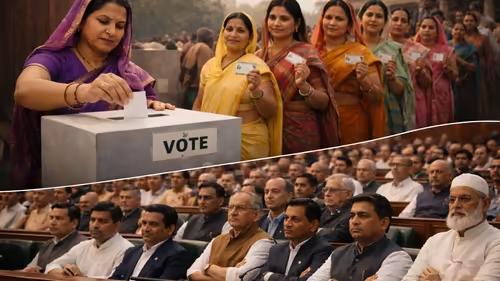
India loves to celebrate Nari Shakti—the divine feminine power. Politicians invoke it in speeches, parties launch women-centric schemes with great fanfare, and election manifestos overflow with promises of empowerment. But here’s the uncomfortable truth: while women are increasingly the decisive force at the ballot box, they’re still shockingly absent from the halls of power.
The paradox is stark. In the 2024 Lok Sabha elections, female voter turnout nearly matched that of men in many states—a historic milestone . Yet, only about 15% of the newly elected MPs are women . This isn’t just a gap; it’s a chasm between symbolic celebration and real political agency. So why does Nari Shakti remain a distant dream?
Table of Contents
- The Voting Booth vs. The Throne
- Nari Shakti in Name Only?
- Barriers to Women’s Political Leadership
- Global Comparison: Where’s India Standing?
- What Would Real Nari Shakti Look Like?
- Conclusion: Beyond Tokenism
- Sources
The Voting Booth vs. The Throne
Over the past two decades, India has witnessed a quiet revolution in electoral participation. Female voter turnout has surged—from 46.7% in 1991 to over 67% in 2019, and even higher in 2024 in key states like Bihar and West Bengal . In some constituencies, women now outvote men.
But this electoral clout hasn’t translated into proportional representation. Despite constituting nearly half the population, women hold:
- Just 15% of seats in the 18th Lok Sabha (81 out of 543)
- A mere 14.4% in the Rajya Sabha
- Only 9% of seats in state legislative assemblies on average
This disconnect reveals a fundamental flaw in how Indian democracy operates: women are valued as voters, not as leaders.
Nari Shakti in Name Only?
Political parties across the spectrum—from BJP to Congress to regional outfits—routinely brandish the banner of Nari Shakti. They launch welfare schemes like free gas cylinders, scooters, or cash transfers targeted at women. And yes, these programs have improved lives.
But when it comes to handing over real power—the party ticket, the cabinet berth, the chief ministership—the gates remain tightly shut. In the 2024 elections, major parties fielded women candidates in less than 10% of winnable seats . Instead, women are often relegated to “safe” or symbolic constituencies where victory is unlikely.
Even when women do win, they’re frequently seen through the lens of family legacy—daughters, wives, or widows of male politicians—rather than as independent leaders with their own vision.
Barriers to Women’s Political Leadership
Why does this gap persist? The obstacles are deeply entrenched:
Patriarchal Party Structures
Most political parties are dominated by male gatekeepers who control candidate selection. Internal democracy is rare, and women’s wings are often sidelined as token appendages rather than decision-making bodies.
Financial and Social Constraints
Running for office requires significant resources. Women face greater difficulty accessing campaign funds and navigating public spaces due to safety concerns and social stigma. A study by the Centre for the Study of Developing Societies (CSDS) found that 68% of female candidates reported facing gender-based harassment during campaigns .
Lack of Quotas in Practice
While the 73rd and 74th Constitutional Amendments reserve one-third of seats in local panchayats and municipalities for women—resulting in over 1.4 million women leaders at the grassroots—the same reservation has never been implemented at the state or national level, despite the Women’s Reservation Bill being passed in 2023 . Even then, its implementation is deferred until after the first census post-delimitation, pushing real change years into the future.
Global Comparison: Where’s India Standing?
Globally, India ranks a dismal 144th out of 193 countries in terms of women’s representation in national parliaments, according to the Inter-Parliamentary Union . Neighbors like Nepal (33%), Bangladesh (21%), and Pakistan (20%) all fare better.
Countries like Rwanda (61%) and New Zealand (48%) demonstrate that systemic change—through quotas, party reforms, and cultural shifts—is possible. India’s reluctance to institutionalize gender equity in its highest legislative bodies stands in stark contrast to its global image as a rising democratic power.
What Would Real Nari Shakti Look Like?
True Nari Shakti isn’t just about welfare schemes or photo ops. It means:
- Enforcing the Women’s Reservation Bill without delay
- Reforming internal party nomination processes to ensure fair access
- Creating safe, funded pathways for first-time women candidates
- Shifting public discourse from “women as beneficiaries” to “women as leaders”
It also means recognizing that women don’t just represent “women’s issues”—they bring diverse perspectives on economy, security, education, and governance that benefit society as a whole.
Conclusion: Beyond Tokenism
Until women are not just voting in large numbers but also shaping policy from positions of authority, Nari Shakti will remain a hollow slogan. The 2024 elections showed India’s women are ready to lead. The question is: are India’s political institutions ready to let them?
Sources
- Times of India: Women sway polls, men take charge: Why Nari Shakti remains a distant dream
- Election Commission of India: Lok Sabha 2024 Election Data
- Inter-Parliamentary Union: Women in National Parliaments – Global Rankings
- PRS Legislative Research: Women’s Reservation Bill, 2023 Analysis
- Centre for the Study of Developing Societies (CSDS): Gender and Political Participation in India