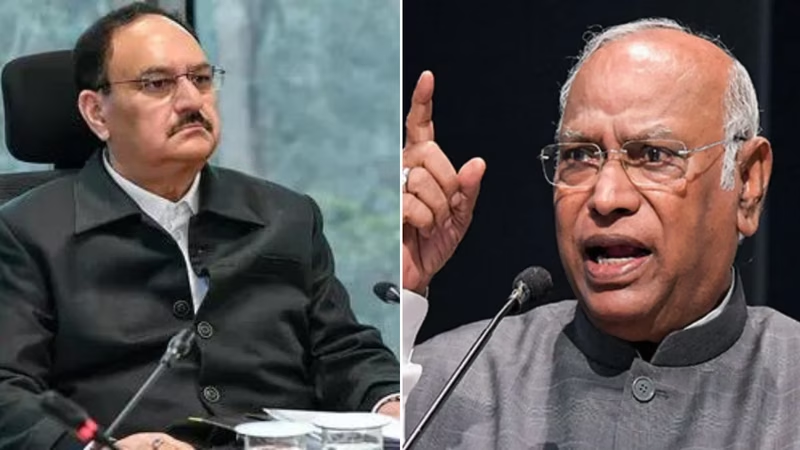
Political temperatures are rising as BJP national president J.P. Nadda launched a scathing counterattack against Congress president Mallikarjun Kharge, accusing him of spreading deliberate misinformation about the Modi government’s performance. In a charged statement that cuts to the core of India’s current political discourse, Nadda didn’t just refute Kharge’s claims—he questioned his motives, labeling him “self-obsessed” and out of touch with public sentiment. This latest salvo in the Nadda vs Kharge war isn’t just political theater; it’s a reflection of the high-stakes battle over truth, perception, and legacy in Indian democracy.
Table of Contents
- What Did Kharge Allegedly Claim?
- Nadda vs Kharge: The BJP Response
- Fact-Checking the Claims: MGNREGA, Economy, and Environment
- Why This Rhetoric Matters in Indian Politics
- Public Trust and the Misinformation Debate
- What Next for Congress and BJP?
- Conclusion
- Sources
What Did Kharge Allegedly Claim?
While the original remarks by Mallikarjun Kharge aren’t detailed in the report, Nadda’s rebuttal gives a clear window into the nature of the allegations. According to Nadda, Kharge made sweeping claims that the Modi government has:
- “Failed” on MGNREGA implementation and wage payments.
- Mismanaged the national economy, leading to inflation and unemployment.
- Neglected environmental protections in favor of corporate interests.
These are not minor critiques—they strike at three pillars of governance where public perception heavily influences electoral outcomes. For a party like Congress, trying to rebuild its national presence, highlighting perceived failures of the ruling BJP is a core opposition strategy.
Nadda vs Kharge: The BJP Response
J.P. Nadda’s response was swift and cutting. He dismissed Kharge’s statements as “falsehoods” and accused him of being disconnected from ground reality. “The people have already rejected Congress’s lies in multiple elections,” Nadda declared, invoking India’s 2014, 2019, and recent state election results as proof of public trust in the BJP .
But Nadda went further—personally. He labeled Kharge as “self-obsessed,” suggesting the Congress president is more focused on personal positioning than national issues. This marks a shift from policy rebuttals to character critique, a tactic often used to delegitimize opponents in the current political climate.
Fact-Checking the Claims: MGNREGA, Economy, and Environment
To understand the Nadda vs Kharge clash, it’s essential to look beyond rhetoric. Let’s unpack the three key areas of contention:
MGNREGA Performance
The Modi government has consistently increased MGNREGA allocations, with over ₹60,000 crore budgeted in recent years. However, delays in wage payments and incomplete works have been flagged by independent monitors like the Mazdoor Kisan Shakti Sangathan (MKSS). Both parties use selective data: BJP highlights fund allocation; Congress cites implementation gaps.
Economic Indicators
India’s GDP growth remains among the world’s highest, but job creation and MSME health remain points of debate. While Nadda touts macroeconomic stability, critics argue inflation—especially food inflation—has hurt ordinary households. The truth, as always, lies in the nuance.
Environmental Record
On paper, India is a global leader in renewable energy expansion. Yet, environmental clearances for mining and infrastructure projects in ecologically sensitive zones (like forests and coastlines) have surged under this government. Environmental NGOs like the Centre for Science and Environment have documented this duality.
Why This Rhetoric Matters in Indian Politics
This exchange isn’t just about two leaders—it’s emblematic of a larger trend: the weaponization of “truth” in Indian politics. Both major parties now routinely accuse each other of spreading misinformation. The BJP frames itself as the victim of “urban elite” and “foreign-backed” narratives, while Congress positions the BJP as an authoritarian force distorting facts.
In an era where social media amplifies every statement, controlling the narrative is as important as policy delivery. That’s why Nadda’s emphasis on “people rejecting lies” is strategic—it appeals to the BJP’s core voter base, which often distrusts mainstream media and opposition claims.
Public Trust and the Misinformation Debate
A 2023 study by the Reuters Institute found that India has one of the lowest levels of trust in news media globally—just 32% . In such an environment, political leaders become primary information sources for their supporters. This makes accusations like Nadda’s incredibly potent: by branding Kharge a “spreader of falsehoods,” he inoculates BJP supporters against future Congress critiques.
But this cycle erodes democratic discourse. When every claim is dismissed as a lie, constructive debate becomes impossible. The danger isn’t just polarization—it’s the collapse of shared reality. For a deeper look at this phenomenon, see our analysis on [INTERNAL_LINK:media-trust-and-political-polarization-india].
What Next for Congress and BJP?
With state elections and a general election on the horizon, expect more such clashes. The BJP will continue to project strength and dismiss opposition criticism as sour grapes. Congress, meanwhile, must find a way to make its critiques resonate beyond urban echo chambers—without being drowned out by the “falsehood” label.
Kharge’s age and perceived lack of charisma are often used by BJP strategists to paint Congress as out of touch. Nadda’s “self-obsessed” jab is part of that narrative. For Congress to break through, it needs not just facts—but a compelling story that connects with India’s aspirations and anxieties.
Conclusion
The Nadda vs Kharge face-off is more than a political spat—it’s a microcosm of India’s fractured information ecosystem. While Nadda’s defense of the Modi government may rally the BJP base, it also highlights a troubling trend: the replacement of debate with denunciation. In a democracy, challenging the government is not a crime—it’s a duty. The real test won’t be who shouts louder, but who listens, adapts, and offers solutions that stand up to scrutiny, not just slogans.