Table of Contents
- From Auction Room to Diplomatic Crisis
- The Mustafizur Rahman Row Explained
- PCB’s Bold Move: Offering a Neutral Venue
- The Bigger Picture: BCB vs. BCCI Tensions
- What This Means for the T20 World Cup
- Conclusion: A Sport Caught in a Geopolitical Web
- Sources
It was supposed to be a moment of triumph. In December 2025, at the IPL 2026 mini-auction, Bangladesh’s star pacer Mustafizur Rahman was snapped up by the Kolkata Knight Riders (KKR) for a massive Rs 9.2 crore—a clear sign of his value and a promising start to his new chapter in the world’s richest T20 league . But within weeks, that dream turned into a nightmare, not just for the player, but for the entire cricketing world. His sudden axing from the KKR squad has ignited a geopolitical firestorm, culminating in the Pakistan Cricket Board (PCB) formally approaching the ICC to host Bangladesh’s T20 World Cup matches. This is the story of the Mustafizur Rahman row.
From Auction Room to Diplomatic Crisis
The sequence of events is stark. Mustafizur, a proven match-winner in T20 cricket, was a prized acquisition for KKR, who were looking to bolster their bowling attack . However, in early January 2026, reports emerged that KKR had been instructed to release him from their squad . The reason? An alleged directive from the Board of Control for Cricket in India (BCCI), stemming from the long-standing political and sporting tensions between India and Pakistan, and by extension, its impact on players from nations that maintain strong ties with Pakistan . This wasn’t a performance-based decision; it was a political one, turning a sports transaction into an international incident.
The Mustafizur Rahman Row Explained
At its core, the Mustafizur Rahman row is a symptom of the deep-seated friction between the BCCI and the Bangladesh Cricket Board (BCB). The BCB has been vocal about its refusal to send its national team to India for the upcoming T20 World Cup unless the BCCI agrees to play a bilateral series in Pakistan—a condition the BCCI has consistently rejected . This tit-for-tat stance has created a stalemate. Mustafizur, a prominent Bangladeshi athlete, became an unwitting pawn in this high-stakes game. His presence in an Indian franchise was seen as incompatible with the BCB’s official position, leading to his forced exit from the IPL 2026 roster . KKR, caught in the crossfire, is now expected to receive a full refund of the Rs 9.2 crore they spent on him .
PCB’s Bold Move: Offering a Neutral Venue
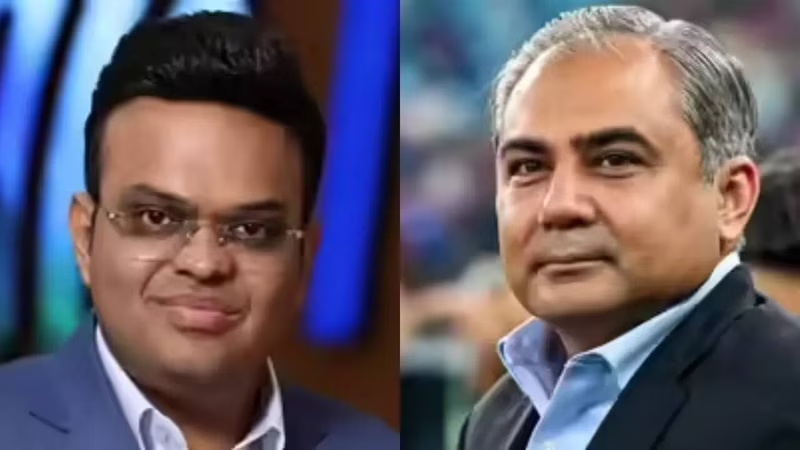
Seeing an opportunity to both support a fellow cricketing nation and potentially gain a foothold in a major ICC event, the Pakistan Cricket Board (PCB) has made a formal offer to the International Cricket Council (ICC). The PCB has expressed its willingness and readiness to host all of Bangladesh’s T20 World Cup 2026 matches if the original co-hosts, Sri Lanka, are unable to accommodate them or if the situation with India remains unresolved [[10], [15]]. PCB Chairman Mohsin Naqvi has been at the forefront of this initiative, stating that Pakistan’s venues are fully equipped to handle such a prestigious tournament . This move is not just logistical; it’s a strategic diplomatic play by Pakistan to reassert its place in the international cricketing community.
The Bigger Picture: BCB vs. BCCI Tensions
This entire saga goes far beyond one player or one team. It reflects the fragile state of cricket diplomacy in South Asia. The BCB’s stance is reportedly a direct response to the BCCI’s long-standing policy of not touring Pakistan due to security concerns, a policy that has been in place since 2008 . By refusing to play in India, Bangladesh is attempting to leverage its participation in a global event to force a change in the BCCI’s position. The ICC, meanwhile, finds itself in a difficult spot, having to balance sporting integrity with complex political realities. While the ICC has reportedly turned down the BCB’s initial request to relocate their matches, the pressure is mounting .
What This Means for the T20 World Cup
The implications for the T20 World Cup 2026 are significant. If the BCB holds firm and does not travel to India, it could lead to forfeited matches, a compromised tournament structure, and a major black eye for the sport’s global governing body. The PCB’s offer provides a potential solution, but it comes with its own set of complications, including security assessments and the willingness of other participating nations to play in Pakistan. For fans, the prospect of missing out on seeing a star like Mustafizur Rahman on the world stage is a bitter pill to swallow. This controversy has already cast a shadow over what should be a celebration of the game. For more on the tournament’s logistics, see our guide on [INTERNAL_LINK:t20-world-cup-2026-venues].
Conclusion: A Sport Caught in a Geopolitical Web
The Mustafizur Rahman row is a stark reminder that cricket in the subcontinent is rarely just a game. It is deeply intertwined with politics, history, and national pride. What began as a simple team selection issue for an IPL franchise has ballooned into a complex international dispute involving three major cricket boards and the ICC. The fate of Mustafizur’s IPL career, Bangladesh’s World Cup campaign, and even the smooth running of the tournament itself now hangs in the balance. One can only hope that cooler heads will prevail, and the sport can find a way to rise above the politics that so often threaten to consume it.