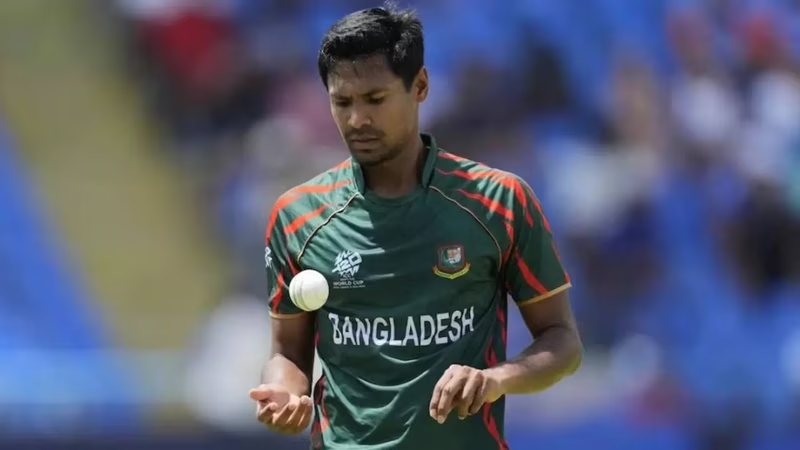
The drama surrounding Mustafizur Rahman’s IPL 2026 participation has reached its final act. In a decisive move that ends weeks of speculation, Kolkata Knight Riders (KKR) have officially confirmed the Mustafizur Rahman KKR release from their squad. The decision, as reported by multiple sources, came not from the franchise itself but from a direct instruction by the Board of Control for Cricket in India (BCCI) . This unexpected reversal—just after Mustafizur was bought for a significant sum during the auction—has sent ripples through the cricketing world, highlighting the complex interplay between sport, politics, and national board policies. For KKR, it’s a major tactical setback; for Mustafizur, it’s yet another barrier between his talent and the world’s biggest T20 stage.
Table of Contents
- The Official Announcement: Mustafizur Rahman KKR Release Confirmed
- Why Did the BCCI Intervene? Unpacking the Political Backdrop
- KKR’s Strategy and the Impact of Losing Mustafizur
- Mustafizur’s Response: BPL Performance in the Midst of Turmoil
- Historical Context: Bangladesh Players and IPL Participation
- What’s Next for KKR and Mustafizur?
- Conclusion: A Lose-Lose Situation for Cricket
- Sources
The Official Announcement: Mustafizur Rahman KKR Release Confirmed
Kolkata Knight Riders issued a brief but unambiguous statement confirming that they have released Mustafizur Rahman from their roster for the upcoming IPL season. The franchise cited “official communication from the BCCI” as the reason for the move . This means KKR is now eligible to name a replacement player before the tournament begins—a crucial lifeline for a team that had built part of its bowling attack around Mustafizur’s renowned death-over expertise.
The timing is particularly jarring. Mustafizur was acquired during the high-profile IPL auction, generating excitement among fans and analysts alike. His sudden exit, just weeks before the season opener, leaves a significant void in KKR’s bowling lineup and raises serious questions about the BCCI’s role in player clearances.
Why Did the BCCI Intervene? Unpacking the Political Backdrop
While the BCCI has not issued a detailed public explanation, multiple reports suggest the decision stems from diplomatic sensitivities. The signing of Mustafizur had sparked controversy on social media and in certain political circles in India, with critics questioning the inclusion of a Bangladesh national amid strained bilateral relations . Though cricket boards typically operate independently of foreign policy, the BCCI appears to have yielded to this pressure.
This marks a troubling precedent. If geopolitical tensions can dictate team selections in a private sports league, it undermines the very spirit of international sport. The BCCI’s move has been criticized by former players and commentators who argue that the IPL should remain a merit-based competition.
KKR’s Strategy and the Impact of Losing Mustafizur
Mustafizur Rahman was not just a name on the team sheet; he was a strategic asset. His ability to bowl pinpoint yorkers and deceptive slower balls at the death made him one of the most effective T20 bowlers of the last decade. In 43 IPL matches, he has taken 45 wickets at an economy rate of just 8.29 .
His absence creates a massive challenge for KKR’s coaching staff. Potential replacement options are limited, especially this close to the season. The team may now be forced to rely more heavily on young Indian pacers or restructure their entire bowling approach—a gamble that could cost them in a highly competitive tournament.
Mustafizur’s Response: BPL Performance in the Midst of Turmoil
Despite the heartbreak over his IPL exclusion, Mustafizur has channeled his focus into domestic cricket. In the ongoing Bangladesh Premier League (BPL), he has been in scintillating form, recently claiming a five-wicket haul and leading his franchise’s bowling attack . His social media post—”Always grateful”—in the wake of the controversy, now reads as a statement of quiet resilience.
His performance proves that his skills are undiminished. The tragedy is that politics, not form or fitness, has barred him from showcasing that talent on the global T20 stage.
Historical Context: Bangladesh Players and IPL Participation
Bangladeshi cricketers have always had a limited presence in the IPL. Only a handful—Shakib Al Hasan, Mashrafe Mortaza, and Mustafizur himself—have ever featured in the league. This scarcity is largely due to the Bangladesh Cricket Board’s (BCB) restrictive policies and, at times, the BCCI’s own hesitance.
The Mustafizur Rahman KKR release is the latest chapter in this fraught history. It sends a discouraging message to future generations of Bangladeshi talent: even if you’re among the world’s best, external forces may deny you a chance to prove it in the IPL.
What’s Next for KKR and Mustafizur?
KKR is expected to announce a replacement player within days. Likely candidates include uncapped Indian fast bowlers or seasoned T20 veterans available on the reserve list. For Mustafizur, the focus shifts entirely to the BPL and his national team duties. He may also explore opportunities in other global leagues like the SA20 or the CPL, where political considerations are less prominent.
For a deeper look at how global leagues are reshaping careers, see our feature on [INTERNAL_LINK:global-t20-leagues-career-impact].
Conclusion: A Lose-Lose Situation for Cricket
The Mustafizur Rahman KKR release is more than a roster change—it’s a setback for the sport itself. Fans are denied the chance to see a world-class bowler in action, a franchise loses a key player, and a talented athlete is punished for circumstances beyond his control. In allowing political noise to override sporting merit, the BCCI has set a dangerous precedent that could haunt the IPL’s reputation as a truly global and inclusive league.