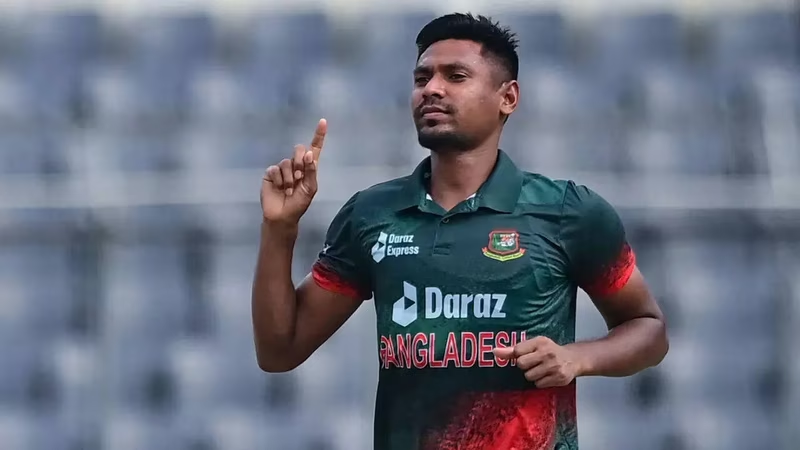
The ripple effects of a single IPL squad decision have now escalated into a full-blown international cricket standoff. After Mustafizur Rahman was released by his IPL franchise just weeks before the T20 World Cup 2026, the Bangladesh Cricket Board (BCB) has taken the extraordinary step of formally requesting the International Cricket Council (ICC) to relocate all of Bangladesh’s matches out of India. The reason? Alleged security concerns tied to the snub—and a deep sense of diplomatic unease.
Table of Contents
- The Mustafizur Rahman IPL Snub That Started It All
- Bangladesh Cricket Board’s Formal Request to ICC
- Why Security Concerns Are Being Cited
- Is This Really About Cricket—or Politics?
- Historical Tensions Between BCB and BCCI
- What the ICC Can (and Can’t) Do
- Possible Venue Alternatives for Bangladesh Matches
- Fan and Player Reactions
- Conclusion: A Delicate Diplomatic Tightrope
- Sources
The Mustafizur Rahman IPL Snub That Started It All
In late December 2025, Mustafizur Rahman—one of Bangladesh’s most valuable T20 assets—was unexpectedly released by his IPL franchise ahead of the 2026 season. The franchise cited “strategic squad rebalancing,” but the timing raised eyebrows. With the T20 World Cup just months away, the move left Mustafizur without competitive match practice in high-pressure environments.
For Bangladesh, this wasn’t just a roster change—it was perceived as a slight. Mustafizur is not only a match-winner; he’s a national icon. His sudden exit, without a clear explanation, fueled speculation of behind-the-scenes friction between the BCB and the Board of Control for Cricket in India (BCCI).
Bangladesh Cricket Board’s Formal Request to ICC
BCB president Aminul Islam confirmed in a press statement that his board has submitted an official request to the ICC to shift Bangladesh’s scheduled T20 World Cup 2026 matches from Indian soil. “This is not a bilateral issue with India,” he emphasized. “This is an ICC event. We are awaiting their formal response before deciding our next course of action.”
Notably, the BCB has stopped all direct communication with the BCCI on this matter, underscoring their stance that the ICC—not India—holds ultimate responsibility for team safety and venue logistics.
Why Security Concerns Are Being Cited
While no specific threat has been publicly disclosed, Bangladeshi officials hint at a “deteriorating environment of respect and assurance” for their players in India. The Mustafizur incident appears to have amplified existing anxieties:
- Lack of consultation: BCB claims it was not consulted before Mustafizur’s IPL release, despite his World Cup importance.
- Player morale: The team fears the incident reflects a broader disregard for Bangladeshi cricketing stature.
- Historical precedents: Past incidents, like the 2015 Dhaka embassy protests, have left lingering sensitivities.
Though speculative, these concerns tap into real geopolitical undercurrents that often surface in South Asian cricket.
Is This Really About Cricket—or Politics?
Cricket in the subcontinent has never been just a sport. It’s diplomacy, identity, and national pride rolled into one. The Mustafizur Rahman controversy may be the spark, but the fire likely stems from deeper issues:
Bangladesh has long felt overshadowed by India in ICC decision-making. From fixture scheduling to broadcast rights, Dhaka often perceives a power imbalance. This episode may be their way of asserting agency—using the ICC’s own protocols to demand equal treatment.
Historical Tensions Between BCB and BCCI
This isn’t the first time BCB has pushed back:
- In 2022, Bangladesh refused to play a bilateral series in India over visa delays for support staff.
- In 2023, BCB publicly criticized the BCCI for excluding Bangladesh from a proposed Asian T20 league.
- Mustafizur himself opted out of the 2024 IPL, reportedly due to “mental fatigue” from constant travel demands.
Each incident has chipped away at trust—making the current standoff less surprising, though no less serious.
What the ICC Can (and Can’t) Do
The ICC has final authority over World Cup hosting, but logistics are complex. India is the primary host for the 2026 T20 World Cup, with the West Indies and Sri Lanka as co-hosts .
Relocating Bangladesh’s matches would require:
- Identifying neutral venues (possibly Sri Lanka or UAE)
- Revising travel and broadcast schedules
- Ensuring no competitive disadvantage to other teams
According to the ICC Playing Conditions Handbook, “player welfare and security are paramount”—a clause Bangladesh is now invoking.
Possible Venue Alternatives for Bangladesh Matches
If the ICC agrees, likely relocation hubs include:
- Colombo, Sri Lanka: Already a co-host, with world-class facilities.
- Dubai or Abu Dhabi, UAE: Neutral, secure, and logistically proven.
- St. Lucia or Trinidad: In the West Indies, though travel fatigue could be a concern.
However, any move could disrupt the tournament’s narrative flow—and set a precedent other boards might follow.
Fan and Player Reactions
On social media, Bangladeshi fans are overwhelmingly supportive of the BCB’s stance, using hashtags like #RespectMustafizur and #MoveTheMatches. Indian fans, meanwhile, are divided—some call it “overreaction,” while others acknowledge the symbolic weight of the IPL snub.
Notably, no senior Indian player has commented publicly, likely to avoid escalating tensions. For more on fan sentiment, see our analysis on [INTERNAL_LINK:social-media-and-cricket-diplomacy].
Conclusion: A Delicate Diplomatic Tightrope
At its core, this crisis isn’t really about one player’s IPL contract. It’s about respect, reciprocity, and the fragile balance of power in subcontinental cricket. The ICC now faces a high-stakes decision: uphold Bangladesh’s request and risk fracturing India’s hosting vision—or deny it and potentially see a team boycott. Whatever happens, the Mustafizur Rahman fallout has already changed the game off the field.