Musk and Trump’s Davos 2026 Split: A Reconciliation Under Strain
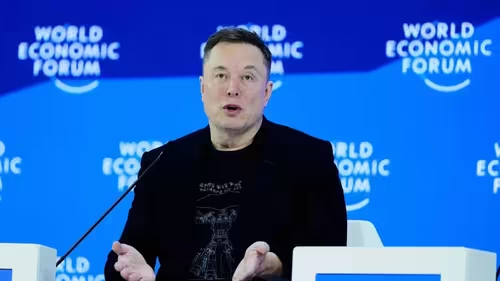
In a twist that’s captivated global observers, the much-publicized truce between tech titan Elon Musk and former U.S. President Donald Trump is already showing cracks—this time over one of the most divisive issues in modern American politics: energy policy. Despite attending a joint memorial in September 2025 that signaled a personal reconciliation, the two powerhouses have now taken starkly opposing stances at the World Economic Forum in Davos 2026.
Musk used the high-profile platform to advocate for solar energy as the cornerstone of America’s future electricity grid. His message? The U.S. must rapidly scale solar infrastructure to meet surging demand from AI data centers, electric vehicles, and industrial electrification. This position directly contradicts Trump’s long-standing dismissal of renewables and his vocal support for fossil fuels—a tension that reveals deeper ideological fractures beneath their surface-level détente.
Table of Contents
- The September 2025 Reconciliation: Backstory
- Musk Trump solar energy rift at Davos 2026
- Trump’s Pro-Oil Agenda vs. Musk’s Renewable Push
- Why Solar Is Non-Negotiable for Musk
- Political and Market Implications of the Split
- Conclusion: A Strategic Alliance or Temporary Truce?
- Sources
The September 2025 Reconciliation: Backstory
After years of public sparring—ranging from Twitter feuds to policy disagreements—Musk and Trump appeared to bury the hatchet in September 2025 when they were photographed together at a private memorial service. While neither confirmed the nature of their conversation, insiders described it as “cordial” and “forward-looking.” Many interpreted this as a strategic alignment ahead of the 2026 U.S. political cycle, especially given Musk’s growing influence in conservative media circles and Trump’s potential presidential run.
But personal rapport doesn’t always translate into policy harmony—and Davos 2026 proved just that.
Musk Trump solar energy rift at Davos 2026
During a panel on “Energy for the AI Era,” Musk declared: “The U.S. cannot meet its future electricity needs without massive solar deployment. It’s not optional—it’s physics.” He emphasized that solar, paired with battery storage, is now the cheapest and fastest-to-deploy energy source available, especially for powering the exponential growth of AI infrastructure.
This statement stands in sharp contrast to Trump’s repeated attacks on wind and solar power. In recent rallies, Trump has called renewable energy “unreliable,” “ugly,” and “a scam,” while pledging to revive coal, oil, and gas as the backbone of American energy independence. The Musk Trump solar energy rift isn’t just philosophical—it’s a direct challenge to Trump’s core campaign narrative.
Trump’s Pro-Oil Agenda vs. Musk’s Renewable Push
Their positions reflect two competing visions for America’s future:
- Trump’s Vision: Energy dominance through fossil fuels; rollback of environmental regulations; expansion of drilling on federal lands; skepticism toward climate science.
- Musk’s Vision: Accelerated transition to sustainable energy; scaling of solar + battery ecosystems (via Tesla and SolarCity); integration of clean power with AI and transport electrification.
Notably, Musk’s companies—including Tesla and SpaceX—are among the largest corporate consumers of clean energy in the U.S., making his stance both ideological and business-driven.
Why Solar Is Non-Negotiable for Musk
For Musk, solar isn’t just an environmental cause—it’s a strategic necessity. With AI data centers projected to consume up to 8% of U.S. electricity by 2030 (per the U.S. Energy Information Administration), traditional grids can’t keep up. Solar farms, he argues, can be deployed in months, not decades, and paired with Megapack batteries to provide 24/7 reliability.
“You can’t power AI with nostalgia,” Musk quipped at Davos, a clear jab at fossil fuel advocates. His comments align with broader industry trends: even oil giants like Shell and BP are investing billions in solar, recognizing its economic inevitability.
Political and Market Implications of the Split
This divergence could have far-reaching consequences:
- For Investors: Renewable stocks may gain momentum if Musk’s stance influences policy, despite Trump’s opposition.
- For Voters: Highlights a growing split within the right-leaning tech elite—pro-innovation vs. pro-fossil fuel conservatism.
- For Global Climate Goals: The U.S. stance will heavily influence whether the world meets 2030 decarbonization targets.
As noted by the International Energy Agency (IEA), solar is now the “cheapest electricity in history” in most markets—a reality even political rhetoric can’t override .
Conclusion: A Strategic Alliance or Temporary Truce?
The Musk Trump solar energy rift reveals that their reconciliation was likely personal, not ideological. While they may agree on issues like free speech or regulatory reform, energy—and by extension, climate policy—remains a fault line. As the 2026 election season heats up, this split could force other tech leaders and policymakers to choose sides in the defining energy debate of our time.
For deeper analysis on how tech billionaires are reshaping climate policy, see our feature on [INTERNAL_LINK:tech-leaders-climate-action].
Sources
- Times of India: Elon Musk breaks rank with Donald Trump at Davos
- International Energy Agency (IEA): Renewables 2025 Report
- U.S. Energy Information Administration (EIA): Electricity Demand Projections for AI Infrastructure