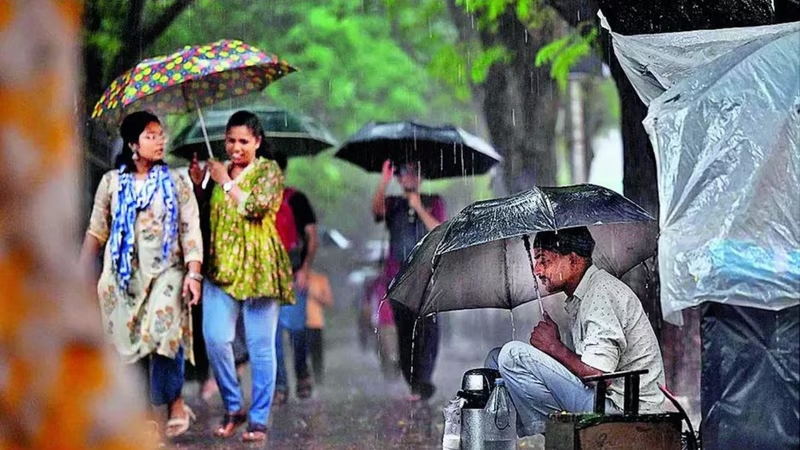
The first day of 2026 was supposed to be about resolutions, hangovers, and fresh starts. Instead, Mumbaikars woke up to the rhythmic drumming of an unseasonal rain that swept across the city just before dawn. This unexpected gift from the skies, while refreshing for many, is a stark departure from the city’s typical dry, cool January weather—and it begs a crucial question: is this just a fluke, or a glimpse into our new, volatile climate reality?
Table of Contents
- A Surprise Shower on New Year’s Day
- Why is Mumbai Unseasonal Rain in January So Alarming?
- What Does the IMD Say About the Anomaly?
- The Ominous Link to Climate Change
- What This Means for Mumbai’s Future
A Surprise Shower on New Year’s Day
The surprise began just before 6 a.m. on Thursday, January 1st, 2026. Heavy showers and a lingering drizzle blanketed various parts of Mumbai, transforming the New Year’s morning from a quiet, potentially chilly affair into a damp, but for some, delightfully fresh experience . Reports from the India Meteorological Department (IMD) confirmed the rainfall was widespread, with the city waking up to a cooler temperature of around 21°C . This was a welcome relief for many, who took to social media to share their appreciation for the unusual, beautiful weather that momentarily washed away the city’s infamous New Year’s Eve pollution haze.
Why is Mumbai Unseasonal Rain in January So Alarming?
For anyone familiar with the city’s climate, the Mumbai unseasonal rain is a significant red flag. January is firmly within Mumbai’s dry season. Historically, the month sees an average rainfall of a mere 1.10 mm . The weather is typically characterized by its pleasant coolness, with average lows around 17-22°C (63-71°F) and highs climbing to a comfortable 29-31°C (85-88°F) [[28], [29]]. In fact, January 2025 was recorded as the hottest January in the city’s history .
So, a measurable downpour on the very first day of the year is not just a quaint oddity—it’s a stark statistical deviation. While a single event doesn’t define a trend, it fits into a growing, and deeply concerning, pattern of meteorological chaos that scientists have been warning about for years.
What Does the IMD Say About the Anomaly?
The India Meteorological Department, the nation’s official weather watchdog, didn’t just note the rain—they forecasted its continuation. Their immediate outlook for the day predicted a partly cloudy sky with light rain persisting across the city and its suburbs [[6], [8]]. Furthermore, the IMD indicated that the mercury would continue its downward slide, with the minimum temperature expected to dip to a crisp 16°C by January 3rd . This forecast of continued wet and cool conditions in the typically stable month of January underscores the unusual nature of the system that brought the New Year’s showers.
This serves as a crucial reminder of the importance of heeding official forecasts from authoritative sources like the IMD’s official website, especially as our weather becomes less predictable.
The Ominous Link to Climate Change
It’s tempting to write off the New Year’s rain as a simple, one-off weather quirk. However, a growing body of scientific evidence suggests that these so-called anomalies are becoming the new normal, driven by our changing climate. Research consistently shows that climate change is intensifying rainfall extremes along India’s west coast, where Mumbai sits .
Studies have found a clear trend of increasing total annual rainfall in the city, ranging from 300 to 500 mm, alongside a disturbing shift in seasonal patterns . The consequences are already being felt. A recent 2025 report concluded that climate change is making Mumbai’s monsoon rains deadlier, particularly for the city’s most vulnerable populations . In fact, rainfall during the monsoon is now linked to more than 8% of the city’s deaths during that season, a figure that is expected to rise .
This unseasonal rain Mumbai January 2026 may not be a monsoon disaster, but it is a powerful data point in the same alarming story: our atmosphere is holding more moisture and behaving in more volatile ways. For a low-lying, densely populated megacity like Mumbai, which is already grappling with the threats of sea-level rise and frequent flooding, any intensification of rainfall—even in the ‘dry’ months—poses a significant risk .
What This Means for Mumbai’s Future
The pleasant drizzle on a sleepy New Year’s morning might have been a momentary joy, but its long-term implications are anything but. If these unseasonal events become more frequent, they could have cascading effects on the city’s infrastructure, public health, and daily life.
- Infrastructure Stress: Mumbai’s drainage system, already strained during the monsoon, is not designed to handle significant rainfall in January. Even moderate showers could lead to localized waterlogging and traffic chaos.
- Public Health: Unseasonal rains can create breeding grounds for mosquitoes, potentially leading to outbreaks of dengue or malaria in a season when health systems are not on high alert for these diseases.
- Economic Disruption: Sudden, unexpected weather can disrupt the economy, from delaying cargo at the port to affecting the productivity of daily wage workers.
This event is a potent signal that resilience planning for Mumbai cannot be confined to the monsoon months. The city must prepare for weather volatility year-round. On a personal level, it’s a reminder to stay informed through reliable sources like the IMD and to consider the broader environmental context of every unusual weather event we experience.
Conclusion: A Pleasant Rain with a Bitter Aftertaste
The Mumbai unseasonal rain on January 1, 2026, was a beautiful, if baffling, way to start the year for many. It offered a cool, clean respite and a talking point for the day. But beneath its pleasant surface lies a more serious narrative—a narrative of a changing climate that is turning historical weather norms on their head. As we move through 2026, this event should serve not just as a memory, but as a wake-up call to the urgent need for climate adaptation and mitigation, both in our sprawling metropolis and across the globe. For more on how other Indian cities are grappling with climate shifts, see our related piece on [INTERNAL_LINK:climate-change-impacts-indian-cities].
Sources
- Times of India: Mumbai receives surprise morning showers on 1st day of 2026
- IMD Mumbai Forecast, January 1, 2026 [[1], [5], [6], [8], [10]]
- Historical Mumbai Weather Data [[23], [24], [28], [29]]
- Scientific Research on Climate Change & Mumbai [[11], [12], [15], [16], [18]]