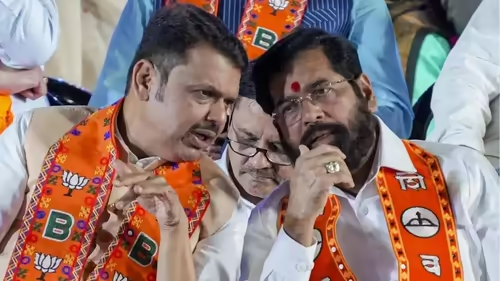
In the glittering, chaotic heart of India’s financial capital, a quiet but intense power struggle is unfolding behind closed doors. The battle isn’t for control of skyscrapers or stock markets, but for a gilded chair in the historic Brihanmumbai Municipal Corporation (BMC) building—the seat of the Mumbai mayor.
The recent BMC elections have delivered a clear verdict: the era of Thackeray dominance is over. The BJP, with a record 89 seats, has emerged as the single largest party in the 227-member house . But here’s the twist—winning the most seats doesn’t automatically mean winning the mayor’s post. To claim that title, a candidate needs a simple majority of 114 votes. And the BJP, despite its massive haul, is still 25 votes short.
This shortfall has thrown the spotlight on the Mahayuti alliance—a coalition of the BJP, the Eknath Shinde-led Shiv Sena, and the Ajit Pawar-led NCP. Together, they command a comfortable 118 seats, easily crossing the halfway mark . So, the path to the Mumbai mayor post seems clear, right? Not quite. The real drama has just begun.
Table of Contents
- The Mahayuti Puzzle: Who Gets the Gavel?
- Why the Mumbai Mayor Post Matters More Than You Think
- A History of “Hotel Politics” in Mumbai
- The Road Ahead for Mumbai’s Civic Leadership
The Mahayuti Puzzle: Who Gets the Gavel?
The core of the conflict lies in an unspoken but critical question: who controls the Mumbai mayor chair, and for how long? Historically, the BJP and its allies have struck power-sharing deals, often splitting the two-and-a-half-year mayoral term between them.
The Shinde-led Shiv Sena, which won 29 seats, will undoubtedly demand its share of the spoils. For them, the mayorship is a crucial tool for maintaining political relevance in the city and rewarding loyal party workers. On the other hand, the BJP, having invested heavily in this election and finally dethroning its rivals, will be reluctant to cede the symbolic victory without a significant concession.
This delicate negotiation is what local pundits are already calling a return to “hotel politics”—a term used to describe the marathon, behind-the-scenes meetings held in luxury hotels where deals are brokered over cups of tea and promises.
Why the Mumbai Mayor Post Matters More Than You Think
While the Mumbai mayor’s role is largely ceremonial—with real administrative power resting with the Municipal Commissioner—the position holds immense political and symbolic weight. The mayor is the public face of the city’s civic body, presides over crucial house meetings, and plays a key role in setting the legislative agenda.
More importantly, the mayor’s office is a powerful platform for patronage. It controls a significant annual budget for local development projects, giving the holder substantial influence over their constituency and the ability to build a formidable grassroots network. In a city as vast and complex as Mumbai, this soft power can translate into hard electoral gains in future state and national elections.
According to the official process, the election for the new mayor is scheduled for January 28, 2026 . All 227 elected corporators will cast their votes, and the candidate who secures more than half the votes will be declared the winner . With the Mahayuti alliance holding 118 seats, their candidate is a shoo-in—provided they can agree on who that candidate will be.
BMC Election Results at a Glance
The numbers tell a story of a decisive shift in Mumbai’s political landscape:
- BJP: 89 seats (Single largest party)
- Shiv Sena (Uddhav Thackeray): 65 seats (Main opposition)
- Shiv Sena (Eknath Shinde): 29 seats (Mahayuti ally)
- Congress: 24 seats
- Others (NCP, MNS, AIMIM, etc.): 20 seats
The combined strength of the Mahayuti alliance (BJP + Shinde Sena) stands at 118, a clear majority in the 227-member house . This victory marks a historic moment, ending decades of dominance by the Thackeray family’s political outfits in the country’s richest civic body.
A History of “Hotel Politics” in Mumbai
The term “hotel politics” is deeply embedded in Mumbai’s political lexicon. It refers to the intense, often days-long negotiations that take place in the city’s five-star hotels, away from the media glare, where party leaders hammer out power-sharing agreements. These meetings are where alliances are tested, loyalties are bought, and the fate of the city’s leadership is decided.
The current standoff between the BJP and its Shinde Sena ally is a classic replay of this drama. Both parties need each other to govern the BMC, yet both have their own internal pressures and ambitions. The BJP must satisfy its cadre that their massive victory wasn’t in vain, while the Shinde faction needs the mayorship to solidify its claim as the “real” Shiv Sena in the eyes of its voters.
This intricate dance of power is a key reason why understanding Mumbai’s civic politics is essential for anyone following Indian democracy. The BMC is not just a municipal corporation; it’s a microcosm of the larger state and national political dynamics.
The Road Ahead for Mumbai’s Civic Leadership
As the January 28 deadline for the mayoral election looms, all eyes are on the backroom talks between Devendra Fadnavis of the BJP and Eknath Shinde of the Shiv Sena. The outcome of these negotiations will do more than just fill a ceremonial post; it will signal the health and stability of the ruling Mahayuti alliance in Maharashtra.
A smooth, amicable power-sharing deal would project an image of a strong, united front, capable of delivering on its promises of accountable governance . However, a protracted and public dispute could expose deep fissures within the alliance, potentially weakening its hold not just on Mumbai, but across the state.
For the citizens of Mumbai, the hope is that this political “musical chairs” concludes swiftly, allowing the new civic leadership to focus on the city’s pressing challenges—from crumbling infrastructure to waste management and affordable housing. The real test for the Mahayuti won’t be in winning the election, but in governing effectively once the music stops and someone finally sits in the Mumbai mayor‘s chair.
[INTERNAL_LINK:maharashtra-politics] [INTERNAL_LINK:bmc-elections-history]
Conclusion
The battle for the Mumbai mayor post is far more than a ceremonial squabble. It’s a high-stakes game of political strategy that will determine the balance of power within the ruling Mahayuti alliance and set the tone for Mumbai’s civic administration for the next two and a half years. While the BJP has won the war, the fight for the spoils of victory has just begun.
Sources
- Times of India: Hotel politics returns to Mumbai
- BMC Election 2026 Results and Analysis [[1], [8]]
- Mumbai Mayor Election Process Explained [[20], [22]]
- Mahayuti Alliance Composition and Strategy [[11], [12]]