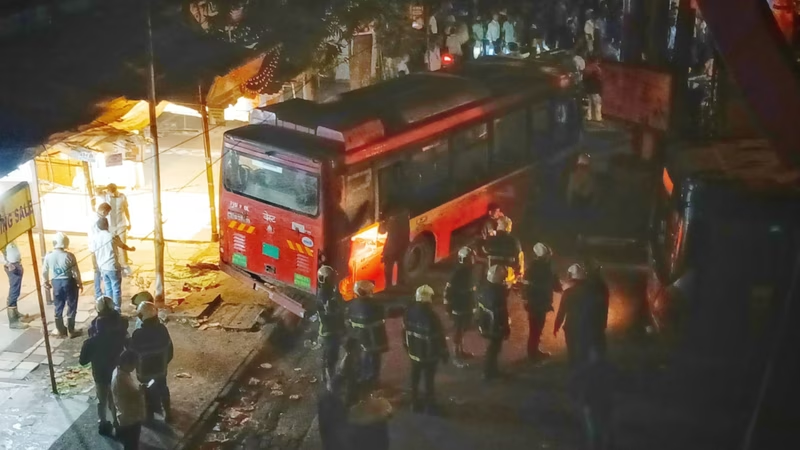
It was supposed to be a quiet Monday night in Bhandup West. Instead, it turned into a scene of horror.
Just before midnight on December 29, 2025, a Mumbai BEST bus reversing on Station Road lost control—or awareness—and crashed into a group of pedestrians waiting near a bus stop. In seconds, lives were shattered: four people were killed, and ten others rushed to hospitals with serious injuries .
The driver was immediately detained by police, and within hours, Mumbai’s civic and transport authorities launched a high-level probe. But for grieving families and survivors, questions remain: How could this happen in one of India’s most monitored urban corridors? And what systemic failures allowed a public transport vehicle to become a weapon?
In this in-depth report, we reconstruct the Mumbai BEST bus accident, examine the city’s crumbling road safety infrastructure, and explore what must change to prevent another tragedy.
Table of Contents
- What Happened in Bhandup West?
- Who Were the Victims?
- Driver Detained: What We Know So Far
- Why This Mumbai BEST Bus Accident Is Different
- Mumbai’s Pedestrian Safety Crisis
- Are Aging BEST Buses a Ticking Time Bomb?
- Official Response and Accountability
- What Must Change to Save Lives?
- Conclusion: A City That Forgets Its Walkers
- Sources
What Happened in Bhandup West?
According to eyewitnesses and preliminary police reports, the incident occurred around 11:45 PM on Station Road near the Bhandup Station Bus Stop—a busy transit point even at night due to late-shift workers and students.
The BEST bus (Route 384, Andheri East to Mulund) was attempting to reverse into a parking or turnaround spot when it suddenly accelerated backward, striking multiple pedestrians. Some victims were pinned under the rear wheels. Others were thrown several feet by the impact .
Local residents and shopkeepers rushed to help before emergency services arrived. Ambulances from Rajawadi and Sion hospitals transported the injured, while four victims—pronounced dead at the scene—were taken to the morgue .
Who Were the Victims?
While names have not been fully released pending family notifications, sources confirm the deceased include:
- A 32-year-old woman returning from a night shift at a private hospital
- Two teenage students waiting for a shared auto
- A 58-year-old street vendor closing his stall
Among the injured is a 7-year-old child in critical condition—a stark reminder that road violence spares no age.
Driver Detained: What We Know So Far
The bus driver, identified as Rajesh Patil (42), was taken into custody by the Bhandup Police. He has not been formally charged but is being questioned under Section 304-A (causing death by negligence) of the Indian Penal Code .
Initial inquiries suggest he may have suffered a medical episode or misjudged the rear clearance. However, witnesses dispute that, claiming he was “arguing on the phone” moments before the crash. The bus’s black box (if functional) and CCTV footage from nearby shops will be critical evidence.
Why This Mumbai BEST Bus Accident Is Different
Mumbai sees hundreds of road accidents yearly, but this Mumbai BEST bus accident stands out for three reasons:
- Location: Station Road is a designated “No Reversing Zone” near a railway crossing—yet buses routinely maneuver there due to lack of turning space.
- Time: Occurred during low-visibility nighttime hours with inadequate street lighting.
- Vehicle Type: BEST buses are city icons—but their size and blind spots make them especially dangerous in pedestrian-heavy zones.
Mumbai’s Pedestrian Safety Crisis
This tragedy didn’t happen in a vacuum. Mumbai consistently ranks among India’s top cities for pedestrian deaths. Key failures include:
- No protected waiting zones: Bus stops often spill onto roads with no barriers.
- Poor street lighting: Especially in eastern suburbs like Bhandup.
- Unmarked crossings: Pedestrians forced to jaywalk across high-speed roads.
According to a 2024 WHO report, over 50% of road fatalities in Indian cities involve pedestrians—a statistic Mumbai exemplifies .
Are Aging BEST Buses a Ticking Time Bomb?
Mumbai’s BEST fleet includes over 3,200 buses—nearly 40% of which are over 12 years old, beyond the recommended operational life. Many lack rear-view cameras, proximity sensors, or even functional mirrors .
While the state has approved electric bus replacements, deployment has been slow. Meanwhile, drivers operate fatigued, on tight schedules, with minimal safety tech—a recipe for disaster.
For more on urban transport risks, see our guide on [INTERNAL_LINK:urban-public-transport-safety-india].
Official Response and Accountability
Within hours, both the BMC and Maharashtra Transport Department issued statements:
- BEST suspended the concerned depot manager.
- Mumbai Police formed a special investigation team (SIT).
- Chief Minister Eknath Shinde ordered “strict action” and compensation for victims’ families.
Compensation announced: ₹5 lakh for each deceased, ₹50,000 for the injured.
What Must Change to Save Lives?
Experts and activists demand immediate reforms:
- Install rear sensors and cameras on all BEST buses within 6 months.
- Redesign high-risk bus stops with pedestrian barriers and lighting.
- Enforce “no reversing” rules with GPS monitoring.
- Launch a city-wide pedestrian safety audit involving urban planners and citizen groups.
Conclusion: A City That Forgets Its Walkers
The Mumbai BEST bus accident is not an anomaly—it’s a symptom. A symptom of a transport system that prioritizes vehicle flow over human life, of infrastructure that treats pedestrians as afterthoughts, and of governance that reacts only after the bodies pile up.
Four lives are gone. Ten more are scarred. The least Mumbai can do is ensure their deaths weren’t in vain—by finally building a city where walking isn’t a gamble with fate.
Sources
- Times of India: Mumbai: 4 killed, 10 injured as BEST bus hits pedestrians
- Hindustan Times: Four killed as BEST bus reverses into pedestrians in Bhandup
- India Today: Mumbai BEST bus accident: 4 dead, driver detained
- World Health Organization: Road Traffic Injuries – Global Fact Sheet
- PTI / The Hindu: BEST Fleet Modernisation: Delays and Dangers