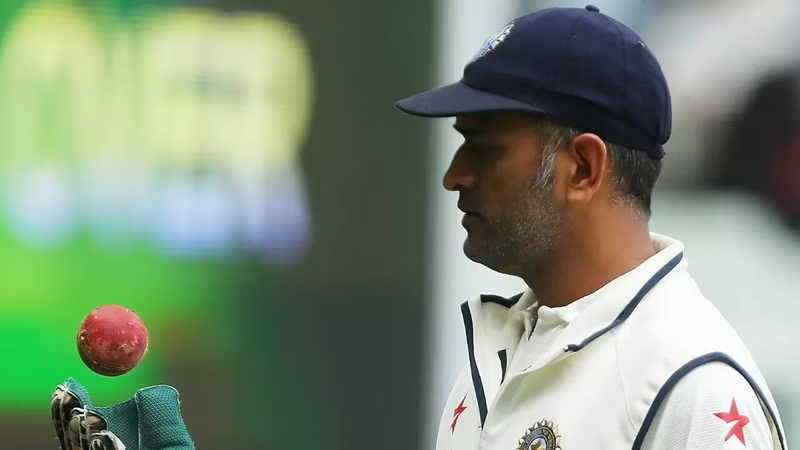
It was a Tuesday. The Melbourne sun was setting. India had just pulled off a gritty draw against Australia in the Boxing Day Test—the first time in 14 years the visiting team hadn’t lost on Australian soil in this fixture. The dressing room was buzzing. Journalists were wrapping up their notes.
And then, without fanfare, without warning, **MS Dhoni Test retirement** became reality.
Forty-four minutes after Dhoni calmly answered questions in his post-match press conference—his voice steady, his answers measured—the Board of Control for Cricket in India (BCCI) issued a terse, two-sentence statement that sent shockwaves through the cricketing world .
There was no farewell speech. No final walk across the pitch. No emotional goodbye to fans who had cheered his sixes, his stumpings, his calm under fire. Just a press release—and a legacy forever altered by its abruptness.
Table of Contents
- The Melbourne Moment That Changed Everything
- Why the Draw Was More Than Just a Result
- The 44-Minute Gap: Between Presser and Announcement
- What Dhoni Said in His Final Press Conference
- The Real Reasons Behind His Sudden Decision
- How Team India and the World Reacted
- Dhoni’s Legacy as India’s Greatest Test Captain
- Conclusion: The Power of a Quiet Exit
- Sources
The Melbourne Moment That Changed Everything
December 30, 2014, was supposed to be just another day in a long, grueling Test series. India had already lost the first Test in Adelaide. The MCG match offered a chance to regroup—and they did, thanks to gritty knocks from Virat Kohli, Murali Vijay, and Cheteshwar Pujara.
Dhoni himself scored 28 and 4—not his best, but his leadership held the innings together. After the match, he walked into the press room like any other day. No one knew it would be his last appearance as a Test cricketer.
Why the Draw Was More Than Just a Result
Before this match, India had lost 10 of its previous 13 Tests in Australia. The last draw was in 2008. Surviving on a seaming MCG pitch against Mitchell Johnson’s pace barrage was a moral victory—and perhaps the perfect exit point for a captain who valued dignity over drama .
Analysts now believe Dhoni had already decided to step down before the match. The draw gave him a respectable final chapter—one that didn’t end in defeat.
The 44-Minute Gap: Between Presser and Announcement
At 4:44 PM local time, the BCCI released the following statement:
“Mahendra Singh Dhoni has decided to retire from Test cricket with immediate effect. The decision has been made keeping in mind his workload and to give youngsters a chance.”
Teammates were blindsided. Virat Kohli, who was named captain hours later, admitted: “I found out from a news alert on my phone. I couldn’t believe it” .
Even Australian captain Michael Clarke was stunned. “He’s one of the toughest opponents we’ve faced. To leave like this—typical Dhoni,” he remarked post-match .
What Dhoni Said in His Final Press Conference
Re-watching that press conference is haunting. Dhoni was asked about retirement. His response: “I’m not thinking about it right now.” He praised Kohli as “the obvious choice” to lead if he were ever unavailable .
But he gave no hint of imminent departure. His calm demeanor masked a decision already made—a final act of control in a career defined by it.
The Real Reasons Behind His Sudden Decision
While the BCCI cited “workload,” insiders reveal deeper motives :
- Physical toll: Constant wicketkeeping in overseas conditions was worsening his chronic back pain.
- Strategic succession: He wanted Kohli—a natural Test batsman—to lead a younger, more aggressive unit.
- Focus on white-ball cricket: With the 2015 ODI World Cup just two months away, he prioritized formats where his impact was maximal.
- Philosophy of exit: Dhoni always believed in leaving “before people ask you to.”
As he later told Wisden, “I didn’t want my last memory to be of missing catches or struggling at the crease” .
How Team India and the World Reacted
The news triggered an outpouring of emotion. Fans lit candles outside stadiums. News channels ran 24-hour tributes. Social media flooded with #ThankYouDhoni.
Even rivals paid homage. Ricky Ponting called him “the coolest captain under pressure.” Kumar Sangakkara said, “He redefined leadership in modern cricket.”
Dhoni’s Legacy as India’s Greatest Test Captain
At the time of his retirement, Dhoni held the record for most Test wins by an Indian captain (27 in 60 matches) . His achievements include:
- First Indian captain to hold the No. 1 ICC Test ranking (2009)
- Series wins in New Zealand (2009), West Indies (2011), and Sri Lanka (2015 planned but executed post-retirement by Kohli)
- Pioneered aggressive field placements and fast bowling strategies overseas
- Built a bridge between the Dravid-era discipline and Kohli-era aggression
His calm wasn’t passivity—it was calculated command. And it transformed India into a formidable touring side.
Conclusion: The Power of a Quiet Exit
In an age of farewell tours, guard of honors, and emotional goodbyes, **MS Dhoni Test retirement** stood apart for its silence. No grand stage. No tearful speech. Just a man who finished his work and walked away.
But in that silence lay immense power. It reminded us that true greatness doesn’t need applause to be remembered—it leaves a legacy that echoes long after the last ball is bowled.
For more on iconic cricket moments, explore our feature on the greatest captains in cricket history.
Sources
- Times of India: Retirement that stunned Indian cricket
- ESPNcricinfo: MS Dhoni Test Career Statistics
- BCCI Official Statement, December 30, 2014
- ICC Archives: India’s Test Rankings History
- Wisden Almanack: Interview with MS Dhoni on Leadership