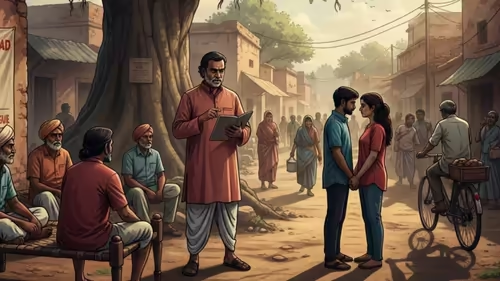
In 21st-century India, a village council in Madhya Pradesh has revived a medieval practice that belongs in the history books—not in modern governance. A panchayat in a remote village near Indore has officially mandated a **social and economic boycott** of any family whose children enter into a love marriage, regardless of caste or religion [[1]].
The order, passed during a recent village assembly, declares that such families will be barred from community events, denied access to shared resources like wells and cremation grounds, and even excluded from local trade networks. “If your child marries by choice, you are no longer one of us,” read the handwritten notice circulated among residents.
This draconian edict isn’t just morally indefensible—it’s illegal. And yet, it reflects a disturbing undercurrent of patriarchal control and caste orthodoxy that still grips parts of rural India, where tradition often trumps constitutional rights.
Table of Contents
- The Panchayat’s Love Marriage Boycott Decree
- Why This Is Illegal and Unconstitutional
- The Real Impact on Families and Youth
- Historical Context: Khap Panchayats and Caste Control
- What Can Be Done to Stop Such Practices?
- Conclusion: Love Marriage Is a Fundamental Right
The Panchayat’s Love Marriage Boycott Decree
According to reports from Indore, the panchayat justified its decision by claiming that “love marriages disrupt social harmony and encourage elopement.” The resolution specifically targets couples who marry without parental consent—even if both partners are adults and from the same caste.
Villagers confirmed that the boycott would be enforced through collective action: no one will sell groceries to the family, their children won’t be allowed to play with others, and they’ll be excluded from religious ceremonies. In close-knit agrarian communities, this form of social ostracism can be devastating, leading to isolation, economic ruin, and even mental health crises.
“They’re treating love like a crime,” said a local teacher who spoke on condition of anonymity for fear of reprisal.
Why This Is Illegal and Unconstitutional
India’s legal framework is crystal clear: **love marriage is a fundamental right**. The Supreme Court has repeatedly affirmed this, most notably in the landmark 2018 *Shakti Vahini v. Union of India* case, which directed all states to prevent honor crimes and protect couples in consensual relationships [[2]].
Key legal protections include:
- Article 21 of the Constitution: Guarantees the right to life and personal liberty, which includes the right to choose a partner.
- Special Marriage Act, 1954: Allows any two Indian citizens to marry irrespective of religion, caste, or parental approval.
- Supreme Court Directives: Mandate police protection for inter-caste and inter-faith couples and criminalize social boycotts.
Despite this, enforcement remains weak in rural areas where panchayats wield de facto power. Local police often turn a blind eye, citing “customary practices” as justification.
The Real Impact on Families and Youth
For young people in such villages, the message is chilling: your heart must obey the council. Many are forced into arranged marriages out of fear, while others flee to cities—often without education or support networks.
Worse, such boycotts can escalate into violence. According to the National Crime Records Bureau (NCRB), over 250 “honor killings” were reported in India between 2020 and 2024, though activists believe the real number is far higher due to underreporting [[3]].
[INTERNAL_LINK:inter-caste-marriage-support-india] Even when violence doesn’t occur, the psychological toll is immense—shame, guilt, and fractured family bonds that last generations.
Historical Context: Khap Panchayats and Caste Control
While this panchayat is in Madhya Pradesh, its logic mirrors that of the infamous **khap panchayats** of Haryana and Uttar Pradesh—unofficial caste councils that have long policed marriage, especially to preserve endogamy (marriage within the same caste).
These bodies claim to uphold “tradition,” but their real function is to maintain rigid social hierarchies. By controlling marriage, they control lineage, property, and power. Love—especially across caste lines—threatens that order, which is why it’s so fiercely punished.
Though khap diktats have been condemned by courts and civil society, their influence persists in pockets where state presence is minimal and patriarchy is entrenched.
What Can Be Done to Stop Such Practices?
Ending these regressive practices requires a multi-pronged approach:
- Legal Accountability: State governments must prosecute panchayat members who issue illegal orders under the SC/ST (Prevention of Atrocities) Act or relevant sections of the IPC.
- Police Sensitization: Train local law enforcement to recognize social boycotts as criminal acts and provide immediate protection to affected families.
- Community Education: Launch awareness campaigns in rural schools and panchayats about constitutional rights and gender equality.
- Empower Youth: Support youth clubs and digital literacy programs so young people know their rights and can seek help anonymously.
Organizations like the National Commission for Women (NCW) and NGOs such as Majlis and Vanangana have been instrumental in providing legal aid—but they need stronger state backing.
Conclusion: Love Marriage Is a Fundamental Right
The MP village panchayat’s attempt to enforce a **love marriage boycott** is not just backward—it’s a direct assault on India’s constitutional values. In a democracy, no unelected council has the right to dictate whom citizens can love or marry.
As the Supreme Court once declared, “The right to marry a person of one’s choice is integral to Article 21.” It’s time for local authorities to uphold that principle—not bury it under layers of archaic custom. Until then, every act of love in defiance of such diktats remains a quiet revolution.
Sources
- [[1]] Times of India: Boycott families if kids opt for love marriage: MP village panchayat
- [[2]] Supreme Court of India: Shakti Vahini v. Union of India (2018)
- [[3]] National Crime Records Bureau (NCRB): Crime in India 2024 Report