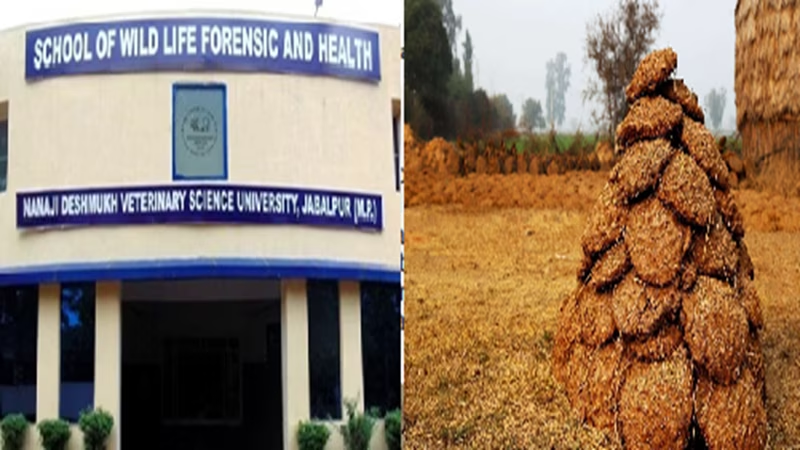
In the heart of India’s agrarian state, a story that blends faith, politics, and scientific inquiry has taken a dark turn. What began as an ambitious, state-funded quest to find a revolutionary gaumutra cancer cure has now been exposed as a massive financial scandal, leaving taxpayers reeling and the scientific community deeply skeptical.
Table of Contents
- The Promise of a Miracle Cure
- The Gaumutra Cancer Cure Scam Unravels
- Where Did the Money Go?
- The Science (or Lack Thereof) Behind Cow-Based Therapies
- Broader Implications for Public Funding and Research
- Conclusion: A Cautionary Tale
- Sources
The Promise of a Miracle Cure
Launched back in 2011 at the Nanaji Deshmukh Veterinary Science University in Jabalpur, the project was born from a potent mix of cultural reverence for the cow and a desperate search for affordable cancer treatments . The proposal was bold: harness the power of Panchgavya—the five products of the cow (milk, curd, ghee, dung, and urine)—to develop a cure for one of humanity’s most feared diseases. The Madhya Pradesh government, seeing both political and social capital in the initiative, approved a staggering Rs 3.5 crore for this research .
This wasn’t just a fringe idea; it was a fully sanctioned, state-backed endeavor housed within a prestigious academic institution. For many, it represented hope. For others, it was a red flag waving in the wind of pseudoscience.
The Gaumutra Cancer Cure Scam Unravels
Fifteen years later, that hope has turned to outrage. A recent probe has revealed that the entire gaumutra cancer cure scam was built on a foundation of financial mismanagement and alleged fraud . Investigators found that while the project was sold to the public as cutting-edge medical research, its actual output was virtually non-existent .
The university’s own claims of spending Rs 1.92 crore on raw materials like cow dung, urine, storage vessels, and machinery now appear highly inflated and questionable [[6], [19]]. The core promise of the project—to deliver tangible results in the fight against cancer—remains completely unfulfilled.
Where Did the Money Go?
If not on groundbreaking research, where did the Rs 3.5 crore of public funds disappear? The investigation paints a damning picture of misuse. Funds meant strictly for scientific inquiry were allegedly diverted to personal and unrelated expenses.
Shocking revelations include:
- The purchase of a new car worth over Rs 7.38 lakh using scheme money .
- Expensive air travel for officials to destinations like Goa and Kolkata, far removed from any plausible research activity .
- A significant portion of the budget was spent on raw materials, but with little to no evidence of their use in any peer-reviewed or documented scientific process .
This pattern of spending suggests a deliberate effort to siphon off public money under the guise of a noble cause, a betrayal of public trust that has left many demanding accountability .
The Science (or Lack Thereof) Behind Cow-Based Therapies
While the financial fraud is clear-cut, the project’s scientific premise has long been a point of contention. Proponents often cite a handful of small-scale studies, such as a 2010 survey from Mandsaur district or a 2016 study from CIMAP, which suggested some bio-enhancing properties of cow urine distillate [[11], [13]]. Some research even points to potential anti-fungal or anti-oxidant effects [[15], [17]].
However, these findings are a far cry from a proven cure for cancer. The overwhelming consensus in the global oncology and scientific community is that there is no credible clinical evidence that cow urine or dung can cure cancer in humans . Reputable organizations like the American Cancer Society do not recognize these as valid treatments.
Funding a large-scale, expensive project based on such preliminary and inconclusive data, especially when pitted against established, evidence-based research avenues, raises serious questions about the prioritization of public health resources .
Broader Implications for Public Funding and Research
The Madhya Pradesh gaumutra cancer cure scam is more than just an isolated case of corruption; it’s a symptom of a larger issue. It highlights the critical need for robust oversight mechanisms for government-funded research projects, particularly those that sit at the intersection of politics and science .
When public funds are allocated based on ideology rather than rigorous scientific merit, the result is often wasted resources and missed opportunities to fund genuinely promising research that could save lives. This incident serves as a stark reminder that taxpayer money must be protected by stringent accountability measures and independent review boards to prevent future debacles .
Conclusion: A Cautionary Tale
The collapse of the MP gaumutra cancer cure project is a cautionary tale for policymakers, researchers, and citizens alike. It demonstrates how a well-intentioned but scientifically dubious idea can be exploited for financial gain, diverting crucial resources away from real solutions. While the cultural significance of the cow in India is undeniable, it should not be used as a shield to justify the misuse of public funds or to promote unproven medical claims. The demand for a thorough investigation and strict punishment for those involved is not just about recovering money—it’s about restoring faith in public institutions and ensuring that science, not superstition, guides our fight against disease.
Sources
- Times of India: MP’s gaumutra, gobar cancer cure project: Probe finds Rs 3.5cr scam
- The Caravan: MP Cow-Based Cancer Research Project Faces Probe Over Alleged Fund Misuse
- PMC: Chemotherapeutic potential of cow urine: A review
- Nature: Indian scientists decry ‘infuriating’ scheme to study benefits of cow dung