Mountains of the Moon: The Mysterious East African Peaks Losing Their Ice Forever
For over 2,000 years, explorers, geographers, and dreamers have whispered about the Mountains of the Moon—a mythical range said to feed the mighty Nile River with snowmelt from its icy peaks. Ancient Greek scholar Ptolemy first described them in the 2nd century CE, but their true location remained a mystery for centuries. Today, we know they’re real—and they’re vanishing before our eyes.
Nestled on the border between Uganda and the Democratic Republic of the Congo, the Rwenzori Mountains are the long-lost “Mountains of the Moon.” But while their legend endures, their glaciers are not. Scientists warn that these equatorial ice fields could disappear entirely within this decade—a silent casualty of global warming.
Table of Contents
- The Origins of the ‘Mountains of the Moon’ Name
- Where Exactly Are the Mountains of the Moon?
- The Alarming Disappearance of Rwenzori’s Glaciers
- Why This Glacier Loss Matters Beyond the Peaks
- Can Anything Be Done? Conservation and Research
- Conclusion: A Legacy Melting Away
- Sources
The Origins of the ‘Mountains of the Moon’ Name
The term “Mountains of the Moon” traces back to ancient cartography. In 150 CE, Claudius Ptolemy wrote in his Geographia that the Nile originated from “Lunae Montes”—Latin for “Mountains of the Moon”—based on reports from a merchant named Diogenes. According to Diogenes, these snow-capped mountains lay inland from Rhapta (a port on Africa’s east coast) and fed two great lakes that were the Nile’s source [[1]].
For centuries, European explorers searched in vain. It wasn’t until 1889 that British explorer Henry Morton Stanley confirmed the Rwenzori range as Ptolemy’s fabled peaks. Towering over 5,000 meters, with permanent snow and glaciers near the equator, they matched the ancient description almost perfectly.
Where Exactly Are the Mountains of the Moon?
The Mountains of the Moon are the Rwenzori Mountains—a non-volcanic range stretching 120 km along the Uganda–DRC border. Unlike Kilimanjaro or Mount Kenya, which are volcanic, the Rwenzoris are block-fault mountains formed by tectonic uplift, making them geologically unique in Africa [[2]].
The range includes six major peaks, the highest being Mount Stanley (5,109 m), followed by Mount Speke and Mount Baker. Despite lying just 60 km north of the equator, these peaks once held over 40 square kilometers of glaciers. Today, less than 1 square kilometer remains.
The Alarming Disappearance of Rwenzori’s Glaciers
Since the early 1900s, the Rwenzori glaciers have lost more than 80% of their surface area. According to a 2023 study published in The Cryosphere, the remaining ice is retreating at a rate of 1–2% per year—and could vanish completely by 2030 [[3]].
Unlike polar glaciers, equatorial ice like that in the Rwenzoris is especially vulnerable. Here’s why:
- Temperature Rise: Average temperatures in the region have increased by 1.5°C since 1950—faster than the global average [[4]].
- Reduced Cloud Cover: Changes in regional weather patterns mean fewer clouds, exposing glaciers to more direct sunlight and accelerating melt.
- No Winter Accumulation: At the equator, there’s no cold season to rebuild ice. Once it melts, it’s gone for good.
Mount Speke’s famous Elena Glacier, once a dramatic ice wall, has already fragmented into isolated patches. Mount Stanley’s glaciers—like the iconic Stanley Plateau—are now mere remnants clinging to shadowed crevices.
Why This Glacier Loss Matters Beyond the Peaks
Losing the Mountains of the Moon glaciers isn’t just a symbolic tragedy—it has real-world consequences:
- Water Security: While the glaciers don’t directly feed the Nile today, they regulate streamflow during dry seasons, supporting local agriculture and communities in western Uganda.
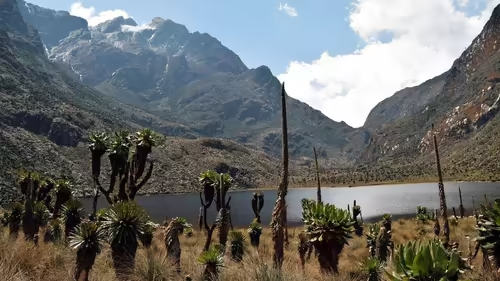
- Biodiversity Hotspot: The Rwenzoris host unique Afro-alpine ecosystems, including giant lobelias and groundsels found nowhere else. Glacier melt alters microclimates, threatening these endemic species.
- Cultural Heritage: For the Bakonzo people, the mountains are sacred. Glacier loss disrupts traditional ecological knowledge and spiritual practices tied to the ice.
As one Ugandan guide put it: “When the ice is gone, part of our soul goes with it.”
Can Anything Be Done? Conservation and Research
While reversing glacier loss is impossible at this stage, efforts are underway to mitigate broader impacts. The Rwenzori Mountains National Park—a UNESCO World Heritage Site since 1994—is expanding community-based monitoring programs [INTERNAL_LINK:rwenzori-conservation-projects].
Scientists from Makerere University and international partners are using satellite imagery and on-ground sensors to track melt rates and model future water availability. Meanwhile, eco-tourism is being promoted as a sustainable livelihood alternative, reducing pressure on fragile highland forests.
Still, without aggressive global climate action, these measures can only slow—not stop—the inevitable.
Conclusion: A Legacy Melting Away
The Mountains of the Moon have captivated human imagination for millennia. Now, in the span of a single lifetime, their icy crowns may vanish forever. Their story is a stark reminder that climate change isn’t just about polar bears or distant islands—it’s erasing ancient landmarks right here, in the heart of Africa. Saving what remains isn’t just about ice; it’s about preserving history, culture, and the delicate balance of one of Earth’s most extraordinary ecosystems.
Sources
- Times of India: Which East African mountains are called the ‘Mountains of the Moon’?
- UNESCO World Heritage Centre: Rwenzori Mountains National Park
- The Cryosphere Journal: Recent glacier retreat in the Rwenzori Mountains
- NASA Earth Observatory: The Disappearing Glaciers of Africa
- Journal of African Earth Sciences: Climate change impacts on Rwenzori hydrology