Table of Contents
- What Is Point Nemo?
- Why It’s the Most Isolated Place on Earth
- NASA and the Spacecraft Graveyard: How It Works
- Famous Objects Buried at Point Nemo
- Environmental Concerns and Future Challenges
- Conclusion: A Silent Cemetery in the Silent Ocean
- Sources
What Is Point Nemo?
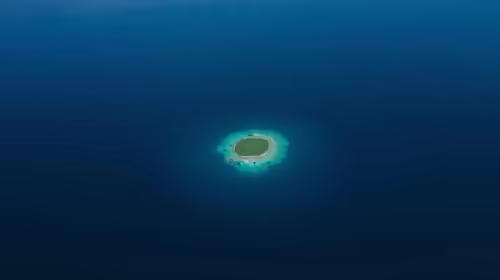
Point Nemo isn’t a city, an island, or even a visible landmark. It’s a coordinate in the vast South Pacific Ocean—48°52.6′S 123°23.6′W—officially known as the oceanic pole of inaccessibility. The name “Nemo” comes from Latin, meaning “no one,” and was popularized by Jules Verne’s *Twenty Thousand Leagues Under the Sea*.
This spot is so far from any landmass that the closest humans are frequently not on Earth at all—but orbiting above it on the International Space Station (ISS), which passes overhead at roughly 400 km altitude .
Why It’s the Most Isolated Place on Earth
Point Nemo holds the record for being the farthest point from any coastline. It sits approximately 2,688 kilometers (1,670 miles) from the nearest land in all directions:
- Ducie Island (Pitcairn Islands) to the north
- Motu Nui (Easter Island) to the northeast
- Maher Island (Antarctica) to the south
Because of this extreme remoteness, the area experiences almost no ship traffic, minimal marine life (due to low nutrient levels), and near-total silence—making it the perfect “quiet zone” for one unusual purpose: a spacecraft graveyard.
NASA and the Spacecraft Graveyard: How It Works
When satellites, cargo ships, and space stations reach the end of their operational lives, they can’t just be left floating in orbit. They become dangerous space debris that could collide with active missions. To prevent this, space agencies perform a controlled deorbit maneuver.
The target? Point Nemo.
Agencies like NASA, ESA (European Space Agency), Roscosmos, and others deliberately guide their retired spacecraft to re-enter Earth’s atmosphere above this remote zone. Most of the object burns up due to atmospheric friction, but larger pieces—like titanium fuel tanks or heat shields—survive and splash into the ocean .
Since 1971, over 260 spacecraft have been laid to rest here, including Russia’s massive Mir space station and numerous Progress and ATV cargo vehicles .
Famous Objects Buried at Point Nemo
Some of the most iconic spacecraft in history now rest beneath the waves of Point Nemo:
- Mir Space Station (2001): Weighing 130 metric tons, Mir was the largest object ever deorbited. Its controlled descent was a major engineering feat.
- ESA’s Automated Transfer Vehicle (ATV) series: These European cargo ships delivered supplies to the ISS before ending their journeys at Point Nemo.
- Future: The International Space Station (planned for 2030): Yes, even the ISS will eventually make its final voyage to this underwater cemetery .
Environmental Concerns and Future Challenges
While Point Nemo’s isolation makes it ideal for safe disposal, questions remain about long-term environmental impact. Though the area is considered a “biological desert,” scientists caution that accumulating metal debris could affect deep-sea ecosystems over time.
Moreover, with the rise of mega-constellations like Starlink, the volume of space junk is growing exponentially. Experts warn that without better recycling or in-orbit servicing technologies, even Point Nemo may not be enough to handle future decommissioning needs .
Still, for now, it remains the safest and most responsible option—a testament to international cooperation in space sustainability.
Conclusion: A Silent Cemetery in the Silent Ocean
Point Nemo—the most isolated place on Earth—is more than a geographic curiosity. It’s a symbol of humanity’s responsibility in space exploration. By choosing this remote zone as a final resting place, space agencies minimize risk to people and property while honoring the legacy of missions that expanded our understanding of the cosmos.
In a world full of noise and connectivity, Point Nemo stands as a quiet, solemn monument to human ingenuity—and humility.
Sources
- Times of India: This place is the most isolated place on Earth, and NASA uses it as a spacecraft graveyard
- NASA Orbital Debris Program Office: https://orbitaldebris.jsc.nasa.gov/
- European Space Agency (ESA): Space Debris Mitigation Guidelines
- National Geographic: The World’s Most Remote Place Is Home to a Spacecraft Graveyard