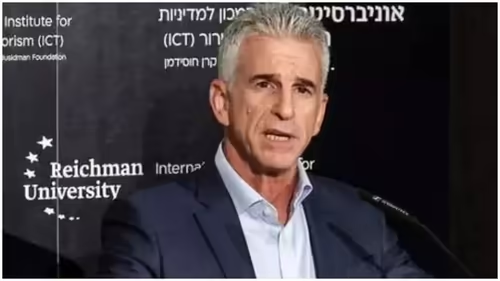
Behind closed doors in Washington, a quiet but seismic conversation may have just altered the course of Middle Eastern history. The Mossad chief US visit by David Barnea—Israel’s top spy—wasn’t just another intelligence liaison. It was a direct intervention to temper American plans for military action against Iran, according to multiple sources familiar with the matter .
Following a phone call between former President Donald Trump and Israeli Prime Minister Benjamin Netanyahu, Israel formally requested that any contemplated strike on Iranian nuclear or military facilities be delayed. Their reasoning? Concerns over massive retaliation, regional destabilization, and doubts about whether a limited strike would achieve lasting strategic goals .
But here’s the chilling twist: many analysts believe this isn’t about de-escalation—it’s about timing. The pause may be Israel and the U.S. coordinating for a more comprehensive, devastating operation down the line.
Table of Contents
- The Secret Meeting: Mossad Chief in Washington
- Why Israel Wanted Trump’s Iran Strike Delayed
- Trump’s Stance on Iran: A History of Bluster and Brinkmanship
- U.S. Military Movements: Silent Preparations
- Is a Bigger Attack Being Planned?
- Diplomatic Channels Still Open—but For How Long?
- Global Implications: Oil Markets and Alliances
- Conclusion: Calm Before the Storm?
- Sources
The Secret Meeting: Mossad Chief in Washington
David Barnea’s presence in the U.S. capital was confirmed by both Israeli and American officials, though details remain classified. The Mossad director met with senior figures in the U.S. intelligence community and possibly members of Trump’s inner circle during his brief but urgent trip .
This wasn’t routine diplomacy. The timing—amid heightened tensions over Iran’s advancing uranium enrichment and its support for proxy militias in Iraq, Syria, and Yemen—suggests Israel is trying to shape, not just react to, U.S. policy. As one former CIA analyst noted, “When the Mossad chief flies personally, it means the stakes are existential” .
Why Israel Wanted Trump’s Iran Strike Delayed
Israel has long viewed Iran as an existential threat. Yet, paradoxically, it urged caution on a potential U.S.-led strike. Three key reasons emerged:
- Fear of Retaliation: Iran could unleash Hezbollah rockets from Lebanon (over 150,000 estimated), target Israeli embassies worldwide, or disrupt shipping in the Strait of Hormuz.
- Questionable Effectiveness: A limited strike might damage facilities but wouldn’t destroy Iran’s nuclear program, which is deeply buried and decentralized.
- Strategic Coordination: Israel may prefer to act jointly with the U.S. in a synchronized, overwhelming campaign—rather than a solo American move that leaves Israel exposed.
In essence, Netanyahu’s message to Trump was: “Don’t go half-measures. If we strike, let’s make it count.”
Trump’s Stance on Iran: A History of Bluster and Brinkmanship
Donald Trump has long advocated a hardline approach to Iran. His 2018 withdrawal from the JCPOA nuclear deal and the 2020 assassination of Qasem Soleimani marked him as the most aggressive U.S. president toward Tehran in decades.
Now, as he campaigns for a 2028 comeback, Trump appears eager to reassert his “maximum pressure” doctrine. Reports suggest his team has been reviewing military options, including cyberattacks and precision airstrikes on Natanz and Fordow enrichment sites . But without Israeli backing—or worse, against Israeli advice—such a move could backfire spectacularly.
U.S. Military Movements: Silent Preparations
Even as diplomacy unfolds, the Pentagon isn’t standing still. Satellite imagery and defense sources confirm:
- Additional F-35 squadrons have been deployed to Al Dhafra Air Base in the UAE.
- The USS Gerald R. Ford carrier strike group is transiting toward the Persian Gulf.
- Cyber Command units are on high alert for potential offensive operations.
These aren’t invasion preparations—they’re signals of readiness. The message to Tehran is clear: the option for force remains very much alive.
Is a Bigger Attack Being Planned?
Many Middle East analysts believe the current “pause” is tactical, not strategic. “Israel doesn’t want to stop a strike—it wants to optimize it,” says Dr. Emily Landau of the Institute for National Security Studies .
Rumors swirl of joint U.S.-Israeli war games simulating coordinated strikes, while intelligence sharing on Iranian facility layouts has intensified. The goal? To ensure that when the hammer falls, it dismantles Iran’s nuclear infrastructure for years—not weeks.
Diplomatic Channels Still Open—but For How Long?
Despite the military posturing, backchannel talks continue. European powers are pushing for a revived nuclear deal, while Oman and Qatar serve as neutral mediators. However, trust is at an all-time low. Iran’s leadership sees any negotiation as weakness, while hardliners in Washington and Tel Aviv view diplomacy as appeasement.
The window for a peaceful resolution is narrowing fast—and the Mossad chief US visit may have just bought a few more weeks of tense calm.
Global Implications: Oil Markets and Alliances
A major conflict would send oil prices soaring past $150/barrel, triggering a global recession. It could also fracture NATO, as European allies oppose military action, while pulling China and Russia deeper into Iran’s orbit.
For now, markets remain steady—but traders are watching every Mossad flight and Pentagon briefing with bated breath.
Conclusion: Calm Before the Storm?
The Mossad chief US visit wasn’t a peace mission. It was a recalibration. Israel and the U.S. aren’t stepping back from confrontation with Iran—they’re ensuring that when they do act, it’s with overwhelming force and unified purpose. The world may be witnessing not the avoidance of war, but its meticulous preparation.
Sources
- Times of India: Mossad chief in Washington: Netanyahu urged Donald Trump to wait
- Council on Foreign Relations: Iran Nuclear Crisis Analysis
- Reuters: U.S. Military Deployments in Middle East
- Institute for National Security Studies (INSS): Israeli Security Strategy Reports