Table of Contents
- The Harrowing Incident
- How the Baby Survived: Monkey Snatches Baby in Chhattisgarh
- The Heroic Role of the Nurse
- Why Was a Monkey in a Residential Area?
- Rising Human-Wildlife Conflicts in India
- Safety Tips for Families in Monkey-Prone Areas
- Conclusion: A Miracle with a Message
- Sources
The Harrowing Incident
In a heart-stopping moment that could have ended in tragedy, a 20-day-old infant in Chhattisgarh became the victim of a bizarre and brutal wildlife encounter. While sitting on her mother’s lap outside their home in the Raipur district, the newborn was suddenly snatched by a monkey—an animal increasingly common in semi-urban Indian neighborhoods .
Witnesses say the primate grabbed the baby and, within seconds, hurled her into a nearby open well. The mother’s screams drew neighbors, who rushed to the scene in panic. What followed was not just a rescue—but a medical miracle that has since captured national attention.
How the Baby Survived: Monkey Snatches Baby in Chhattisgarh
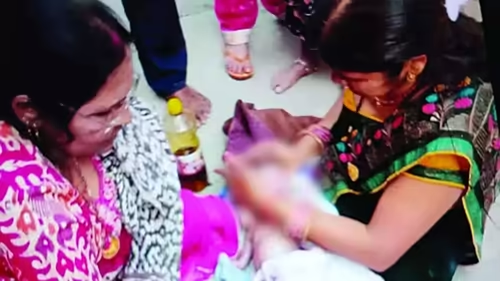
Against all odds, the infant was pulled from the well alive—but unresponsive. She had been underwater long enough to stop breathing. It was at this critical juncture that a visiting nurse, who happened to be in the neighborhood, stepped in.
Recognizing the signs of respiratory arrest, the nurse immediately began administering CPR. Within minutes, the baby gasped for air. She was rushed to a local health center, where doctors confirmed she was stable—bruised, shaken, but miraculously without major internal injuries.
The father later shared a poignant detail: he believes two things saved his daughter’s life—the nurse’s presence and the thick cloth diaper she was wearing. “The diaper acted like a cushion,” he told reporters. “It may have absorbed some of the impact when she hit the water” .
The Heroic Role of the Nurse
Medical professionals emphasize that timely CPR is often the difference between life and death in drowning or near-drowning cases—especially for infants. According to the American Heart Association, starting CPR within the first few minutes can double or triple a child’s chance of survival [EXTERNAL_LINK:https://www.heart.org/].
In this case, the nurse’s training and composure under pressure were nothing short of heroic. Had she not been there, or if bystanders had waited for an ambulance, the outcome could have been fatal. This incident underscores the importance of basic life support training for community members—a point public health advocates are now highlighting across social media.
Why Was a Monkey in a Residential Area?
This isn’t an isolated event. Across central and northern India, monkeys—particularly rhesus macaques—are increasingly encroaching on human settlements. Deforestation, shrinking forest corridors, and easy access to food waste have driven them into villages, towns, and even city centers.
In Chhattisgarh, rapid urban expansion near forest fringes has blurred the line between wildlife habitat and residential zones. Open wells, once common in rural India for irrigation and drinking water, remain uncovered in many areas—posing dual risks: as attractants for animals and as hazards for children and livestock.
Local authorities have been urged to cover unused wells and implement better waste management to discourage wildlife from entering populated areas [INTERNAL_LINK:wildlife-conservation-india].
Rising Human-Wildlife Conflicts in India
The Chhattisgarh incident is part of a growing trend. According to the Ministry of Environment, Forest and Climate Change, reports of human-wildlife conflict have risen by over 35% in the last decade . Monkeys, elephants, leopards, and even snakes are increasingly interacting—and sometimes clashing—with humans.
Key factors include:
- Loss of natural habitat due to infrastructure projects.
- Climate-induced changes in animal migration patterns.
- Lack of coordinated wildlife management at the district level.
Experts argue that reactive measures—like culling or translocation—are ineffective. Instead, long-term solutions must include community education, early warning systems, and eco-sensitive urban planning.
Safety Tips for Families in Monkey-Prone Areas
If you live in or visit regions with frequent monkey sightings, consider these precautions:
- Never leave infants or small children unattended outdoors.
- Avoid eating or storing food in open areas—monkeys are attracted to smells.
- Secure open wells, septic tanks, and water bodies with grills or covers.
- Do not provoke or feed monkeys—this encourages dependency and aggression.
- Keep emergency numbers handy, including local forest department contacts.
Additionally, learning basic first aid and CPR—as demonstrated in this case—can be a literal lifesaver.
Conclusion: A Miracle with a Message
The survival of this newborn after a monkey snatched her and threw her into a well is nothing short of extraordinary. But beyond the headlines lies a sobering reality: as human settlements expand, our coexistence with wildlife requires smarter planning, greater awareness, and community preparedness.
This incident should serve as a wake-up call—not just for Chhattisgarh, but for every region grappling with the delicate balance between development and nature. The baby’s second chance at life is a gift; let it inspire action to prevent future tragedies.
Sources
- Times of India: Snatched by monkey, thrown into well: newborn’s miraculous escape in Chhattisgarh
- Ministry of Environment, Forest and Climate Change (MoEFCC): Annual Report on Human-Wildlife Conflict
- American Heart Association: CPR Guidelines for Infants and Children