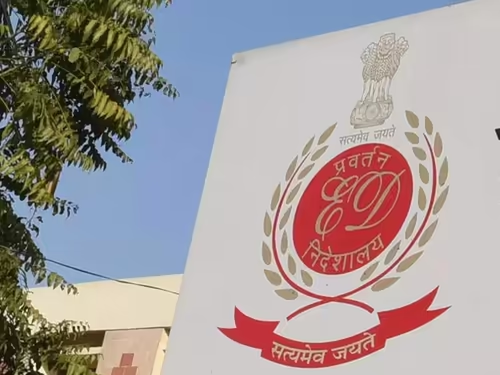
In a significant crackdown on cross-border financial crime, the Enforcement Directorate (ED) has filed a detailed chargesheet in a high-profile money laundering probe targeting an illegal online betting platform allegedly operated by Pakistani nationals. The investigation, which spans multiple states and digital payment gateways, has led to the naming of 14 accused—including Indian promoters, shell company operators, and payment aggregators—unveiling a sophisticated scheme designed to siphon crores from unsuspecting users while funneling illicit funds abroad.
This case is not just about illegal gambling—it’s a stark reminder of how cyber-enabled betting platforms are being weaponized for large-scale financial fraud, with potential national security implications. Here’s everything you need to know about the operation, the players involved, and what this means for India’s fight against digital financial crime.
Table of Contents
- The ED Investigation: What Was Uncovered?
- How the Betting Racket Worked
- Money Laundering Probe: Key Findings
- Who Are the 14 Accused?
- Legal and National Security Implications
- Broader Crackdown on Illegal Betting in India
- Conclusion
- Sources
The ED Investigation: What Was Uncovered?
The money laundering probe began after intelligence inputs flagged suspicious fund flows linked to a popular but unlicensed betting website operating under multiple domain names. While marketed as a fantasy sports or cricket prediction platform, investigators found it functioned as a full-fledged illegal betting portal—accepting real-money wagers on international matches without any regulatory oversight.
According to the ED, the platform was controlled by individuals based in Pakistan, who used encrypted communication channels and cryptocurrency wallets to manage operations. Indian accomplices handled user acquisition, customer support, and local banking transactions—creating a layered structure that masked the true ownership.
Searches conducted across Delhi, Mumbai, Hyderabad, and Bengaluru led to the seizure of bank accounts, mobile devices, and digital evidence linking the accused to over ₹200 crore in suspicious transactions .
How the Betting Racket Worked
The modus operandi was deceptively simple yet highly effective:
- User Onboarding: The website lured users with aggressive social media ads, celebrity endorsements (often fake), and bonus offers.
- Deposit & Play: Users deposited money via UPI, credit cards, or prepaid wallets into accounts held by front companies registered in India.
- Fund Diversion: Instead of using deposits for legitimate payouts, a large portion was immediately routed through a chain of shell entities.
- Cross-Border Transfer: Funds were converted into cryptocurrency or transferred via hawala networks to accounts in Dubai, Singapore, and ultimately Pakistan.
Investigators noted that many users never received their winnings. Complaints were ignored, and accounts were frozen once large bets were placed—classic signs of a “scam betting” operation.
Money Laundering Probe: Key Findings
The ED’s money laundering probe revealed several alarming tactics used to legitimize illicit income:
- Shell Companies: At least six dummy firms were created with fake directors to receive and layer funds.
- Payment Aggregators: Complicit fintech startups processed transactions without proper KYC, violating RBI guidelines.
- Benami Bank Accounts: Dozens of accounts were opened using forged identity documents to obscure the money trail.
- Use of Cryptocurrency: Bitcoin and Tether were used to move value across borders, bypassing traditional banking scrutiny.
Under the Prevention of Money Laundering Act (PMLA), all proceeds of crime are liable to attachment—even if the original offense (like illegal betting) occurred overseas.
Who Are the 14 Accused?
While the masterminds remain in Pakistan, the ED has named 14 individuals in India, including:
- Two app developers from Hyderabad who built the betting interface
- Three promoters running digital marketing agencies in Delhi
- Four alleged “beneficial owners” of shell companies in Mumbai
- Five payment gateway operators who facilitated fund transfers
Notably, none of the accused held valid licenses from state gaming authorities, making their operations entirely illegal under Indian law. The ED has already attached assets worth ₹45 crore linked to these individuals.
Legal and National Security Implications
Beyond financial fraud, this case raises serious national security concerns. The Ministry of Home Affairs has long warned that illegal betting platforms—especially those with foreign links—can be used for:
- Terror financing
- Data harvesting (collecting user info for espionage)
- Match-fixing collusion with international syndicates
The involvement of Pakistani nationals adds another layer of complexity, potentially triggering diplomatic and intelligence-level responses. For more on cybercrime trends, see our report on [INTERNAL_LINK:india-cybercrime-statistics-2026].
Broader Crackdown on Illegal Betting in India
This case is part of a nationwide surge in enforcement actions against unregulated betting apps. In 2025 alone, the ED and state police filed over 80 cases related to online gambling fraud, resulting in asset seizures exceeding ₹1,200 crore .
The central government is also fast-tracking the Digital Gaming Regulation Bill, which aims to create a federal framework for licensing and monitoring online gaming platforms—closing loopholes exploited by offshore operators.
Meanwhile, the Reserve Bank of India (RBI) has issued strict directives to banks and payment processors to block transactions to known illegal betting sites—a move that could dry up funding for such operations in the future.
Conclusion
The ED’s chargesheet in this money laundering probe is more than just a legal document—it’s a blueprint of how modern financial crime operates in the digital age. By exposing the nexus between illegal betting, shell companies, and cross-border fund flows, authorities have sent a clear message: India will not be a playground for foreign-backed fraudsters. As regulations tighten and enforcement intensifies, users are urged to verify the legitimacy of any gaming platform before depositing a single rupee.
Sources
- Times of India: Money laundering probe: ED files chargesheet against betting website owned by Pakistanis
- Enforcement Directorate Official Website: Recent Press Releases & Case Updates
- Reserve Bank of India (RBI): Guidelines on Online Gaming Transactions (2025)