Table of Contents
- Mohan Bhagwat Weighs In on NOTA Controversy
- What Is NOTA and Why Is It Debated?
- Mohan Bhagwat’s Argument: A Call for Responsible Voting
- Historical Context: NOTA in Indian Elections
- Public Reaction and Expert Opinions
- What Voters Should Consider Before Pressing NOTA
- Conclusion: Democracy Thrives on Participation
- Sources
Mohan Bhagwat Weighs In on NOTA Controversy
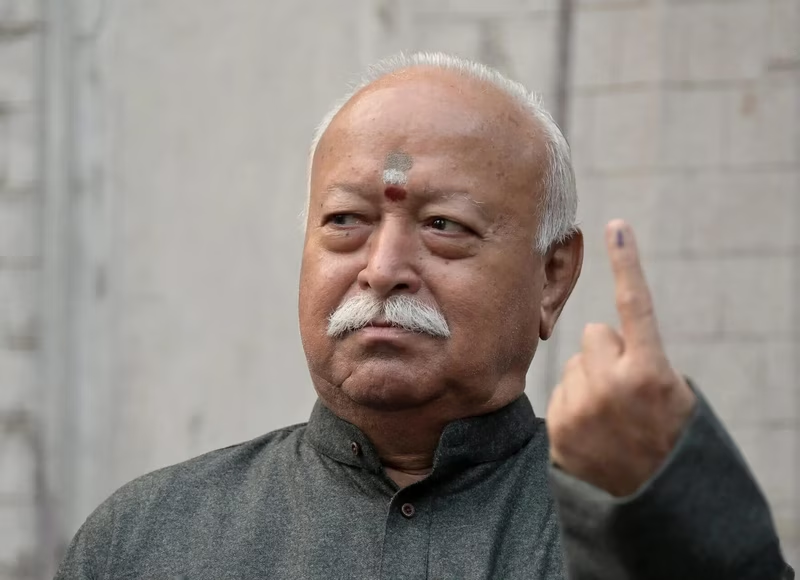
In a striking intervention during the Nagpur Municipal Corporation (NMC) elections, Rashtriya Swayamsevak Sangh (RSS) chief Mohan Bhagwat has openly criticized the use of NOTA (None of the Above), calling it an inadequate response to electoral dissatisfaction. Casting his vote at a local polling booth, Bhagwat declared, “An unwanted person gets promoted if you don’t choose the right one,” emphasizing that abstaining from selecting a candidate—or resorting to NOTA—only empowers the very individuals voters wish to reject .
His remarks come amid growing voter apathy and rising NOTA usage in urban local body polls, where disillusionment with candidates often leads citizens to register protest votes. But Bhagwat argues this approach backfires—and undermines the very foundation of democracy.
What Is NOTA and Why Is It Debated?
Introduced by the Supreme Court of India in 2013 following a landmark Public Interest Litigation, NOTA allows voters to reject all candidates on the ballot without compromising the secrecy of their choice . The option appears as the last button on EVMs and ballot papers.
Proponents see NOTA as a tool for expressing dissent and pressuring political parties to field cleaner, more competent candidates. However, critics—including now Mohan Bhagwat—point out a critical flaw: NOTA votes are symbolic and do not trigger re-elections or disqualify candidates. Even if NOTA receives the most votes, the candidate with the highest number among the listed options still wins.
This has led many experts to label NOTA as a “toothless protest”—a sentiment echoed by Bhagwat’s recent comments.
Mohan Bhagwat’s Argument: A Call for Responsible Voting
Bhagwat’s core message is simple yet profound: voting is not just a right—it’s a responsibility. He stressed that democracy functions only when citizens actively engage in choosing leaders who serve the public interest, rather than opting out through protest mechanisms that lack legal consequence.
“Elections are a mandatory part of democracy,” he stated, urging voters to research candidates, assess their track records, and make informed choices—even if imperfect . His analogy was stark: “If you don’t select the right person, the wrong one gets promoted.” This framing shifts the narrative from passive rejection to active selection.
Historical Context: NOTA in Indian Elections
Since its inception, NOTA has seen varying levels of adoption:
- 2014 Lok Sabha Elections: NOTA received over 60 lakh votes nationwide (~1.1% of total polled).
- 2019 Lok Sabha Elections: Usage dropped slightly to ~1%, but remained significant in urban constituencies.
- Local Body Polls: NOTA often garners higher percentages—sometimes exceeding 3–5%—reflecting deeper voter frustration with municipal governance .
Despite these numbers, no election result has ever been overturned due to NOTA, reinforcing Bhagwat’s point about its limited practical impact.
Public Reaction and Expert Opinions
Bhagwat’s statement has sparked intense debate on social media and in policy circles. While some applaud his call for civic engagement, others argue that in constituencies dominated by criminal or corrupt candidates, NOTA remains the only ethical outlet.
Dr. Anupama Roy, a political scientist at Jawaharlal Nehru University, notes: “NOTA may not change outcomes, but it sends a powerful signal to parties. Dismissing it entirely ignores the systemic failures that drive voters to it” .
Conversely, election integrity advocates like former Chief Election Commissioner S.Y. Quraishi support Bhagwat’s stance, urging voters to “vote *against* bad candidates by supporting better alternatives—not by pressing NOTA” .
What Voters Should Consider Before Pressing NOTA
If you’re tempted to choose NOTA in upcoming elections, ask yourself:
- Have I researched all candidates? Sometimes, lesser-known independents or regional party nominees have strong local credibility.
- Is there a ‘least harmful’ option? In a flawed field, strategic voting can prevent worse outcomes.
- Am I part of the solution? Consider joining citizen forums that vet and promote clean candidates—like those run by [INTERNAL_LINK:citizen-driven-election-reforms].
Conclusion: Democracy Thrives on Participation
Mohan Bhagwat’s message cuts through the noise: democracy isn’t a spectator sport. While NOTA offers emotional catharsis, real change comes from informed, responsible voting. As India gears up for more local and national elections, his appeal—to prioritize public interest over protest—is a timely reminder that every vote shapes the nation’s future. The ballot isn’t just a right; it’s a tool. Use it wisely.
Sources
- [1] Times of India: ‘Unwanted person gets promoted’: RSS chief says Nota not best option
- [2] Supreme Court of India Judgment: People’s Union for Civil Liberties (PUCL) vs. Union of India (2013)
- [3] Election Commission of India – NOTA Statistics (2014–2024)
- [4] Dr. Anupama Roy, Centre for Political Studies, JNU – Interview on Electoral Reforms
- [5] S.Y. Quraishi, Former CEC – Public Lecture on Voter Responsibility (2022)
- [6] Election Commission of India Official Portal: https://eci.gov.in/