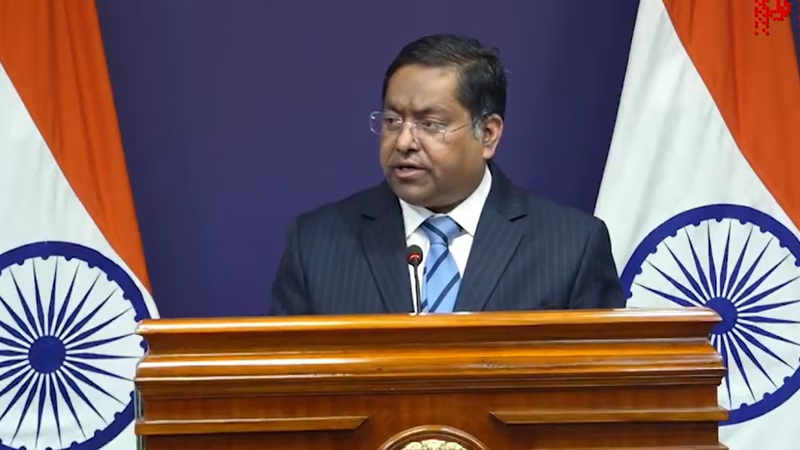
Diplomatic tensions flared this week after a high-ranking U.S. official made a startling claim about the state of communication between two of the world’s most powerful leaders. But New Delhi wasn’t having it. In a rare and pointed public correction, India’s Ministry of External Affairs (MEA) swiftly dismissed U.S. Commerce Secretary Howard Lutnick’s assertion that “Prime Minister Modi did not call” President Trump—backing its rebuttal with hard data: eight confirmed Modi-Trump calls in 2025.
Table of Contents
- The Controversial Claim That Sparked a Diplomatic Rebuttal
- MEA’s Official Response: Setting the Record Straight
- Modi-Trump Calls 2025: A Timeline of Engagement
- The Broader Context: US-India Trade Deal Negotiations
- Why Accurate Diplomatic Communication Matters
- Conclusion: A Relationship Built on Dialogue, Not Denial
- Sources
The Controversial Claim That Sparked a Diplomatic Rebuttal
The controversy began when U.S. Secretary of Commerce Howard Lutnick, during a media appearance, suggested that Prime Minister Narendra Modi had failed to initiate contact with President Donald Trump regarding ongoing trade negotiations. His exact phrasing implied a lack of proactive engagement from the Indian side—a narrative that, if left unchallenged, could have cast doubt on India’s commitment to the strategic partnership .
In today’s hyper-connected world of global diplomacy, such a claim isn’t just a minor gaffe—it’s a direct challenge to the credibility of a nation’s foreign policy apparatus. And India was ready with receipts.
MEA’s Official Response: Setting the Record Straight
MEA spokesperson Randhir Jaiswal didn’t mince words. Calling Lutnick’s remarks “inaccurate,” he provided a clear and factual counter-narrative. Jaiswal emphasized that not only had PM Modi and President Trump maintained regular communication throughout 2025, but they had spoken on no fewer than eight separate occasions .
Furthermore, Jaiswal highlighted the depth of the bilateral dialogue, noting that multiple rounds of technical and ministerial-level talks had already taken place. He added that on several instances, both sides were “very close” to finalizing key elements of a comprehensive trade agreement . This level of detail underscores that the relationship operates on far more than just leader-to-leader phone calls—it’s a multi-layered, institutionalized partnership.
Modi-Trump Calls 2025: A Timeline of Engagement
While the MEA did not release the exact dates of all eight Modi-Trump calls 2025, historical patterns and past disclosures suggest these conversations likely covered critical issues including:
- Defense and security cooperation, especially in the Indo-Pacific;
- Supply chain resilience and technology partnerships;
- Energy security and clean tech collaboration;
- And, of course, the long-pending comprehensive economic and trade agreement.
This frequency of communication is consistent with the “Chalein Saath Saath” (Let’s Walk Together) ethos that has defined the India-U.S. relationship over the past decade. It also reflects the personal rapport that has developed between the two leaders since their first meeting in 2017 .
The Broader Context: US-India Trade Deal Negotiations
The Lutnick comment must be viewed against the backdrop of protracted and often complex trade negotiations. While both nations share a vision for deeper economic integration, sticking points remain—such as market access for dairy products, medical devices, and digital services taxation .
However, experts argue that progress has been steady. The establishment of the U.S.-India Initiative on Critical and Emerging Technology (iCET) and the successful conclusion of defense logistics and space agreements show that where there’s political will, bureaucratic hurdles can be overcome . The trade file is no different. The idea that PM Modi would neglect such a crucial channel is, as the MEA stated, simply not grounded in reality.
Why Accurate Diplomatic Communication Matters
Misstatements by senior officials, even if unintentional, can have outsized consequences. They can erode trust, fuel media speculation, and create unnecessary friction between allies. In an era of great power competition, the U.S.-India partnership is a cornerstone of regional stability. Ensuring its integrity requires precision in public commentary from both sides.
India’s swift and factual rebuttal serves as a reminder that strategic partnerships are built on mutual respect and accurate information—not on soundbites or assumptions. For more on how India navigates its global alliances, see our deep dive on [INTERNAL_LINK:india-foreign-policy-principles].
Conclusion: A Relationship Built on Dialogue, Not Denial
The MEA’s forceful correction of Howard Lutnick’s remarks about the Modi-Trump calls 2025 is more than just a point of clarification—it’s a reaffirmation of the robust, active, and high-level dialogue that defines the India-U.S. relationship. With eight confirmed conversations between the two leaders in a single year, the notion of disengagement is not just false; it’s the opposite of the truth. As both nations work toward a landmark trade deal, this episode underscores a simple fact: real diplomacy happens through consistent, honest, and frequent communication.
Sources
- Times of India: ‘Inaccurate’: MEA rebuts Trump aide’s ‘PM did not call’ remarks; cites 8 Modi-Trump calls in 2025
- U.S. Department of State: U.S. Relations With India
- Ministry of External Affairs, India: Official Statements Archive
- Peterson Institute for International Economics: Analysis on U.S.-India Trade Negotiations
- [INTERNAL_LINK:us-india-strategic-partnership]