Modi vs. Stalin: The ‘Corrupt’ DMK Accusation Ignites Tamil Nadu’s 2026 Election Battle
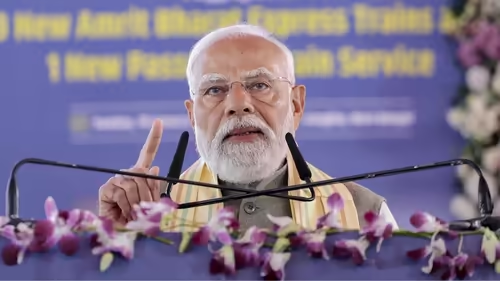
The calm before the storm is officially over in Tamil Nadu politics. With the Tamil Nadu election 2026 on the horizon, Prime Minister Narendra Modi has thrown down the gauntlet, directly accusing the ruling DMK of being a ‘corrupt’ regime that the state is ready to oust. This isn’t just political rhetoric; it’s a calculated opening salvo in what promises to be one of the most fiercely contested state elections in recent memory.
In a move that has sent shockwaves through the Dravidian political landscape, CM M.K. Stalin has fired back with equal ferocity, framing the NDA not as a savior, but as a betrayer of the state’s interests. This tit-for-tat exchange between India’s most powerful leader and its most prominent regional chief minister has set the narrative for the coming year.
Table of Contents
- Modi’s Opening Salvo: Declaring War on a ‘Corrupt’ DMK
- Stalin’s Fierce Counter: Accusing the NDA of Betrayal
- The NDA’s Alliance Math for Tamil Nadu Election 2026
- What This High-Stakes Duel Means for Tamil Nadu Voters
- Conclusion: The Road Ahead to 2026
- Sources
Modi’s Opening Salvo: Declaring War on a ‘Corrupt’ DMK
Prime Minister Modi’s campaign launch for the NDA in Tamil Nadu was anything but subtle. He went straight for the jugular, painting the DMK government led by M.K. Stalin as fundamentally corrupt and out of touch with the people’s will. His core message was clear: Tamil Nadu is ready for a change.
This line of attack is not new for the BJP, but its directness from the Prime Minister himself marks a significant escalation. The party has been consistently hammering the DMK on issues of governance and alleged corruption, with BJP leaders like Nitin Nabin calling the regime “steeped in corruption, dynastic politics and divisive” policies . The recent elevation of Udhayanidhi Stalin to Deputy CM and the re-induction of Senthil Balaji, who was previously acquitted in a corruption case, have been used by the BJP to bolster their narrative of a “cruel dynastic regime” mired in “unprecedented corruption” [[8], [9]].
By framing the Tamil Nadu election 2026 as a referendum on corruption, Modi is attempting to cut through traditional Dravidian loyalties and appeal directly to a voter base frustrated with any perceived malfeasance. It’s a high-risk, high-reward strategy that aims to nationalize the state election.
Stalin’s Fierce Counter: Accusing the NDA of Betrayal
Chief Minister M.K. Stalin was quick to respond, refusing to let Modi’s accusations go unanswered. Instead of merely defending his government, Stalin launched a powerful counter-offensive, shifting the focus from state-level governance to the Centre’s relationship with Tamil Nadu.
His central argument is one of betrayal. Stalin contends that the BJP-led central government has consistently failed the state, ignoring its long-pending demands for financial aid, special category status, and a permanent exemption from the NEET exam for medical admissions. He has publicly stated that the “BJP government’s betrayal of Tamil Nadu is unacceptable,” especially given the state’s record of economic growth and development .
Stalin’s strategy is to portray the NDA not as an alternative, but as an adversary that only remembers Tamil Nadu during election season. He has accused Modi of timing his visits purely for political gain and has slammed the BJP-AIADMK alliance as an “alliance of defeat” that the people of Tamil Nadu will not tolerate [[12], [13]]. This narrative aims to rally regional pride against what is painted as a dismissive and exploitative central government.
The NDA’s Alliance Math for Tamil Nadu Election 2026
The success of Modi’s aggressive campaign hinges entirely on the strength and unity of the NDA alliance in the state. The primary vehicle for the BJP remains its partnership with the AIADMK, led by Edappadi K. Palaniswami (EPS). Preliminary talks between the two parties have already begun, with both sides working on a seat-sharing matrix for the upcoming polls .
The alliance has also secured the support of the Pattali Makkal Katchi (PMK), a crucial player with a strong Vanniyar community base, which was confirmed to join the NDA for the 2026 elections . This consolidation is a direct attempt to build a formidable coalition capable of challenging the DMK-led front.
However, the path is not without its challenges. There have been reports of differing voices within the AIADMK-led NDA regarding strategy and seat allocation, indicating potential friction points that the DMK will surely exploit . Union Home Minister Amit Shah has expressed confidence in the alliance, but the real test will be maintaining cohesion throughout the long campaign trail .
What This High-Stakes Duel Means for Tamil Nadu Voters
For the average voter in Tamil Nadu, this escalating war of words between the nation’s top leader and their state’s chief minister translates into a critical choice:
- On one side: A promise of change from a ‘corrupt’ system, backed by the immense power and resources of the central government.
- On the other side: A defense of regional autonomy and a call to reject a central government accused of betraying the state’s interests.
This election is likely to be fought on multiple fronts: development vs. corruption, central authority vs. state rights, and national agenda vs. regional identity. The DMK will bank on its welfare schemes and strong grassroots network, while the NDA will leverage Modi’s personal popularity and its narrative of clean, efficient governance.
Key issues like the NEET exemption, water sharing disputes, and industrial investment will be the battlegrounds where these larger narratives play out in the minds of the electorate.
Conclusion: The Road Ahead to 2026
The verbal sparring between PM Modi and CM Stalin is just the beginning. As we move closer to the Tamil Nadu election 2026, expect the rhetoric to intensify, the alliances to solidify or fracture, and the campaign promises to become more specific. This is no longer just a state election; it has become a crucial indicator of the national political mood and the resilience of regional parties against the BJP’s national wave. The battle for Tamil Nadu’s soul—and its 234 assembly seats—has well and truly begun.
Sources
- Times of India: PM Modi says Tamil Nadu ready to bid farewell to ‘corrupt’ DMK; Stalin hits back
- Various news reports on BJP’s corruption allegations against DMK [[2], [8], [9]]
- Reports on M.K. Stalin’s statements on BJP’s betrayal of Tamil Nadu [[10], [12], [13]]
- News on NDA alliance formation for Tamil Nadu polls [[20], [21], [22], [25]]
- Election Commission of India: Official Website