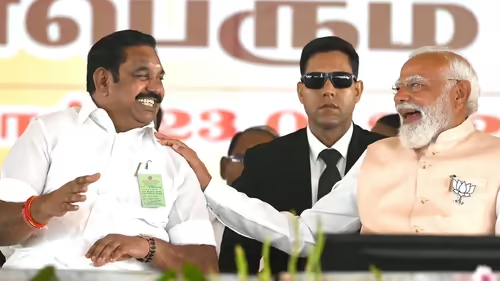
In a political salvo that has set the stage for a fierce battle in the 2026 Tamil Nadu Assembly elections, Prime Minister Narendra Modi has declared that the end of the current DMK regime is near. Speaking to a massive crowd in Madhuranthagam on January 23, 2026, his first visit to the state this year, PM Modi didn’t mince words: “The countdown has begun for the exit of the DMK government. The time has come for an NDA government in Tamil Nadu.”
This bold statement isn’t just campaign rhetoric; it’s a direct challenge to the incumbent government and a clear signal of the BJP’s intensified ambitions in the Dravidian heartland. But what does an “NDA government in Tamil Nadu” actually promise, and is the electorate ready for such a seismic shift?
Table of Contents
- Modi’s Rally and the DMK Exit Message
- The Vision for an NDA Government in Tamil Nadu
- The Political Landscape Ahead of 2026 Elections
- Can the BJP-AIADMK Alliance Deliver on Development?
- Conclusion: Is the NDA Wave Finally Reaching Tamil Nadu?
- Sources
Modi’s Rally and the DMK Exit Message
PM Modi’s speech was a masterclass in political messaging, blending sharp criticism with a forward-looking vision. He accused the DMK government of being “hostile to Tamil culture” and labeled it a “CMC government – standing for Corruption, Mafia, and Cronyism” . His core argument was that the state’s progress is being hampered by a lack of synergy between the Centre and the state government.
He positioned the NDA government in Tamil Nadu as the solution—a regime that would work “in tandem with the Centre to accelerate development and attract investments” . This message directly targets a key vulnerability often cited by industry leaders: the friction between state and central policies that can deter large-scale investments. By promising a “double-engine government,” Modi is betting on the electorate’s desire for seamless governance and faster economic growth.
The Vision for an NDA Government in Tamil Nadu
So, what does the NDA coalition—primarily the BJP and its ally, the AIADMK—plan to offer? Their pitch revolves around three main pillars:
- Accelerated Infrastructure Development: Leveraging the full support of the Union government for projects in railways, highways, and airports, which they claim has already been scaled up under the current NDA regime at the Centre .
- Unprecedented Investment Influx: Promising to create a more investor-friendly environment by aligning state policies with central initiatives like ‘Make in India’. Tamil Nadu already boasts over 1,000 investment opportunities worth a staggering $167.6 billion, a figure the NDA aims to capitalize on .
- Enhanced Fund Flow: Highlighting that the NDA government at the Centre has released significantly more funds to the state—claiming a release of ₹3 lakh crore in devolution, which they state is three times more than previous administrations .
The underlying promise is simple: a friendly state government will unlock the full potential of central support, leading to a new era of prosperity for Tamil Nadu.
The Political Landscape Ahead of 2026 Elections
The path to forming an NDA government in Tamil Nadu is far from guaranteed. The state’s political history is dominated by regional parties, and the BJP has struggled to gain a significant foothold on its own. Its success hinges entirely on its alliance with the AIADMK .
However, this alliance itself is not without its challenges. There have been reports of “leaders speaking in different voices,” indicating internal tensions within the NDA camp in the state . Furthermore, analysts point out that in the 2019 Lok Sabha elections, the alliance was behind in most Assembly segments, casting doubt on narratives of an impending victory .
The DMK, on the other hand, sits comfortably in power, leading a strong coalition of its own and enjoying the advantages of incumbency. The 2026 election is shaping up to be a classic battle between the established regional force and a national party seeking to break through with a powerful local ally.
Can the BJP-AIADMK Alliance Deliver on Development?
The NDA’s development promises are ambitious. They point to the Central government’s allocation of ₹11 lakh crores to Tamil Nadu over the last decade as proof of their commitment . Yet, the critical question remains: can a change in state leadership truly be the catalyst for the transformative development they envision?
It’s important to note that the current DMK government has its own robust development plans, including a ₹1,000 crore Green Fund and a State Action Plan on Climate Change . The debate, therefore, is less about the intent to develop and more about the model and speed of execution.
The NDA’s argument is that their model, with its direct line to the Centre, eliminates bureaucratic red tape and accelerates project implementation. Whether voters will buy into this narrative over the DMK’s track record and deep-rooted cultural connection will be the central drama of the 2026 elections.
Conclusion: Is the NDA Wave Finally Reaching Tamil Nadu?
Prime Minister Modi’s declaration of a “countdown” for the DMK government is a definitive opening shot in the 2026 electoral war. The promise of an NDA government in Tamil Nadu is a high-stakes gamble that offers a compelling vision of accelerated development and massive investment, contingent on a harmonious relationship between the state and the Centre. While the BJP-AIADMK alliance presents a formidable challenge, it must overcome historical voting patterns and internal cohesion issues to turn this vision into a political reality. For now, all eyes are on Tamil Nadu as it stands at a potential political crossroads.
Sources
- Times of India: Countdown has begun for exit of DMK govt, time has come for NDA govt: Narendra Modi
- Government of Tamil Nadu, Economic Survey 2024-25: Economic Survey of Tamil Nadu 2024 – 25
- India Investment Grid: Explore Investment Opportunities in Tamil Nadu