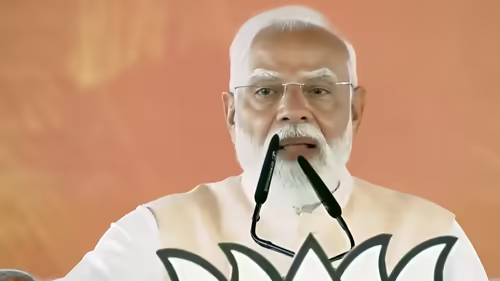
In the heart of Malda, a town steeped in history and political significance, Prime Minister Narendra Modi’s voice echoed with a singular, resonant message: Asli Poriborton. This wasn’t just a campaign slogan; it was a direct, unambiguous challenge to the decade-long rule of Chief Minister Mamata Banerjee and her Trinamool Congress (TMC) government. On this Saturday in January 2026, the PM painted a stark picture of a Bengal held back by what he termed “divisive politics,” and offered his party as the sole vehicle for genuine transformation.
Table of Contents
- Modi’s ‘Asli Poriborton’ Message in Malda
- Targeting the TMC Government
- Leveraging Nationwide Victories
- The Road to a Developed India 2047
- What This Means for West Bengal Politics
- Conclusion
- Sources
Modi’s ‘Asli Poriborton’ Message in Malda
Addressing a massive and enthusiastic crowd, PM Modi sought to redefine the very meaning of change in the Bengali political lexicon. He argued that the TMC’s version of “poriborton” had run its course, leaving behind a legacy of unfulfilled promises and stagnation. His “Asli Poriborton” is a promise of a future anchored in development, security, and national pride. He highlighted central government initiatives like the Vande Bharat trains, which he flagged off during his visit, as tangible symbols of this new era . The rally was not just a speech; it was a carefully orchestrated display of the BJP’s growing organizational strength in a state that has long been a TMC stronghold.
Targeting the TMC Government
Modi’s speech was a masterclass in political rhetoric, directly taking aim at the core of Mamata Banerjee’s governance. He accused the TMC of fostering an environment of fear and division, contrasting it with his vision of a united and prosperous Bengal. He pointed to issues of law and order, economic development, and the alleged marginalization of certain communities as evidence of the TMC’s failure. This aggressive stance comes at a critical juncture, with the next West Bengal Assembly elections on the horizon. The TMC, under Mamata Banerjee, has already declared its intention to go it alone in the 2026 polls, a move that has further intensified the political battle lines .
Leveraging Nationwide Victories
To bolster his argument for a change in Bengal, PM Modi confidently pointed to the BJP’s recent electoral triumphs across the country. He specifically cited the landmark victory of the NDA in the Bihar Assembly elections of November 2025, where the alliance overcame anti-incumbency to return to power . Similarly, he referenced the BJP-led NDA’s sweeping win in the Assam Panchayat elections, where they captured a vast majority of Zilla Parishad seats, a significant indicator of their grassroots penetration in the region . By framing these victories as a rejection of “divisive politics” and an embrace of his development model, Modi sought to create a powerful narrative that Bengal is the next logical step in this national trend.
Recent BJP Electoral Gains
The BJP’s momentum in eastern India is undeniable. Here’s a quick look at their recent successes:
- Bihar (2025): The NDA secured a decisive victory in the state assembly elections, giving Nitish Kumar another term .
- Assam (2025): The BJP-led NDA won a staggering 300 out of 397 Zilla Parishad seats in the panchayat elections, a major setback for the opposition .
- Odisha: While specific recent results weren’t detailed in the search, Modi’s mention of Odisha alongside Bihar and Assam suggests a strategic effort to project a pan-eastern dominance.
The Road to a Developed India 2047
Modi seamlessly wove his local message into his grand national vision of a ‘Viksit Bharat’ or a developed India by 2047. He posited that a state mired in what he described as the TMC’s parochial politics cannot contribute meaningfully to this national goal. For India to achieve its full potential, he argued, every state, including West Bengal, must be on the path of progress and stability. This framing elevates the state election from a regional contest to a crucial chapter in the nation’s larger story, appealing to voters who see themselves as part of a bigger, aspirational India.
What This Means for West Bengal Politics
The Malda rally is a clear signal that the BJP is doubling down on its West Bengal strategy. With the TMC ruling out any pre-poll alliances , the stage is set for a direct, high-stakes confrontation between the two parties. Modi’s “Asli Poriborton” is designed to cut through the noise of local politics and offer a simple, powerful alternative. It’s a message aimed at the youth, the business community, and anyone disillusioned with the current state of affairs. The success of this narrative will be the key determinant in whether the BJP can finally break the TMC’s formidable hold on the state. For more on the evolving political landscape, see our deep dive on [INTERNAL_LINK:west-bengal-election-2026-preview].
Conclusion
Prime Minister Modi’s “Asli Poriborton” rally in Malda was far more than a routine political event. It was a strategic declaration of intent, a comprehensive critique of the incumbent government, and a bold promise for the future. By linking local grievances to national successes and a grand vision for 2047, Modi has set the tone for what promises to be one of the most fiercely contested and consequential elections in West Bengal’s history. The battle for the soul of Bengal is well and truly underway, and the call for “real change” is now the central theme of the campaign.
Sources
- Times of India. “‘Asli poriborton’: PM Modi targets Mamata govt, calls for change in Bengal”. https://timesofindia.indiatimes.com/…
- News Live. “‘Paltano darkar, chai BJP sarkar’: PM Modi in Malda”.
- The Hindu. “Bihar Assembly Election Results 2025”.
- India Today. “What Assam’s panchayat poll results reveal about the 2026 Assembly elections”.
- The Indian Express. “Mamata Banerjee announces going solo in 2026 Bengal polls”.