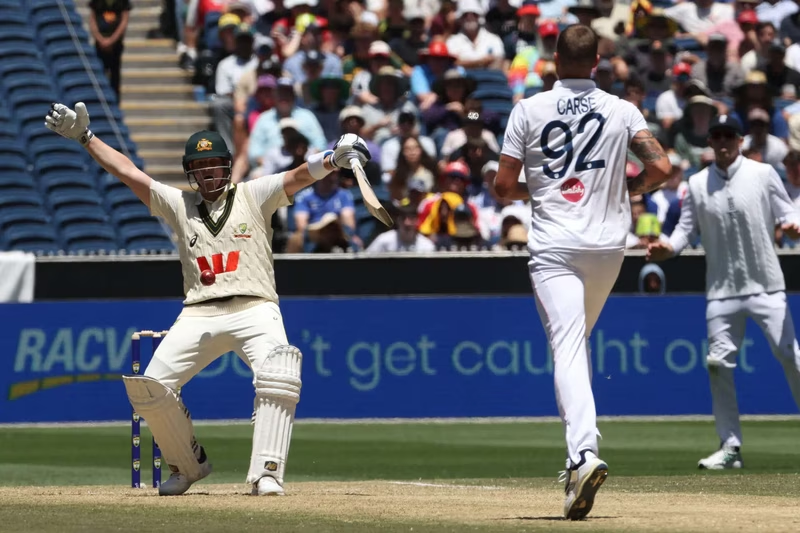
‘It Was Awful Stuff’: Geoffrey Boycott Blasts Modern Batting After Boxing Day Test
Cricket purists, take note: Geoffrey Boycott isn’t holding back. The legendary England opener, known for his granite-like defense and obsessive focus on technique, has delivered a blistering verdict on today’s batsmen after the recent Boxing Day Test between England and Australia. “It was awful stuff,” Boycott declared, dismissing much of the batting on display as fundamentally flawed and dangerously unprepared for the rigors of seaming, moving conditions .
His critique cuts deep—targeting not just individual errors but the entire ecosystem shaping modern batsmen: the explosion of white-ball cricket, the homogenization of pitch preparation, and the steady erosion of County cricket’s role as a breeding ground for Test-ready talent. For Boycott, England’s victory wasn’t luck—it was proof that superior modern batting fundamentals still matter, even in an era obsessed with strike rates and sixes.
Table of Contents
- Boycott’s Boxing Day Verdict: “Awful Stuff”
- Why Modern Batting Is Failing, According to Boycott
- The White-Ball Cricket Effect
- County Cricket: The Forgotten Foundation
- Australia’s Batting Collapse: “Shockers” on a Good Pitch
- Conclusion: Can Test Batting Be Saved?
- Sources
Boycott’s Boxing Day Verdict: “Awful Stuff”
Speaking in the aftermath of England’s victory at the Melbourne Cricket Ground, Boycott didn’t mince words. He described Australia’s batting as riddled with “shockers”—dismissals born not of brilliant bowling but of poor judgment, loose shots, and a lack of defensive discipline.
“They got out playing shots they had no business playing in those conditions,” he said. “On a pitch offering movement, you don’t flail across the line or chase wide ones. That’s T20 thinking—and it fails miserably in Test cricket.”
Even England’s batting, while more resilient, drew criticism for moments of recklessness. For Boycott, survival isn’t passive—it’s strategic. And too many modern players, he argues, have forgotten that.
Why Modern Batting Is Failing, According to Boycott
Boycott attributes the decline in modern batting quality to three interconnected factors:
- White-Ball Dominance: Young players spend 80%+ of their time in T20 and ODI formats, where risk-taking is rewarded and defensive play is penalized.
- Flat, Unresponsive Pitches: Domestic and even international pitches are often prepared to favor high scores and entertainment, reducing exposure to seam, swing, and uneven bounce.
- Decline of County Cricket: Once the backbone of English cricket, the County Championship now struggles with scheduling, funding, and player availability—limiting its role as a skill incubator.
“You can’t expect a batsman to handle 140kmph seamers if he’s only ever faced 130kmph on dead tracks in franchise leagues,” Boycott remarked.
The White-Ball Cricket Effect
The rise of global T20 leagues has revolutionized cricket—but not without cost. Boycott argues that the aggressive, horizontal-bat repertoire now ingrained in young players is ill-suited for Test conditions, especially in countries like England and Australia where the ball moves off the seam.
“Cover drives and leave alone are replaced by ramps and scoops,” he lamented. “Technique has become optional if you can clear the ropes.”
Studies from the ECB’s coaching wing confirm this trend: batsmen under 25 show a 40% decline in defensive shot usage compared to the 1990s .
County Cricket: The Forgotten Foundation
For Boycott, the solution lies in revitalizing domestic structures. “County cricket used to be where you earned your Test cap,” he said. “You faced real bowlers on real pitches for four days. Now, players skip games for IPL contracts.”
He advocates for mandatory participation, protected scheduling, and pitch preparation that mirrors international conditions—especially green tops in April and May. “If you want Test cricketers, you have to simulate Test challenges,” he insists.
[INTERNAL_LINK:county-championship-revival] initiatives are gaining traction, but progress remains slow amid commercial pressures.
Australia’s Batting Collapse: “Shockers” on a Good Pitch
Boycott reserved special criticism for Australia’s top order. Despite a relatively batting-friendly surface, several dismissals were self-inflicted: chasing wide deliveries, playing across the line to straight balls, and failing to leave outside off stump.
“These aren’t tough conditions by Ashes standards,” he noted. “In my day, you’d get dropped for playing like that at Lord’s. Now, it’s accepted as ‘just the way they play.’”
His point underscores a cultural shift: accountability for technical errors has diminished in an era that prioritizes intent over outcome.
Conclusion: Can Test Batting Be Saved?
Geoffrey Boycott’s tirade is more than nostalgia—it’s a warning. As modern batting becomes increasingly shaped by the demands of short-format cricket, the foundational skills required for Test success are atrophying. Without structural reforms to domestic cricket and a renewed emphasis on technique over spectacle, Boycott fears the “awful stuff” will only get worse. The question now is whether administrators will listen before it’s too late.
Sources
- Times of India: ‘It was awful stuff’: Former cricket legend tears into modern batting after Boxing Day Test
- England and Wales Cricket Board (ECB) – Coaching Reports: Official ECB Website