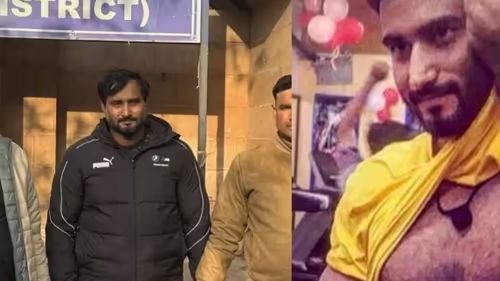
A high-stakes game of cat-and-mouse ended at Delhi’s Indira Gandhi International Airport on Saturday, January 24, 2026, when authorities apprehended Imran Khan—the alleged mastermind behind the chilling Mirzapur gym conversion racket. Khan, who had a Rs 25,000 bounty on his head, was moments away from boarding a flight to Dubai when he was intercepted by a joint team from the Uttar Pradesh Police and the Central Bureau of Investigation (CBI) [[1], [3]].
This arrest marks a critical turning point in a disturbing case that has shaken communities across eastern Uttar Pradesh. The racket, operating under the guise of fitness and wellness, allegedly preyed on young women, using sophisticated digital manipulation and psychological coercion to force religious conversions—a scheme that has now led to the sealing of five gyms and the detention of seven individuals [[2], [5]].
Table of Contents
- The Modus Operandi of the Mirzapur Gym Conversion Racket
- Imran Khan’s Arrest and the Broader Investigation
- How Victims Were Targeted and Blackmailed
- Legal and Social Implications
- Conclusion: A Warning for Digital Safety
- Sources
The Modus Operandi of the Mirzapur Gym Conversion Racket
At first glance, the gyms linked to this operation appeared legitimate—modern facilities offering yoga, weight training, and nutrition counseling. But beneath the surface, investigators say, they functioned as recruitment hubs for a sinister agenda. According to UP Police, the ringleaders would identify vulnerable young women, often from economically disadvantaged backgrounds, and lure them with promises of free memberships, career guidance, or even romantic attention .
Once trust was established, the perpetrators would secretly record videos or take photos of the victims during routine gym sessions. These images were then digitally altered—morphed—to create compromising or suggestive content. The victims were then threatened with public exposure unless they agreed to convert to another religion and comply with further demands .
Imran Khan’s Arrest and the Broader Investigation
Imran Khan, not to be confused with Pakistan’s former prime minister, had been on the run since the racket began unraveling in early January. With a Rs 25,000 reward announced by local authorities, his capture was a top priority .
Acting on a tip-off about his travel plans, police staked out Terminal 3 of Delhi airport. Khan, traveling under his own name with a valid UAE visa, was detained just before immigration clearance. Authorities recovered multiple mobile phones, SIM cards, and a laptop—items now being forensically examined for evidence linking him to additional victims and accomplices .
His arrest brings the total number of detained suspects to seven. In a coordinated crackdown, police have also sealed five gyms across Mirzapur and neighboring districts, all suspected of being part of the same network .
Key Details of the Crackdown
- Total Arrests: 7 individuals, including the alleged mastermind.
- Gyms Sealed: 5 fitness centers in and around Mirzapur.
- Bounty on Khan: ₹25,000, issued by Mirzapur district police.
- Escape Route: Attempted flight to Dubai via Air India Express.
How Victims Were Targeted and Blackmailed
The psychological manipulation employed in this racket was both calculated and cruel. Victims—mostly women aged 18 to 25—were initially approached by “trainers” or “wellness counselors” who built rapport over weeks or months. Once a level of comfort was established, private photos from gym mirrors or locker rooms were surreptitiously captured.
Using basic photo-editing apps, these images were then spliced with unrelated content to fabricate scenarios of intimacy or impropriety. The victims would receive these morphed images via anonymous messages, accompanied by ultimatums: convert, pay large sums of money, or face social ruin .
Many victims, fearing stigma and family dishonor, complied in silence—until one courageous woman filed a complaint with the local women’s helpline, triggering the wider investigation . This case underscores the growing threat of digital blackmail in India, a trend highlighted in recent reports by the National Crime Records Bureau (NCRB) .
Legal and Social Implications
The Mirzapur gym conversion racket sits at the intersection of several legal and ethical issues: cybercrime, religious freedom, gender-based violence, and data privacy. While India has laws against forced conversion (such as the Uttar Pradesh Prohibition of Unlawful Conversion of Religion Act, 2021), proving coercion in such cases is notoriously difficult—especially when digital evidence is involved .
Moreover, the use of fitness centers as fronts raises urgent questions about regulatory oversight. Gyms in India are largely unregulated beyond basic business licensing, creating blind spots that criminals can exploit. For more on how businesses can be weaponized for exploitation, see our analysis on [INTERNAL_LINK:unregulated-businesses-and-criminal-networks].
Socially, the case has reignited debates about online safety, consent, and the vulnerability of young women in digital spaces. Experts urge parents, educators, and tech platforms to collaborate on digital literacy programs that teach users how to protect their personal data and recognize grooming tactics .
Conclusion: A Warning for Digital Safety
The arrest of Imran Khan is a significant victory, but it’s only the beginning. The Mirzapur gym conversion racket reveals a dangerous new playbook where physical spaces like gyms merge with digital tools to exploit the innocent. As authorities continue to investigate, the case serves as a stark reminder: in an age of deepfakes and data harvesting, vigilance, education, and stronger legal safeguards are not optional—they’re essential for survival.
Sources
- Times of India: Mirzapur gym conversion racket kingpin arrested at Delhi airport
- Hindustan Times: UP Police seal five gyms in Mirzapur linked to conversion racket
- India Today: Mastermind of Mirzapur conversion racket held at Delhi airport
- The Wire: How the Mirzapur Gym Racket Used Blackmail to Force Conversions
- NDTV: 7 Arrested, 5 Gyms Sealed in Mirzapur Conversion Racket
- Deccan Herald: Morphed photos used to blackmail women in UP conversion racket
- National Crime Records Bureau (NCRB): Crime in India 2024 Report – Cyber Crime Statistics
- PRS India: Uttar Pradesh Prohibition of Unlawful Conversion of Religion Act, 2021