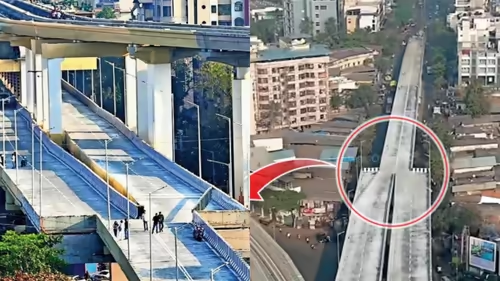
A new flyover in the bustling Mira-Bhayander region was meant to be a symbol of progress, a solution to the area’s chronic traffic woes. Instead, it’s become a viral sensation for all the wrong reasons. Commuters and residents are raising alarms over a baffling design feature: a four-lane stretch that suddenly and dramatically narrows down to just two lanes. Many have dubbed it an “invitation to crashes,” and the controversy is putting the Metropolitan Region Development Authority (MMRDA) squarely in the hot seat [[1]].
Table of Contents
- The Heart of the Controversy: What Happened?
- MMRDA Response: Denying a Design Flaw
- Why the Mira-Bhayander Flyover Matters for Mumbai
- Public and Political Backlash
- Lessons from Global Infrastructure Planning
- Conclusion: Is This the Future of Mumbai’s Roads?
- Sources
The Heart of the Controversy: What Happened?
The issue lies on the double-decker flyover connecting key parts of Mira-Bhayander. Drivers cruising comfortably on a four-lane road are met with a jarring transition where the carriageway is cut in half. This sudden bottleneck isn’t just inconvenient; it’s a serious safety concern. At high speeds, such an unexpected reduction can lead to last-minute lane changes, panic braking, and, as many fear, a significant increase in the risk of multi-vehicle collisions [[4]].
Videos of this peculiar design have gone viral on social media, with netizens expressing disbelief and frustration. The core question on everyone’s mind is simple: why would a modern infrastructure project, built to ease congestion, be designed with such a glaring and seemingly counterproductive feature?
MMRDA Response: Denying a Design Flaw
Facing mounting criticism, the MMRDA has issued a firm defense of the Mira-Bhayander flyover’s design. Officials claim there is no error or oversight. According to their explanation, the four-lane section is intended to split its traffic flow. Two lanes are dedicated to the immediate Bhayander East arm, while the other two lanes are being held in reserve for a future connection to Bhayander West, which is still under development [[2]].
“Because the Bhayander East arm appears first along the alignment, the present four-lane section transitions into two lanes,” an MMRDA official stated, attempting to clarify the logic behind the design [[2]]. They argue that this is a forward-looking plan, not a mistake. However, this explanation has done little to quell public anxiety, as the current reality is a dangerous and confusing bottleneck for thousands of daily commuters.
The Gap Between Planning and Reality
While the MMRDA’s long-term vision might be sound on paper, the execution on the ground tells a different story. Infrastructure planning must account for the user experience in the present moment. A design that creates a hazardous situation today, even if it’s meant to be fixed years from now, is a failure of practical engineering. The authority seems to have prioritized future expansion over current-day safety—a decision that could have dire consequences.
Why the Mira-Bhayander Flyover Matters for Mumbai
The Mira-Bhayander region is one of the fastest-growing suburbs of Mumbai, home to a massive population of daily commuters who travel to the city for work. Efficient and safe transportation links are not a luxury here; they are a necessity for the economic and social well-being of the area. Any infrastructure project in this corridor has a direct and profound impact on millions of lives.
This controversy is symptomatic of a larger issue in urban planning: the frequent disconnect between bureaucratic planning and the lived experiences of citizens. When a project like the Mira-Bhayander flyover—a critical piece of public infrastructure—fails to meet basic safety standards, it erodes public trust in the very agencies tasked with building a better future [INTERNAL_LINK:mumbai-urban-planning-challenges].
Public and Political Backlash
The backlash has been swift and severe. Local residents’ associations have organized protests, and political parties have seized on the issue. The Congress party has been particularly vocal, calling the design “bizarre” and an outright “danger” to the public [[7]]. The viral nature of the story has also put immense pressure on the MMRDA to provide a more convincing and empathetic response.
Public trust in large-scale infrastructure projects is fragile. Every misstep, especially one that appears so visually obvious and potentially dangerous, chips away at that trust. For the MMRDA, this is more than just a PR problem; it’s a crisis of credibility.
Lessons from Global Infrastructure Planning
Globally, best practices in civil engineering emphasize smooth, predictable transitions. Abrupt changes in road geometry are avoided at all costs. The U.S. Department of Transportation’s Federal Highway Administration, for instance, has strict guidelines for lane reductions, mandating long, gradual tapers and clear signage well in advance to prepare drivers for any change in the road ahead [[9]].
The Mira-Bhayander case seems to ignore these fundamental principles. It serves as a stark reminder that importing grand designs without adapting them to local traffic behavior and driver psychology can lead to disastrous outcomes. Good infrastructure isn’t just about concrete and steel; it’s about human-centered design.
Conclusion: Is This the Future of Mumbai’s Roads?
The controversy surrounding the Mira-Bhayander flyover is a cautionary tale. It highlights the critical need for greater transparency, public consultation, and user-centric design in India’s ambitious infrastructure projects. While the MMRDA may have a long-term plan, its failure to address the immediate safety concerns of its citizens is a serious oversight. As Mumbai continues to grow, its leaders must ensure that its roads are not just wide, but also wise, safe, and built with the people in mind.
Sources
- Times of India. “‘Invitation to crashes’: 4-lane bridge near Mumbai suddenly narrows to 2; MMRDA denies design flaw.” https://timesofindia.indiatimes.com/city/mumbai/invitation-to-crashes-4-lane-mmr-bridge-near-mumbai-suddenly-narrows-to-2-mmrda-denies-design-flaw/articleshow/127663940.cms [[1]]
- Daijiworld. “MMRDA defends Mira–Bhayander flyover design amid ‘invitation to crashes’ row.” https://daijiworld.com/news/newsDisplay?newsID=1304828 [[2]]
- Republic World. “Does Four-Lane Highway In Mira Bhayandar Abruptly Transition Into Two? Civic Body Says Not A Design Flaw.” https://www.republicworld.com/india/does-four-lane-highway-in-mira-bhayandar-abruptly-transition-into-two-civic-body-says-not-design-flaw [[3]]
- Siasat. “Maharashtra’s 4-lane flyover suddenly narrows into 2 lanes.” https://www.siasat.com/maharashtras-4-lane-flyover-suddenly-narrows-into-2-lanes-3332489/amp/ [[4]]
- India Today. “4 lanes abruptly turning 2 on flyover near Mumbai sparks controversy, MMRDA defends design.” https://www.indiatoday.in/india/story/mira-bhayander-flyover-danger-four-to-two-lanes-mumbai-congress-criticism-mmrda-defence-2858533-2026-01-27 [[7]]
- Federal Highway Administration (U.S. DOT). “Roadway Departure Safety.” https://safety.fhwa.dot.gov/roadway_dept/ [[9]]