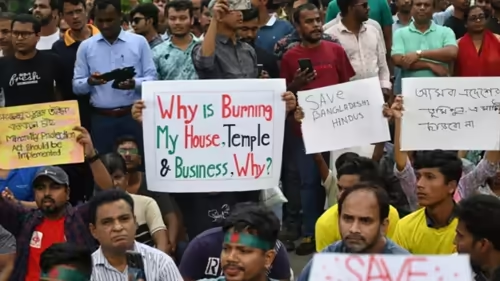
“It’s criminal, not communal.”
That’s the official line from Bangladesh’s interim government regarding a surge in reported attacks on religious minorities in early 2025. According to Adviser Muhammad Yunus, out of 645 documented incidents involving minority communities—primarily Hindus, but also Buddhists and Christians—only 71 were driven by religious animosity. The rest, he insists, were ordinary crimes like land disputes, theft, or personal vendettas.
On the surface, this seems like a reassuring clarification: perhaps the situation isn’t as dire as headlines suggest. But dig deeper, and a troubling question emerges: when victims are targeted because they’re vulnerable *due to their faith*, does labeling it “criminal” erase the underlying bigotry?
This debate over semantics isn’t academic—it’s existential for Bangladesh’s 50 million religious minorities. And their trust in the state is hanging by a thread.
Table of Contents
- The Official Claim: Breaking Down the Numbers
- What Counts as Communal Violence?
- Minority Groups Push Back on Data
- Case Studies: When Crime and Bigotry Blur
- Why Accurate Classification Matters
- International Perspective on Bangladesh Minority Safety
- Conclusion: A Crisis of Perception and Protection
- Sources
The Official Claim: Breaking Down the Numbers
Speaking to reporters, Muhammad Yunus—a key figure in Bangladesh’s interim administration—stated that authorities meticulously reviewed all 645 incidents reported between January and March 2025 involving minority communities .
Of these:
- 71 cases (11%) were classified as “communal”—including temple vandalism, forced conversions, hate speech, and threats based on religion.
- 574 cases (89%) were deemed “criminal in nature,” such as land grabbing, assault during property disputes, or robbery.
The government argues this distinction is crucial to prevent “misinformation” and avoid inflaming interfaith tensions. “We must not conflate crime with communalism,” Yunus emphasized.
What Counts as Communal Violence?
Here’s where definitions get murky. According to the Asian Centre for Human Rights, communal violence includes “any act of violence against individuals or groups based on their religious identity, even if economic motives are present” .
In rural Bangladesh, land disputes often have a sectarian dimension. Hindu families, historically owning fertile plots, are frequent targets of encroachment. Perpetrators may use religious slurs, destroy idols, or threaten entire villages—yet police file it under “trespassing” or “mischief.”
As one human rights lawyer put it: “If you rob a bank, it’s theft. If you target a Hindu family’s home because they can’t fight back, and you shout ‘Allahu Akbar’ while doing it—is that still just ‘crime’?”
Minority Groups Push Back on Data
Leaders from the Bangladesh Hindu Buddhist Christian Unity Council (BHBCUC) have strongly contested the government’s figures. “These so-called ‘criminal’ cases happen almost exclusively to minorities,” said Rana Dasgupta, General Secretary of BHBCUC. “Why aren’t Muslim families facing the same level of land grabs or mob intimidation?”
They argue the classification system itself is biased. Police, often under local political pressure, avoid labeling incidents as “communal” to keep district-level communal harmony reports clean—a practice documented in past Human Rights Watch investigations .
Case Studies: When Crime and Bigotry Blur
Consider two recent incidents:
- February 2025, Cumilla: A Hindu farmer’s land was seized by neighbors who claimed it was “waqf property.” When he protested, his house was set on fire. Police filed it as “arson and illegal occupation”—no mention of religious motive.
- March 2025, Rangpur: A mob vandalized a Durga Puja pandal after false rumors spread online about “insulting content.” Authorities arrested 12 people for “rioting”—but refused to invoke the Digital Security Act for hate speech.
In both cases, the victims believe their faith made them targets. Yet officially, these are “just crimes.”
Why Accurate Classification Matters
Labeling isn’t just bureaucratic—it shapes policy:
- Resource Allocation: Communal incidents trigger special monitoring cells and rapid response teams. Criminal cases don’t.
- Legal Accountability: Hate crime laws carry harsher penalties. Without proper classification, perpetrators get lighter sentences.
- International Standing: Bangladesh’s image as a secular democracy (enshrined in its constitution) hinges on protecting minorities. Downplaying violence risks diplomatic fallout.
More importantly, it signals to victims: your suffering isn’t seen as systemic.
International Perspective on Bangladesh Minority Safety
Global watchdogs remain concerned. The U.S. Commission on International Religious Freedom (USCIRF) has repeatedly placed Bangladesh on its watchlist for rising intolerance . Meanwhile, the UN Special Rapporteur on minority issues has urged Dhaka to adopt a “zero-tolerance policy” toward identity-based violence.
Ironically, Bangladesh’s own constitution guarantees equal protection—but enforcement remains weak, especially outside urban centers.
Conclusion: A Crisis of Perception and Protection
The debate over minority violence in Bangladesh isn’t really about numbers—it’s about recognition. By insisting most attacks are “criminal,” the interim government may be trying to project stability. But for minorities living in fear, that narrative feels like gaslighting.
True security won’t come from reclassifying violence—it will come from preventing it. Until then, every temple guarded by sandbags, every family too scared to celebrate festivals, tells a story the official statistics refuse to count.
Sources
- Times of India: Yunus defends minority-violence in Bangladesh
- Asian Centre for Human Rights: Definition of Communal Violence in South Asia
- Human Rights Watch – Bangladesh: Reports on Minority Rights
- U.S. Commission on International Religious Freedom (USCIRF): Bangladesh Country Reports