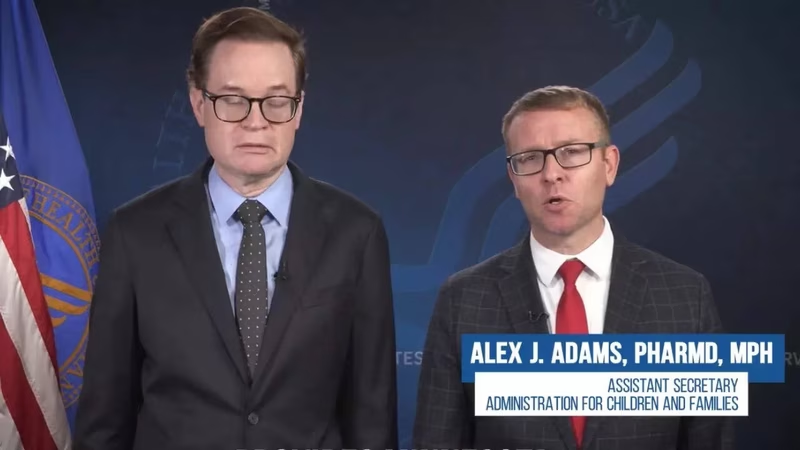
In a move that’s sent shockwaves through Minnesota’s early childhood sector, the U.S. Department of Health and Human Services (HHS) has **frozen all federal child care funds** to the state—citing “widespread fraud” and a stunning case involving a so-called “ghost daycare” that received **$4 million in taxpayer money despite showing zero activity**. The decision, rooted in policies from the Trump administration era but enforced under current oversight, has left families, providers, and state officials scrambling for answers.
At the heart of the controversy is a systemic failure in oversight that allowed fictitious child care centers to siphon public funds meant for working families. Now, HHS is rolling out a **nationwide requirement**: every child care payment must be backed by verifiable evidence and active enrollment data. For Minnesota—the first state to face a total funding freeze—the stakes couldn’t be higher.
Table of Contents
- Why Were Minnesota Child Care Funds Frozen?
- The $4 Million Ghost Daycare Scandal
- Trump Administration’s Role in the Funding Freeze
- Impact on Families and Child Care Providers
- New HHS Rules for Child Care Payments Nationwide
- How Minnesota Is Responding
- Conclusion: Accountability vs. Access in Child Care Policy
- Sources
Why Were Minnesota Child Care Funds Frozen?
According to HHS officials, the **Minnesota child care funds frozen** decision came after an internal audit uncovered “egregious vulnerabilities” in the state’s child care subsidy program. The program, funded through the federal Child Care and Development Fund (CCDF), is designed to help low-income working parents afford licensed child care.
But investigators allege that Minnesota’s system lacked basic safeguards—allowing payments to flow to providers with no verified children, no staff, and in some cases, no physical location. As one HHS spokesperson bluntly put it: *“We turned off the money spigot”* . The freeze isn’t just punitive; it’s a pause to force systemic reform before more public money disappears.
The $4 Million Ghost Daycare Scandal
The most alarming discovery? A single “learning center” in the Twin Cities area that received **over $4 million** in federal and state child care subsidies—yet showed **zero signs of operation**.
Investigators found:
- No children ever enrolled or attended.
- No licensed staff on record.
- Utility bills and lease agreements suggesting the space was never used as a daycare.
- Bank transfers showing rapid movement of funds to personal accounts.
This case isn’t isolated. Preliminary reviews suggest dozens of similar “paper providers” may have exploited Minnesota’s lax verification process—a loophole that’s now under federal microscope.
Trump Administration’s Role in the Funding Freeze
While the freeze was enacted recently, its legal and policy foundation stems from the **Trump administration’s 2019 CCDF rule changes**, which emphasized state accountability and fraud prevention . Those rules gave HHS stronger authority to withhold funds from non-compliant states.
Although implemented under a Democratic administration, the current action is framed as **enforcement of existing federal standards**—not a new political maneuver. Still, critics argue the timing and severity disproportionately impact vulnerable families, while supporters hail it as long-overdue accountability.
Impact on Families and Child Care Providers
The immediate fallout is severe. Thousands of Minnesota families who rely on subsidized care now face uncertainty. Licensed providers—who operate on razor-thin margins—are missing critical payments, risking closures.
“This isn’t just about fraudsters,” says Lena Martinez, director of a St. Paul-based nonprofit daycare. “Real providers who follow the rules are being punished because the state didn’t do its job.”
Advocates warn that the freeze could trigger a **child care desert** in already underserved communities, forcing parents—especially single mothers—out of the workforce.
New HHS Rules for Child Care Payments Nationwide
In response to the Minnesota case, HHS is implementing a **nationwide verification protocol** effective immediately. All states must now:
- Confirm active enrollment through biometric or digital check-ins.
- Verify provider licenses in real time via state databases.
- Submit monthly proof of service (e.g., attendance logs, parent attestations).
- Undergo random third-party audits.
States that fail to comply risk partial or full funding suspension—making Minnesota a cautionary tale for the entire country.
How Minnesota Is Responding
Minnesota’s Department of Human Services (DHS) has launched an emergency task force to address the freeze. Officials admit to “gaps in oversight” but argue the scale of fraud was previously unknown.
The state is now:
- Digitalizing its entire child care subsidy system.
- Hiring fraud detection specialists.
- Negotiating with HHS for a phased reinstatement of funds tied to verified cases.
Meanwhile, Governor Tim Walz has urged the federal government to release emergency funds for innocent providers while reforms are implemented.
Conclusion: Accountability vs. Access in Child Care Policy
The **Minnesota child care funds frozen** crisis exposes a painful tension in public policy: how to prevent fraud without cutting off lifelines to families in need. While no one defends $4 million going to a phantom daycare, the collateral damage from a total funding halt is real and immediate.
Going forward, the solution lies in smarter systems—not just stricter penalties. Real-time data, transparent audits, and robust provider support can ensure taxpayer dollars go where they’re meant to: to real children in real classrooms. As HHS rolls out its new nationwide rules, Minnesota’s ordeal may become the catalyst for a more secure—and more equitable—child care future.
[INTERNAL_LINK:us-child-care-subsidy-guide] [INTERNAL_LINK:federal-fraud-in-education-programs]
Sources
Times of India: ‘We turned off the money spigot’: Trump admin freezes Minnesota child care funds. But why?
U.S. Department of Health and Human Services: Child Care and Development Fund (CCDF) Program
National Conference of State Legislatures (NCSL): State Child Care Assistance Programs