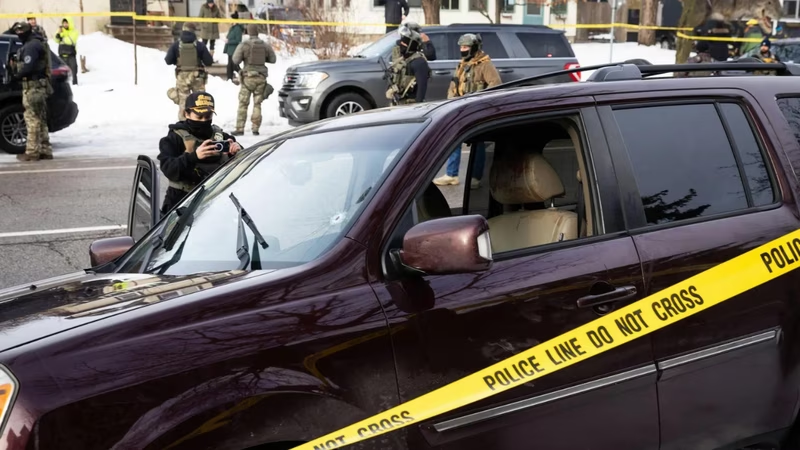
A routine immigration enforcement operation in south Minneapolis took a deadly and dramatic turn this week, culminating in an ICE shooting that has sent shockwaves across the nation. The incident, which was captured on multiple cameras, has ignited fierce debates about the use of force, the conduct of federal agents in local communities, and the very nature of immigration policy in America.
Table of Contents
- The Fatal Encounter: How It Unfolded
- Who Was Renee Good?
- The ICE and DHS Official Statement
- President Trump’s Controversial Response
- Public Outcry and Local Reaction
- The Broader Implications for ICE Enforcement
- Conclusion
- Sources
The Fatal Encounter: How It Unfolded
According to official accounts from the Department of Homeland Security (DHS), a large team of over 100 federal agents descended on a south Minneapolis location for an immigration-related operation . The situation escalated when a group of people, including the driver of an SUV, began to interfere with the agents .
DHS Secretary Kristi Noem and other administration officials stated that the driver, later identified as 37-year-old Renee Good, attempted to run over law enforcement officers [[9], [18]]. In response to this alleged threat, an Immigration and Customs Enforcement (ICE) officer fired his weapon through the window of the SUV, fatally shooting her [[2], [14]]. The entire incident occurred on a Wednesday morning and was reportedly captured on multiple cell phone videos and police body cameras [[11], [17]].
Who Was Renee Good?
Renee Nicole Good, a 37-year-old Minneapolis resident, was identified as the woman killed in the shooting . While the Trump administration has labeled her a “violent rioter” involved in the obstruction of a federal operation , community members and local officials have painted a different picture. They describe her as a local citizen who was in the wrong place at the wrong time, caught in the crossfire of an aggressive federal crackdown that had been announced just 24 hours prior . Her death marks at least the fifth fatality linked to the administration’s recent wave of aggressive immigration enforcement actions .
The ICE and DHS Official Statement
The official narrative from the federal government is clear and unwavering. They claim that the ICE officer’s actions were a direct and necessary response to an imminent threat to his life and the lives of his colleagues. “The driver of the vehicle attempted to run over law enforcement officers,” a DHS statement confirmed, justifying the use of lethal force .
Homeland Security Secretary Kristi Noem, speaking at a press conference in Minneapolis, acknowledged the tragedy of any death but stood firmly behind the officer’s actions, framing them as a matter of self-defense in a volatile situation . This stance is consistent with the administration’s broader policy of supporting its law enforcement personnel without public criticism during active investigations .
President Trump’s Controversial Response
While some in his administration chose caution, President Trump offered a swift and inflammatory public commentary. He called the incident “horrible” but immediately pivoted to characterize Good as a “professional agitator” who had “violently, willfully and viciously” run over the ICE officer before being shot .
These comments, made without the benefit of an official investigation’s findings, have been widely criticized for being premature, prejudicial, and for inflaming an already tense situation. Critics argue that the President’s language demonized the victim and prejudged the facts, potentially interfering with a fair and impartial inquiry into the ICE shooting .
Public Outcry and Local Reaction
The local reaction in Minneapolis has been one of anger and protest. The shooting has further strained the relationship between the city’s leadership and the federal government. Minneapolis Mayor Jacob Frey has been a vocal critic, alleging that the ICE officer acted ‘recklessly’ and that the presence of so many federal agents was ‘causing chaos in our city’ .
Community activists and civil rights groups have organized vigils and demonstrations, demanding a full, independent investigation and the release of all video evidence. The incident has tapped into deep-seated concerns about the militarization of immigration enforcement and the potential for excessive force in communities of color .
The Broader Implications for ICE Enforcement
This ICE shooting is not an isolated event but appears to be part of a larger, coordinated strategy. It occurred less than 24 hours after the Trump administration publicly announced a major immigration crackdown in Minnesota . This timing raises critical questions about the intent and planning behind such operations, and whether aggressive tactics are being used to achieve political objectives.
The deployment of over 100 agents for a single operation, the resulting fatal shooting, and the immediate, high-level political commentary suggest a deliberate escalation. This incident will likely fuel ongoing national debates about the role, scope, and accountability of ICE, and could lead to calls for significant reforms or even the defunding of the agency.
Conclusion
The fatal ICE shooting of Renee Good in Minneapolis has become a flashpoint in America’s ongoing struggle with immigration policy, law enforcement accountability, and political rhetoric. With conflicting narratives from federal officials and local leaders, a grieving community, and a nation watching, the demand for a transparent and thorough investigation has never been more urgent. The outcome of this case will have far-reaching consequences for how federal power is exercised on American streets.
Sources
- Associated Press: ICE agent shoots, kills woman accused of trying to hit officers in Minneapolis [[1], [3], [14]]
- Star Tribune: ICE officer fatally shoots driver through car window in south Minneapolis
- CBS News: Trump’s border czar on Minneapolis ICE shooting
- The Guardian: Trump Claims Woman Killed By ICE Ran Over An Agent
- WCCO-TV: ICE officer fatally shoots woman in Minneapolis