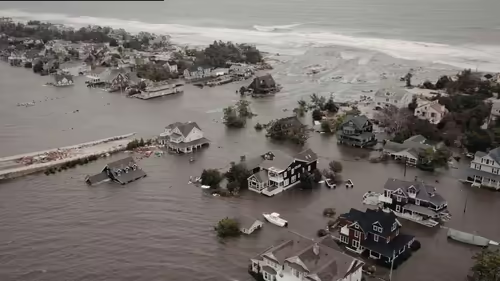
Imagine waking up one morning to find your street underwater—not from a storm, but from the high tide. Now imagine that becoming your new normal. This isn’t science fiction. According to alarming new projections, **millions of Americans** could be living this reality by the year 2100 as **coastal flooding** transforms from a rare disaster into a daily nuisance—and eventually, a permanent condition [[1]].
Fueled by accelerating ice melt in Greenland and Antarctica, along with thermal expansion of warming oceans, sea levels are rising faster than previously predicted. The consequences? Widespread property loss, crumbling infrastructure, economic disruption, and a potential mass migration inland that could reshape the American demographic map.
Table of Contents
- The Shocking Scale of Coastal Flooding by 2100
- Which U.S. Cities Are Most at Risk?
- The Human Cost: Displacement and Inequality
- What Can Be Done? Adaptation vs. Retreat
- Conclusion: A Call for Urgent Action
The Shocking Scale of Coastal Flooding by 2100
Recent modeling from leading climate scientists suggests that under a high-emissions scenario (where global carbon output continues unchecked), global sea levels could rise by **up to 2 meters (over 6.5 feet)** by 2100 [[2]]. For the United States—a nation with over 12,000 miles of coastline—this is catastrophic.
The National Oceanic and Atmospheric Administration (NOAA) estimates that even a 1-meter rise would put **13 million Americans** at risk of chronic inundation, defined as flooding that occurs more than 26 times per year [[3]]. But the real number could be far higher when accounting for compound events like storm surges riding on top of elevated sea levels.
This isn’t just about beachfront homes. Critical infrastructure—including airports, power plants, wastewater treatment facilities, and major highways—sits just feet above current sea level. A single foot of sea-level rise could expose $1 trillion worth of U.S. coastal property to regular flooding [[4]].
Which U.S. Cities Are Most at Risk?
While the entire coast is vulnerable, some areas face existential threats:
- Miami, Florida: Built on porous limestone, Miami can’t simply build seawalls—the water seeps up from below. “Sunny day flooding” already disrupts traffic weekly.
- New Orleans, Louisiana: Already below sea level and sinking, the city relies on a complex levee system that may not withstand future storm intensities.
- New York City, New York: Superstorm Sandy was a preview. With 520 miles of coastline, NYC faces billions in future flood damage.
- Charleston, South Carolina: Historic districts are increasingly flooded during king tides, threatening cultural heritage.
- San Francisco Bay Area, California: Tech campuses and low-income neighborhoods alike are at risk from bay-side inundation.
[INTERNAL_LINK:climate-resilient-cities] These cities are now racing to implement resilience plans—but time and funding are running out.
The Human Cost: Displacement and Inequality
The burden of **coastal flooding** won’t be shared equally. Low-income communities and communities of color—who often live in lower-lying, less-protected areas—are disproportionately affected. They also have fewer resources to adapt, insure, or relocate.
This could trigger a domestic climate migration crisis. Experts predict a wave of “climate refugees” moving inland to cities like Atlanta, Nashville, or Denver—straining housing, schools, and services in receiving communities. The social and political tensions from such a shift could be immense.
As Dr. Katharine Hayhoe, a renowned climate scientist, puts it: “Climate change is a threat multiplier. It takes every existing injustice and makes it worse” [[5]].
What Can Be Done? Adaptation vs. Retreat
Faced with this looming crisis, policymakers have two main strategies:
- Adaptation: Building sea walls, elevating roads, restoring wetlands, and updating building codes. While necessary, these measures are expensive and often only buy time.
- Managed Retreat: The controversial but increasingly necessary option of relocating entire communities away from high-risk zones. This requires massive federal investment and careful planning to avoid trauma and displacement.
The Biden administration has begun integrating climate risk into federal infrastructure spending, and FEMA now uses updated flood maps that account for sea-level rise. But without aggressive global emissions cuts, even the best local efforts may be overwhelmed.
Conclusion: A Call for Urgent Action
The projection that millions of Americans will face **coastal flooding** by 2100 is not a distant prophecy—it’s a direct consequence of choices we make today. Every fraction of a degree of warming we prevent translates to inches of sea-level rise avoided. The window for meaningful action is narrow, but not yet closed.
This isn’t just an environmental issue; it’s a matter of national security, economic stability, and social justice. The fate of America’s coasts—and the millions who call them home—depends on our collective will to act before the water reaches our doorsteps.
Sources
- [[1]] Times of India: Millions of Americans are projected to face coastal flooding by 2100
- [[2]] IPCC Sixth Assessment Report (2023): Climate Change 2023: The Physical Science Basis
- [[3]] NOAA Technical Report: Global and Regional Sea Level Rise Scenarios for the United States
- [[4]] Union of Concerned Scientists: Underwater: Rising Seas, Chronic Floods, and the Implications for US Coastal Real Estate
- [[5]] NASA Climate: Katharine Hayhoe on Climate Change and Hope