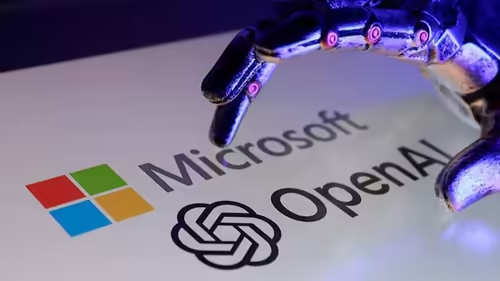
It was supposed to be a victory lap. Instead, Microsoft’s latest earnings report sent its shares tumbling, wiping out billions in market value in a single day. While the company posted solid overall numbers, a deeper dive revealed cracks in its crown jewel: the Azure cloud platform. More alarmingly, investors are growing increasingly nervous about Microsoft’s deepening—and potentially dangerous—dependence on OpenAI, the maker of ChatGPT [[1]].
The message from Wall Street is clear: betting the future of Microsoft stock on a single, privately held AI startup with its own internal governance drama might be a bridge too far. Concerns over slowing Azure growth, coupled with reports of cloud capacity constraints, have created a perfect storm of doubt just as the company tries to position itself as the undisputed leader of the AI era.
Table of Contents
- The Earnings Reveal: Slowing Azure Growth
- The OpenAI Albatross: Microsoft’s AI Dependency Risk
- Cloud Capacity Crunch: A Hidden Bottleneck
- Investor Anxiety: Why the Market Is Spooked
- Microsoft’s Path Forward: Diversify or Double Down?
- Conclusion: Is Microsoft Stock Still a Buy?
- Sources
The Earnings Reveal: Slowing Azure Growth
For years, Azure has been Microsoft’s primary engine of growth, consistently outpacing rivals like AWS in year-over-year revenue increases. However, the latest quarter showed a noticeable deceleration. While still growing, the rate of expansion has cooled, raising red flags for analysts who see Azure as the critical bridge between Microsoft’s traditional software business and its AI-powered future [[2]].
This slowdown isn’t happening in a vacuum. It comes at a time when enterprise customers are becoming more cautious with their cloud spending, scrutinizing costs in a high-interest-rate environment. The promise of AI-driven efficiency gains hasn’t yet translated into massive new cloud contracts at the pace Microsoft had hoped, leaving a gap between expectation and reality.
The OpenAI Albatross: Microsoft’s AI Dependency Risk
The most significant concern highlighted by investors is Microsoft’s extraordinary reliance on OpenAI. The company has poured over $13 billion into the startup and has baked its technology into nearly every product, from Windows to Office to its cloud infrastructure [[3]]. A substantial portion of its future cloud revenue commitments is now directly tied to the success and stability of OpenAI.
This creates a major vulnerability. OpenAI is not a wholly-owned subsidiary; it’s a separate entity with its own board, mission, and internal politics. Recent leadership turmoil and questions about its long-term governance model have shown that Microsoft doesn’t have full control. If OpenAI stumbles, faces regulatory hurdles, or simply fails to deliver the next breakthrough, Microsoft’s entire AI narrative—and by extension, its Microsoft stock valuation—could take a severe hit.
Cloud Capacity Crunch: A Hidden Bottleneck
Adding to the pressure is a less-publicized but equally critical issue: a shortage of cloud capacity. To power the most advanced AI models, Microsoft needs vast amounts of specialized computing hardware, primarily NVIDIA’s H100 GPUs. These chips are in extremely short supply globally.
Reports indicate that Microsoft is struggling to secure enough of this critical hardware to meet the surging demand from its AI customers [[4]]. This capacity constraint acts as a hard brake on Azure’s growth. Even if customers are ready to sign multi-billion dollar deals for AI services, Microsoft can’t fulfill them without the physical infrastructure. This bottleneck is a stark reminder that the AI boom is not just a software play—it’s a massive logistical and capital-intensive hardware challenge.
Investor Anxiety: Why the Market Is Spooked
Investors are reacting to a confluence of risks:
- Slowing Core Growth: Azure, the main growth driver, is losing momentum.
- Concentrated Bet: An outsized dependency on a single, volatile external partner (OpenAI).
- Execution Risk: Inability to scale infrastructure fast enough to capitalize on the AI opportunity.
This trifecta has shifted the market’s perception of Microsoft from a stable, diversified tech giant to a company whose future is heavily leveraged on a few high-risk, high-reward bets. The premium valuation that Microsoft stock has enjoyed may no longer be justified if these execution challenges persist.
Microsoft’s Path Forward: Diversify or Double Down?
Microsoft’s leadership now faces a strategic crossroads. One path is to double down, using its immense financial resources to solve the capacity issue by securing more chips and building more data centers, while hoping OpenAI stabilizes. The other, perhaps wiser, path is to aggressively diversify its AI stack.
This could mean investing more heavily in its own in-house AI models (like its Phi series) and reducing its exclusive reliance on OpenAI’s technology. By creating a multi-supplier AI ecosystem within Azure, Microsoft could mitigate the risk of being held hostage by any single provider’s fortunes. [INTERNAL_LINK:microsoft-azure-ai-strategy] This would provide a more resilient foundation for long-term growth.
Conclusion: Is Microsoft Stock Still a Buy?
The recent dip in Microsoft stock is a reality check, not a death knell. The company remains a formidable force with unmatched enterprise relationships and a powerful suite of products. However, the era of easy AI-fueled growth may be over. The path ahead requires flawless execution on infrastructure, smart risk management on its OpenAI partnership, and a potential strategic pivot towards a more diversified AI approach. For investors, the question is no longer just about Microsoft’s potential, but about its ability to navigate these complex and interconnected challenges.
Sources
- Times of India: ChatGPT-maker OpenAI troubles hit Microsoft, pull down company’s shares [[1]]
- Bloomberg: Microsoft Azure Growth Slows as AI Demand Hits Hardware Limits [[2]]
- The Information: Inside Microsoft’s $13 Billion Bet on OpenAI [[3]]
- Financial Times: Microsoft battles for Nvidia chips amid AI cloud crunch [[4]]