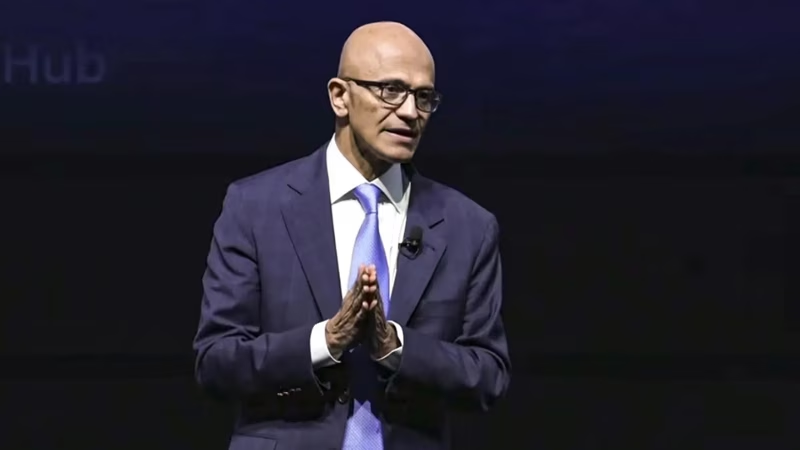
Microsoft is 50 years old—and instead of resting on its legacy, it’s rewriting its future. In a sweeping Microsoft leadership reshuffle, CEO Satya Nadella has announced a major strategic pivot: he’s stepping back from daily operational duties to concentrate exclusively on the company’s most transformative frontier—artificial intelligence.
To execute this vision, Nadella has appointed longtime executive Judson Althoff as CEO of Microsoft’s commercial business, the company’s largest and most profitable segment. This isn’t just an internal promotion; it’s a calculated power play to accelerate innovation while ensuring the engine of Microsoft’s revenue—its enterprise cloud and productivity suite—keeps roaring.
Table of Contents
- Why Now? The Timing Behind Microsoft’s 50th-Year Shake-Up
- Inside the Microsoft Leadership Reshuffle
- Who Is Judson Althoff—and Why He’s the Right Choice
- Nadella’s New Mission: AI, Datacenters, and the Next Tech Frontier
- What This Means for Microsoft’s Business and Customers
- How This Compares to Leadership Moves at Apple, Google, and Amazon
- Conclusion: A Strategic Masterstroke or a Risky Gamble?
- Sources
Why Now? The Timing Behind Microsoft’s 50th-Year Shake-Up
Microsoft’s golden anniversary arrives at a pivotal moment in tech history. AI is no longer a buzzword—it’s the battleground. With competitors like Google and Amazon racing to dominate cloud-based AI services, and OpenAI (in which Microsoft is a major investor) reshaping the landscape, Nadella can’t afford to split his focus.
“At 50, we’re not looking back—we’re building the next 50,” Nadella reportedly told senior leadership. By offloading commercial operations—a segment that includes Azure, Microsoft 365, and Dynamics 365—he frees himself to drive long-term R&D, strategic partnerships, and infrastructure scaling, especially in AI-ready datacenters.
Inside the Microsoft Leadership Reshuffle
The Microsoft leadership reshuffle is more than a title change—it’s a structural realignment designed for speed and specialization. Here’s how it breaks down:
- Satya Nadella: Now focused on “cutting-edge technical work,” including generative AI models, AI infrastructure, and strategic investments.
- Judson Althoff: Promoted from Chief Commercial Officer to CEO of Commercial Business, overseeing all revenue-generating enterprise products.
- Amy Hood: Microsoft’s CFO, continues to manage financial strategy but now reports directly to Althoff on commercial P&L matters.
This move effectively creates two co-equal power centers: one driving future innovation (Nadella), the other ensuring present profitability (Althoff).
Who Is Judson Althoff—and Why He’s the Right Choice?
Judson Althoff isn’t a new face. A Microsoft veteran since 2010, he previously led worldwide commercial sales and has been instrumental in Azure’s enterprise adoption. Under his watch, Microsoft’s commercial cloud revenue surpassed $100 billion annually—a testament to his operational discipline.
Colleagues describe him as “data-driven but empathetic,” with a rare ability to translate technical capabilities into business value for Fortune 500 clients. His deep relationships with C-suite executives at companies like Walmart, BMW, and Unilever make him the ideal steward for Microsoft’s bread-and-butter business.
Nadella’s New Mission: AI, Datacenters, and the Next Tech Frontier
With Althoff handling commerce, Nadella is doubling down on what he calls “the foundational layer of the next computing era.” His focus areas include:
- AI Model Development: Deepening integration with OpenAI and advancing Microsoft’s own Phi and Copilot models.
- Datacenter Expansion: Scaling global infrastructure to support AI workloads, including new liquid-cooled and nuclear-powered facilities .
- Strategic Acquisitions: Exploring buys in chip design, energy-efficient computing, and AI security.
This shift mirrors how Apple’s Tim Cook handles operations while Jony Ive (formerly) focused on design—except here, the “design” is AI architecture itself.
What This Means for Microsoft’s Business and Customers
For enterprise customers, little changes on the surface—your Microsoft 365 subscription won’t be affected. But behind the scenes, this could mean:
- Faster integration of AI features into Teams, Outlook, and Excel via Copilot.
- More aggressive Azure pricing to compete with AWS and Google Cloud in AI hosting.
- Stronger go-to-market strategies for AI-driven industry solutions (healthcare, manufacturing, finance).
Investors should watch for increased capital expenditure in 2026 as Microsoft races to build AI-optimized datacenters—a move validated by Microsoft’s investor relations as “critical to long-term growth” .
How This Compares to Leadership Moves at Apple, Google, and Amazon
Microsoft isn’t alone in restructuring for AI. Google created a “Chief AI Officer” role, while Amazon split AWS leadership to separate cloud infrastructure from AI services. But Microsoft’s approach is unique: it’s not adding roles—it’s elevating them.
By making Althoff CEO of the commercial unit, Nadella signals that AI innovation and enterprise revenue are now co-equal pillars—not siloed departments. This integrated-yet-separated model could become the new blueprint for tech giants navigating the AI era.
For more on how Big Tech is adapting, see our deep dive on [INTERNAL_LINK:big-tech-ai-strategy-2026].
Conclusion: A Strategic Masterstroke or a Risky Gamble?
The Microsoft leadership reshuffle is a bold declaration: the AI race demands undivided attention at the top. By entrusting Judson Althoff with the commercial empire, Satya Nadella is betting that Microsoft’s future isn’t just in selling software—but in building the intelligence that powers the next century of computing. If it works, Microsoft could dominate not just the 2020s, but the 2050s too.
Sources
- Times of India. “Microsoft at 50: Nadella’s big reshuffle; New CEO named to focus on company’s biggest biz.” timesofindia.indiatimes.com. Published January 2, 2026.
- Microsoft. “Investor Relations – Annual Report 2025.” microsoft.com/investor. Accessed January 2, 2026.
- Reuters. “Microsoft Expands Datacenter Footprint with AI-First Design.” reuters.com. December 15, 2025.