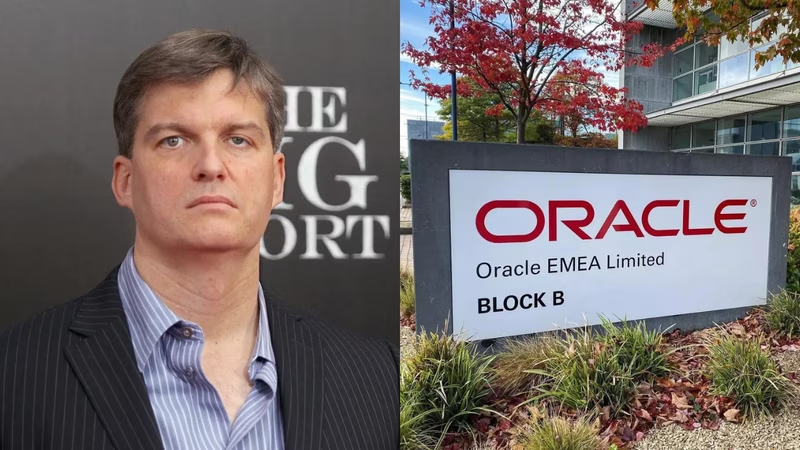
He called the housing bubble. He warned about meme stocks. Now, Michael Burry is sounding the alarm on one of Silicon Valley’s most hyped AI plays: Oracle. The investor who became a household name through “The Big Short” has revealed he’s placed a significant Michael Burry Oracle short bet, using both put options and direct short positions built over the last six months . His reasons? A toxic cocktail of unsustainable debt and an enormous, high-wire act of an AI infrastructure deal with Sam Altman’s OpenAI .
This isn’t just another market prediction; it’s a direct challenge to the narrative that every company touching AI is a guaranteed winner. Burry’s move forces us to ask a critical question: Is Oracle’s meteoric rise built on solid ground or a foundation of sand?
Table of Contents
- Who is Michael Burry and Why His Bets Matter
- The Michael Burry Oracle Short Position Explained
- Oracle’s Debt Crisis Fueled by AI Ambitions
- The $300B OpenAI Deal: A Boon or a Burden?
- Why Burry is Avoiding Other Tech Giants
- What This Means for Investors
- Sources
Who is Michael Burry and Why His Bets Matter
Michael Burry isn’t your average investor. His legendary foresight in predicting and profiting from the 2008 subprime mortgage crisis cemented his status as a contrarian genius. He doesn’t follow the herd; he hunts for systemic weaknesses others ignore. When Burry takes a public stance, especially a short position, the market listens because his track record suggests he’s often several steps ahead of the curve .
The Michael Burry Oracle Short Position Explained
Burry’s strategy against Oracle is two-pronged. He hasn’t just bought put options—a financial instrument that gains value if the stock price falls—he has also directly shorted the stock itself . This dual approach amplifies his bearish conviction, signaling he believes Oracle’s share price is not just due for a dip but a potential collapse.
In his own words, Burry has expressed deep skepticism about Oracle’s current trajectory, stating he simply does “not like how it is” positioned in the market . This vague but powerful statement points to fundamental flaws he sees in the company’s business model and financial health, far beyond the typical market volatility.
Oracle’s Debt Crisis Fueled by AI Ambitions
At the heart of Burry’s concern is Oracle’s staggering debt load. To fund its aggressive push into AI infrastructure, the company has amassed a debt mountain of approximately $108 billion . This is a seismic shift from its legacy as a moderately leveraged software firm .
The company is reportedly seeking an additional $38 billion in debt financing just to keep its AI data center projects on track . This relentless capital burn is raising red flags:
- Unsustainable Leverage: A debt-to-equity ratio this high leaves little room for error in a rising interest rate environment.
- Capital Expenditure Overload: Management has already raised its fiscal 2026 capex guidance to a jaw-dropping $50 billion .
- Liquidity Risk: Such massive outflows for construction loans on data centers in New Mexico and Wisconsin could strain cash reserves .
The $300B OpenAI Deal: A Boon or a Burden?
Oracle’s entire AI narrative hinges on its historic $300 billion cloud infrastructure deal with OpenAI, set to begin in 2027 . On the surface, it’s a massive win, securing Oracle as a primary cloud partner for one of the world’s most valuable AI startups.
However, Burry and other skeptics see immense execution risk. This deal is a colossal gamble for both parties. OpenAI, despite its fame, is still a money-losing startup . If its revenue models fail to materialize at the scale needed to pay for Oracle’s infrastructure, the entire house of cards could fall.
Furthermore, reports have surfaced of potential delays in the data center build-out, with Oracle’s own carefully worded denials doing little to quell fears about the project’s structural feasibility . The pressure to deliver on this contract is immense, and any stumble could devastate Oracle’s stock price and credit rating.
Why Burry is Avoiding Other Tech Giants
Interestingly, Burry has drawn a clear line in the sand. While he’s shorting Oracle, he’s explicitly avoiding placing similar bets against tech titans like Google (Alphabet) and Microsoft . His reasoning is key to understanding his thesis.
He views these companies as having rock-solid, cash-generative core businesses—search advertising and enterprise software, respectively—that provide a stable foundation for their AI investments. Their AI spending is an expansion of strength, not a desperate Hail Mary pass to redefine their entire company, as he likely perceives Oracle’s move to be.
What This Means for Investors
Burry’s Michael Burry Oracle short is a stark warning to retail and institutional investors alike. It urges a deeper look beyond the shiny AI headlines. The key questions for any Oracle shareholder should now be:
- Can Oracle service its $108+ billion debt without its stock or credit rating taking a severe hit?
- Is the $300 billion OpenAI deal a guaranteed revenue stream, or a massive liability waiting to happen?
- Does Oracle have a viable Plan B if the AI infrastructure gold rush cools down or faces oversupply issues ?
While the AI trend is undeniable, Burry’s bet suggests that not all boats will rise with this tide. Some, burdened by debt and reliant on a single, high-risk contract, might just sink.
Summary
In conclusion, Michael Burry’s bearish stance on Oracle is a masterclass in fundamental analysis. He’s betting that the market is overlooking the company’s dangerous debt levels and the extreme execution risk tied to its landmark OpenAI deal. While others chase the AI dream, Burry is focused on the hard financial realities that could turn Oracle’s big bet into a catastrophic loss. For investors, his move is a crucial reminder to always question the narrative and look for the cracks beneath the surface.
Sources
- Times of India. “One of America’s biggest investors Michael Burry is betting against Oracle…” January 2026 .
- Financial news reports on Oracle’s Q2 2026 earnings and debt levels [[13], [11], [15]].
- Analysis of the Oracle-OpenAI $300B cloud infrastructure agreement [[27], [22], [21]].
- Investor communications and filings detailing Burry’s short positions [[3], [1]].
- [INTERNAL_LINK:ai-stock-investing-guide]
- [INTERNAL_LINK:michael-burry-investment-strategy]
- U.S. Securities and Exchange Commission (SEC) Filings