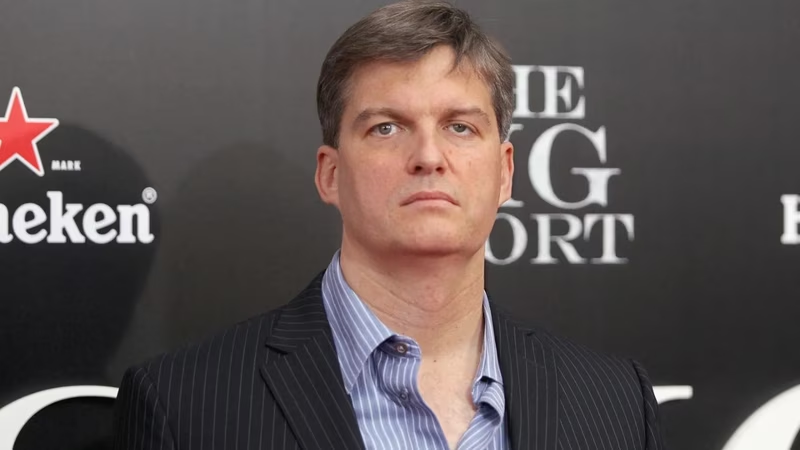
Forget subprime mortgages—Michael Burry is now betting big on atoms. The investor who famously predicted the 2008 financial crisis has turned his sharp analytical lens toward America’s most pressing existential threat: an energy infrastructure woefully unprepared for the AI revolution. In a direct appeal to Donald Trump and Senator J.D. Vance, Burry has unveiled a bold, $1 trillion proposal to rapidly deploy small modular nuclear reactors (SMRs) and rebuild the nation’s aging power grid .
His message is stark: without immediate, massive investment in clean, reliable baseload power, the U.S. will not only fail to meet the explosive electricity demands of AI data centers but also cede global technological and economic dominance to China. This isn’t just an energy plan—it’s a national survival strategy.
Table of Contents
- The Core of Burry’s $1 Trillion Vision
- The Looming AI Energy Crisis: Why Data Centers Are Power Hogs
- Beating China: The Geopolitical Stakes of Energy Independence
- Michael Burry nuclear plan: Feasible or Fantasy?
- The Real Enemy: Regulatory Gridlock
- Conclusion
- Sources
The Core of Burry’s $1 Trillion Vision
Burry’s proposal rests on two interconnected pillars:
- Mass Deployment of Small Modular Reactors (SMRs): Unlike traditional gigawatt-scale nuclear plants that take a decade+ to build, SMRs are factory-built, scalable, and can be deployed near industrial hubs—including AI data farms—in under five years.
- National Grid Hardening & Expansion: A continent-wide upgrade to create a resilient, high-capacity transmission network capable of moving vast amounts of clean power from generation sites to urban and tech corridors.
He estimates the total cost at roughly $1 trillion—a figure he argues is trivial compared to the trillions the U.S. already spends on defense or pandemic relief, and essential for ensuring the Treasury can service its growing debt through sustained economic growth .
The Looming AI Energy Crisis: Why Data Centers Are Power Hogs
The AI boom is an energy tsunami. A single large AI training run can consume as much electricity as **dozens of homes use in a year**. Microsoft, Google, and Amazon are racing to build new data centers, each requiring 200–500 megawatts—equivalent to a small city .
Current grids, reliant on intermittent solar and wind plus aging gas/coal plants, simply can’t keep up. Rolling blackouts in tech-heavy states like California and Texas are early warning signs. As Burry bluntly puts it: “You cannot run the future on hope and lithium batteries alone.”
Beating China: The Geopolitical Stakes of Energy Independence
Burry ties energy directly to national security. China is aggressively building nuclear capacity—over 20 new reactors under construction—and dominates global supply chains for critical minerals and grid tech. If the U.S. remains dependent on fossil fuels or unreliable renewables, it risks becoming technologically and strategically vulnerable.
“This is the only hope to keep up with China,” Burry warned in his communication to Trump and Vance . A robust, nuclear-powered grid would not only fuel AI innovation but also reduce reliance on foreign energy sources and strengthen manufacturing resilience—a core tenet of both Trump’s and Vance’s economic platforms.
Michael Burry nuclear plan: Feasible or Fantasy?
Experts are cautiously optimistic but highlight major hurdles:
- Cost & Scale: While SMRs promise lower upfront costs, deploying enough to make a national impact requires unprecedented capital mobilization.
- Public Perception: Nuclear energy still faces stigma from past accidents (Fukushima, Chernobyl), despite modern designs being far safer.
- Workforce Gap: The U.S. lacks enough nuclear engineers and construction crews to execute such a rapid build-out [INTERNAL_LINK:us-clean-energy-workforce-shortage].
However, proponents note that countries like France (which gets ~70% of its power from nuclear) prove large-scale deployment is possible. The question is political will—not technical feasibility.
The Real Enemy: Regulatory Gridlock
Even Burry’s biggest supporters agree: the #1 obstacle isn’t money or technology—it’s bureaucracy. The U.S. nuclear licensing process, managed by the Nuclear Regulatory Commission (NRC), can take **10–15 years** for a single plant. SMRs, despite their simplicity, face the same labyrinthine approvals.
Burry’s call for “fast-tracking” is really a demand for radical regulatory reform: creating emergency pathways for critical energy infrastructure, similar to wartime production efforts. Without it, even a $1 trillion commitment could stall in red tape while AI’s power hunger grows unchecked.
Conclusion
Michael Burry’s nuclear gambit is more than an investment thesis—it’s a wake-up call. The convergence of AI’s energy appetite, climate imperatives, and great-power competition has created a perfect storm that legacy energy systems cannot weather. Whether his $1 trillion vision becomes policy depends on whether U.S. leaders see energy not as a partisan issue, but as the bedrock of 21st-century sovereignty. As Burry implies: the time for incrementalism is over. The future runs on watts—and right now, America is running low.