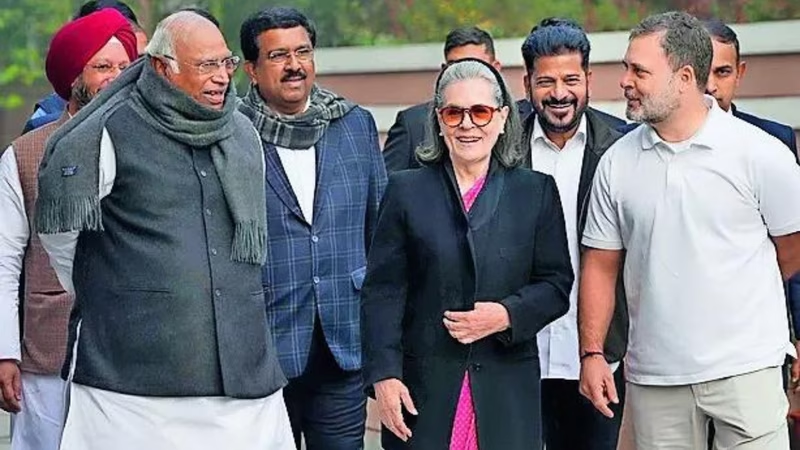
In a fiery political salvo that draws a direct parallel to one of the most controversial economic decisions of the last decade, the Congress party has accused Prime Minister Narendra Modi’s government of deliberately orchestrating the MGNREGA decimation—a move it describes as “even more damaging than demonetisation” for India’s rural poor.
Speaking after a high-level meeting of the Congress Working Committee (CWC), senior leaders alleged that chronic underfunding, delayed wage payments, and artificial caps on person-days have crippled the Mahatma Gandhi National Rural Employment Guarantee Act (MGNREGA), leaving millions of vulnerable households without a critical safety net. In response, the party has announced a nationwide campaign—starting January 5—to “force the restoration” of the scheme in its original spirit.
“Just as demonetisation shattered small businesses overnight, this slow-motion sabotage of MGNREGA is starving rural India piece by piece,” said a CWC statement. “This isn’t mismanagement—it’s policy.”
Table of Contents
- What Is MGNREGA and Why Does It Matter?
- Evidence of MGNREGA Decimation: Budget Cuts and Delays
- Congress Campaign Plan: January 5 Onwards
- BJP’s Defense and Government Response
- Why This Matters for 2029—and Beyond
- Conclusion: A Battle for Rural India’s Soul
- Sources
What Is MGNREGA and Why Does It Matter?
Enacted in 2005 under the UPA government, MGNREGA guarantees 100 days of wage employment per year to every rural household whose adult members volunteer to do unskilled manual work. It’s not just a welfare scheme—it’s a legal right. Designed as a buffer against agrarian distress, drought, and economic shocks, MGNREGA has been a lifeline for over 50 million households annually .
Studies by the World Bank and Reserve Bank of India have credited the scheme with reducing rural poverty, empowering women (who constitute nearly 55% of participants), and creating durable assets like ponds, roads, and check dams .
Evidence of MGNREGA Decimation: Budget Cuts and Delays
Congress leaders and independent analysts point to several alarming trends they call proof of systemic erosion:
- Budget Allocation Slashed: The 2025–26 Union Budget allocated ₹60,000 crore—just 60% of the ₹1 lakh crore demanded by experts to meet actual demand. In 2023–24, over 30% of states ran out of funds by October.
- Wage Payment Delays: Average payment delays have stretched to 30–45 days in states like Bihar and Jharkhand—far exceeding the mandated 15 days. In 2024, over ₹8,000 crore in wages remained unpaid.
- Artificial Work Caps: Many states have imposed unofficial limits of 50–70 person-days per household, violating the 100-day guarantee.
“This isn’t incompetence—it’s design,” said Congress leader Jairam Ramesh. “When you starve a scheme of funds and delay wages, people stop seeking work. That’s how you kill MGNREGA without formally abolishing it.”
Congress Campaign Plan: January 5 Onwards
The CWC has approved a multi-phase campaign to reclaim MGNREGA as a central political issue:
- Phase 1 (Jan 5–31): “MGNREGA Satyagraha” – Block-level protests, worker testimonials, and social media blitz under #RestoreMGNREGA.
- Phase 2 (Feb–Mar): State-wide rallies in 10 high-impact states (UP, Bihar, MP, Rajasthan, etc.).
- Phase 3 (Apr onward): National march to Delhi if the Centre fails to respond.
The party plans to leverage its network of rural leaders, farmers’ unions, and women’s self-help groups to amplify ground-level narratives. For deeper analysis on rural distress, see [INTERNAL_LINK:rural-india-economic-crisis-explained].
BJP’s Defense and Government Response
The government counters that MGNREGA is “fully functional” and that budget allocations are demand-driven. “We release funds based on actual work generated, not wishful thinking,” said a Ministry of Rural Development official.
However, data from the Ministry’s own dashboard shows that in 2024, over 1.2 crore job cards were rejected due to “insufficient funds”—a clear mismatch between demand and supply. Critics argue this reflects a deliberate policy shift toward “privatizing rural distress” through schemes like PM-Kisan, which lack employment guarantees.
Why This Matters for 2029—and Beyond
Beyond immediate welfare, this battle is deeply strategic. Rural voters—especially landless laborers and SC/ST communities—are a decisive bloc in over 200 parliamentary constituencies. By framing MGNREGA’s decline as a Modi-led betrayal, Congress aims to rebuild its rural narrative ahead of the 2029 general elections.
Moreover, with climate change intensifying agrarian uncertainty, a robust MGNREGA could be India’s best insurance against mass migration and urban slum growth. Its weakening, therefore, isn’t just political—it’s existential for rural resilience.
Conclusion: A Battle for Rural India’s Soul
Congress’s comparison of MGNREGA decimation to demonetisation is more than rhetoric—it’s a calculated framing to position the Modi government as anti-poor and anti-rural. As the January 5 campaign kicks off, the real test will be whether this message resonates beyond party lines. For millions in India’s villages, MGNREGA isn’t a scheme—it’s survival. And its fate may well determine the political future of the nation.
Sources
Times of India: Congress Blames Modi for MGNREGA Decimation
World Bank: Impact Evaluation of MGNREGA
The Mahatma Gandhi NREGA Act, 2005 – Official Gazette
Ministry of Rural Development: MGNREGA Fund Allocation vs Demand (2024–25)