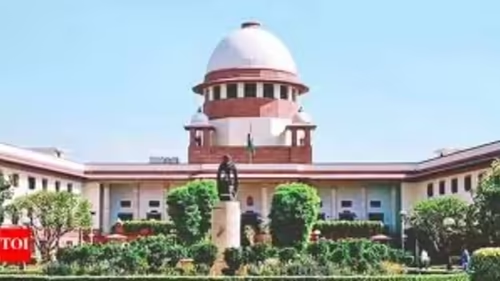
Supreme Court Declares Menstrual Health a Fundamental Right: What This Landmark Ruling Means for Every Girl in India
In a watershed moment for gender justice in India, the Supreme Court has officially recognized menstrual health fundamental right under Article 21 of the Constitution—the right to life and personal liberty. This isn’t just symbolic language; it’s a legally binding directive that forces every school in the country, whether government-run or private, to provide free sanitary pads and construct separate, functional toilets for girls. The judgment, born from growing alarm over incidents of “period shaming” and school dropouts linked to poor menstrual hygiene, marks a turning point in how India treats its adolescent girls.
No longer can menstruation be treated as a taboo or a logistical afterthought. The Court has made it clear: access to menstrual products and safe sanitation is not a privilege—it’s a constitutional guarantee.
Table of Contents
- Why This Ruling Is a Game-Changer
- The 3 Key Orders from the Supreme Court
- How Article 21 Now Includes Menstrual Dignity
- The Real-World Impact on Girls’ Education
- What Schools and States Must Do Now
- Challenges Ahead and How to Overcome Them
- Conclusion: A New Era for Menstrual Justice
- Sources
Why This Ruling Is a Game-Changer
For decades, millions of Indian girls have faced their periods in silence, shame, and discomfort. Many miss school during their cycles because they lack access to clean toilets or affordable pads. Some even drop out entirely. The Supreme Court’s ruling directly tackles this systemic failure by elevating menstrual hygiene from a public health issue to a matter of fundamental rights. This shift means non-compliance isn’t just poor policy—it’s a constitutional violation.
The judgment also explicitly links menstrual dignity to broader goals like gender equality, education access, and bodily autonomy. It’s a powerful acknowledgment that you cannot empower girls if you ignore half of their lived experience.
The 3 Key Orders from the Supreme Court
The Court’s directive is clear, actionable, and enforceable. Here are the three core mandates:
- Free Sanitary Pads in All Schools: Both government and private schools must provide free, high-quality sanitary pads to all girl students. This removes financial barriers that disproportionately affect low-income families [[12]].
- Separate and Functional Toilets for Girls: Every school must have clean, private, and well-maintained toilets exclusively for girls. These facilities must include safe disposal mechanisms for used pads—a critical but often overlooked detail [[12]].
- Accountability for All Institutions: The ruling applies universally. Private schools cannot claim exemption, and state governments are now legally obligated to monitor and enforce compliance. Failure to do so can lead to legal consequences [[12]].
How Article 21 Now Includes Menstrual Dignity
Article 21 of the Indian Constitution guarantees the “right to life with dignity.” The Supreme Court has consistently expanded this to include rights to health, privacy, and a clean environment. In this landmark judgment, the Court has now firmly included menstrual health fundamental right within that framework. The logic is simple: a girl who is forced to manage her period without basic hygiene facilities is being denied her dignity and, by extension, her right to a full and equal life.
This interpretation aligns India with global human rights standards. The United Nations has long recognized menstrual health as a human rights issue, stating that stigma and lack of access violate rights to health, education, and non-discrimination [[UN Women]].
The Real-World Impact on Girls’ Education
The data is stark. Studies show that up to 23% of girls in India drop out of school when they start menstruating, primarily due to inadequate sanitation and social stigma [[UNICEF India]]. Even those who stay often miss 3–5 days of school each month, creating a significant learning gap over time.
By mandating free pads and safe toilets, the Supreme Court is directly attacking one of the biggest structural barriers to girls’ education. When a girl doesn’t have to worry about leaks, odors, or embarrassment, she’s more likely to attend class, participate fully, and stay in school. This ruling could be a catalyst for improving female literacy rates and long-term economic outcomes for women across the country [[INTERNAL_LINK:girls-education-india-impact]].
What Schools and States Must Do Now
The ball is now in the court of state governments and school administrations. Immediate action is required:
- State education departments must allocate budgets for regular pad distribution.
- School management committees (SMCs) must audit toilet infrastructure and submit compliance reports.
- Teacher training programs should include menstrual health awareness to combat stigma and provide support.
- Parents and students should be informed of their new rights and encouraged to report non-compliance.
Transparency will be key. Public dashboards tracking school-level compliance could help ensure accountability.
Challenges Ahead and How to Overcome Them
Implementation is where many well-intentioned policies falter. Challenges include inconsistent supply chains for pads, maintenance of toilets in remote areas, and deep-rooted cultural taboos that may resist change. However, these are not insurmountable.
Solutions include leveraging local self-help groups for pad production, integrating menstrual health into the curriculum, and using community radio and social media to normalize conversations about periods. The success of this ruling will depend on sustained political will and active citizen participation.
Conclusion: A New Era for Menstrual Justice
The Supreme Court’s declaration that menstrual health fundamental right is more than a legal victory—it’s a moral imperative. It sends a powerful message to every girl in India: your body is not a source of shame, and your right to dignity is non-negotiable. As states roll out this mandate, the nation has a historic opportunity to break the cycle of silence and inequality. The classroom, once a site of exclusion for many, can now become a space of empowerment, safety, and equality.
Sources
- [[12]] Times of India. (2026, January 30). ‘Menstrual health a fundamental right’: SC makes landmark ruling – 3 key orders explained. Retrieved from https://timesofindia.indiatimes.com/india/landmark-ruling-on-womens-health-sc-declares-menstrual-hygiene-a-fundamental-right-mandates-free-sanitary-pads-distribution-separate-toilets-in-schools-disable-friendly/articleshow/127796680.cms
- [[UN Women]] United Nations Entity for Gender Equality and the Empowerment of Women. (2023). Menstrual Health and Human Rights. https://www.unwomen.org/en
- [[UNICEF India]] UNICEF. (2022). Menstrual Hygiene Management in India: A Situation Analysis. https://www.unicef.org/india