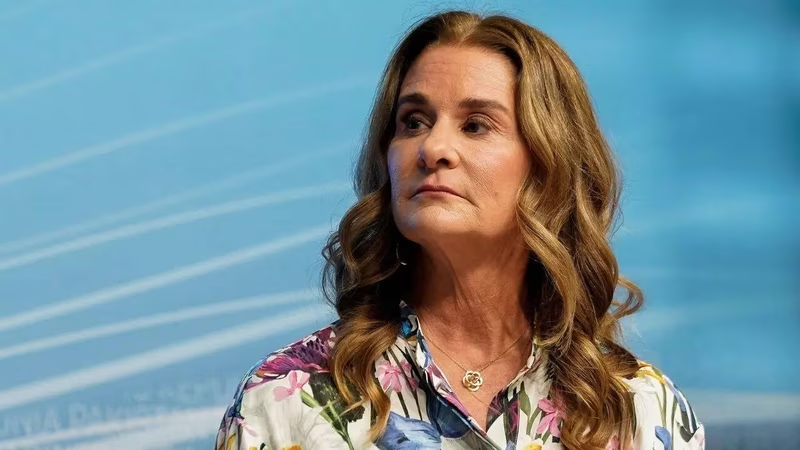
Imagine turning down a job at IBM—one of the most powerful tech giants of the 1980s—to work for a scrappy Seattle startup most people had barely heard of. That’s exactly what Melinda French Gates did. In a recent interview, she revealed a now-iconic anecdote: she once thought of Microsoft as just a “little company.” Yet, she chose it over IBM—and that single career decision would go on to define not just her professional life, but global philanthropy for decades to come.
Table of Contents
- The IBM Offer vs. the ‘Little Company’
- Melinda French Gates at Microsoft: Early Days and Rise
- Why Her Hiring Manager Said, “Take the Risk”
- From Product Manager to Billionaire Philanthropist
- The Legacy of Her Microsoft Decision
- Conclusion: Lessons from a Bold Career Choice
- Sources
The IBM Offer vs. the ‘Little Company’
It was 1987. Melinda French, fresh out of Duke University with an MBA in hand, had two golden opportunities on the table. One was a coveted position at IBM—a household name, a Fortune 500 titan, and the epitome of corporate stability. The other? Microsoft, a relatively young software company founded just 12 years earlier by Bill Gates and Paul Allen.
“I remember thinking, ‘Microsoft? That’s a little company,’” she recalled in a recent interview . At the time, Microsoft was still climbing the ladder, known mostly for MS-DOS and early versions of Windows. It didn’t have IBM’s gravitas—or its global footprint.
Yet, instead of playing it safe, Melinda opted for the unknown. And that choice would prove revolutionary.
Melinda French Gates at Microsoft: Early Days and Rise
Her journey at Microsoft began humbly—as a product manager for multimedia products. But she quickly made her mark. Known for her sharp intellect, strategic thinking, and people-first leadership style, she rose through the ranks in a male-dominated industry.
Over the course of nine years at Microsoft, Melinda contributed significantly to the development of key consumer products, including Microsoft Encarta and Expedia—projects that helped define the company’s shift from operating systems to user-friendly digital experiences .
She eventually became General Manager of Information Products, overseeing teams that shaped how millions interacted with early digital content. Her success wasn’t just professional; it was financial. Her Microsoft stock options, combined with her marriage to Bill Gates, would later place her among the wealthiest women in the United States .
Why Her Hiring Manager Said, “Take the Risk”
What pushed Melinda to choose Microsoft over IBM? According to her account, it was the encouragement of the very person who interviewed her at Microsoft.
“My hiring manager told me, ‘You’ve got an offer from IBM—that’s safe. But Microsoft is where you’ll grow. Take the risk,’” she shared . That advice encapsulates a timeless truth about career growth: sometimes, the greatest opportunities lie not in institutions, but in movements.
In the late 1980s, Microsoft was more than a company—it was a culture of innovation, long hours, and relentless ambition. For someone like Melinda, who thrived on problem-solving and impact, it was the perfect environment.
From Product Manager to Billionaire Philanthropist
Melinda left Microsoft in 1996 to focus on raising her family—but she didn’t step away from leadership. In 2000, she co-founded the Bill & Melinda Gates Foundation, which has since become the world’s largest private charitable foundation.
Hundreds of millions of lives have been impacted by its work in global health, education, and gender equity—efforts deeply informed by Melinda’s tech background and data-driven mindset [INTERNAL_LINK:bill-melinda-gates-foundation-impact].
Even after her 2021 divorce from Bill Gates, she retained significant assets, including a stake in Microsoft, and launched Pivotal Ventures, her own investment firm focused on advancing women and underrepresented groups in tech and business .
As of early 2026, Forbes estimates her net worth at over $7 billion, cementing her status not just as a tech pioneer, but as a self-made force in global philanthropy .
The Legacy of Her Microsoft Decision
The story of Melinda French Gates calling Microsoft a “little company” is more than a charming anecdote—it’s a masterclass in career courage. It reminds us that:
- Prestige ≠ Potential: Big names aren’t always where the future is being built.
- Mentorship Matters: One piece of honest advice can change your life trajectory.
- Women Have Always Been in Tech: Long before “diversity in tech” became a buzzword, women like Melinda were shaping the industry from within.
Her journey also highlights how early tech experience can fuel lifelong impact—proving that code and compassion aren’t mutually exclusive.
Conclusion: Lessons from a Bold Career Choice
Melinda French Gates’ decision to join a “little company” called Microsoft wasn’t just a career move—it was a bet on vision over visibility. Today, as she continues to champion gender equality and innovation through Pivotal Ventures, her story inspires a new generation to look beyond brand names and seek out environments where they can truly grow, lead, and give back. In a world obsessed with safety, her legacy is a powerful reminder: sometimes, the biggest rewards come from the boldest bets.
Sources
- When Melinda French Gates called Microsoft a ‘little company’. Times of India. https://timesofindia.indiatimes.com/…
- Melinda Gates’ role at Microsoft. Microsoft Archives. [INTERNAL_LINK:microsoft-women-leaders-history]
- Melinda French Gates net worth and assets. Forbes Real-Time Billionaires List. https://www.forbes.com/
- Pivotal Ventures: Advancing Women in Tech. Pivotal Ventures Official Site. https://www.pivotalventures.org/
- The Evolution of the Gates Foundation. Council on Foreign Relations. https://www.cfr.org/