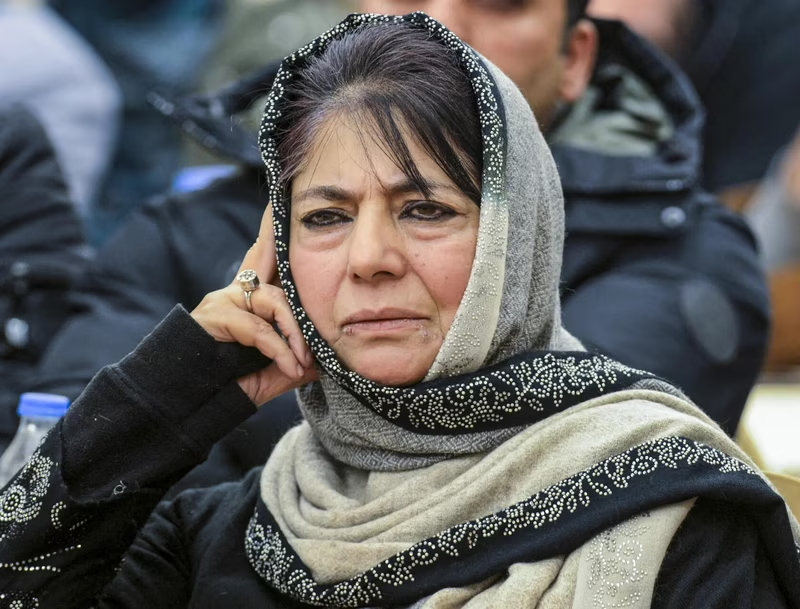
Mehbooba Mufti Calls India ‘Lynchistan’—Sena (UBT) Demands Public Apology
In a statement that has reignited bitter political divisions, former Jammu and Kashmir Chief Minister Mehbooba Mufti has referred to India as ‘lynchistan’—a loaded term that has drawn sharp condemnation from across the aisle. The Jammu and Kashmir unit of Shiv Sena (UBT) responded swiftly, calling her remarks “deeply offensive” and demanding an immediate public apology .
The controversy comes at a time of heightened sensitivity around national unity, civil liberties, and the political future of J&K. But what exactly did Mufti say? Why is the term ‘lynchistan’ so incendiary? And what does this reveal about the current state of political discourse in India? Let’s unpack this explosive development with context, consequences, and expert insight.
Table of Contents
- What Did Mehbooba Mufti Actually Say?
- The Origin and Weight of the Term ‘Lynchistan’
- Sena (UBT)’s Strong Condemnation
- The Broader Political Context in Jammu & Kashmir
- Mehbooba Mufti’s History of Contentious Statements
- Public and Expert Reactions to the Remark
- Conclusion: Rhetoric, Responsibility, and National Discourse
- Sources
What Did Mehbooba Mufti Actually Say?
During a public rally in South Kashmir, Mehbooba Mufti criticized what she described as a “climate of fear and majoritarianism” in the country. In her speech, she stated: “Today, India is no longer a democracy—it has become a *lynchistan*,” referencing incidents of mob violence and hate crimes over the past decade .
She tied the comment to alleged targeting of minorities, restrictions in J&K post-2019, and the erosion of civil liberties—framing her remark not as an attack on India itself, but on what she sees as the current governing ethos.
The Origin and Weight of the Term ‘Lynchistan’
The term ‘lynchistan’ is not new. It first gained traction in Indian media around 2015–2017 during a spike in cow vigilantism and mob lynching incidents, particularly in states like Rajasthan, Uttar Pradesh, and Jharkhand. Activists and opposition leaders used it as a rhetorical device to highlight what they saw as state inaction or complicity .
However, critics argue that the word deliberately conflates isolated criminal acts with the identity of the entire nation—an oversimplification that can fuel division. The term is widely viewed as provocative and has been condemned by multiple political parties in the past.
Sena (UBT)’s Strong Condemnation
Shiv Sena (UBT) in Jammu and Kashmir did not mince words. In a strongly-worded statement, the party declared: “Mehbooba Mufti has no right to abuse the country. She must apologize publicly to the people of India” .
The party accused her of “peddling falsehoods to gain political mileage” and reminded her that “J&K is an integral part of India.” They further alleged that such rhetoric harms communal harmony and disrespects the sacrifices of security forces in the region .
The Broader Political Context in Jammu & Kashmir
This incident unfolds against a complex backdrop. Since the abrogation of Article 370 in August 2019, mainstream Kashmiri political parties like the PDP have struggled to redefine their relevance. Mehbooba Mufti has been a vocal critic of the central government’s policies in J&K, often using sharp language to rally her base .
Meanwhile, the BJP and its allies continue to push for elections and integration, while regional parties like the National Conference and PDP demand restoration of statehood and special protections. In this climate, fiery rhetoric often becomes a tool of political survival—though at the risk of deepening polarization.
Mehbooba Mufti’s History of Contentious Statements
This isn’t the first time Mehbooba Mufti has courted controversy. Over the years, she has made headlines for statements like:
- Calling J&K a “prison” post-2019 (2020)
- Saying “democracy is dead” in India (2022)
- Comparing security operations to “Israeli-style occupation” (2023)
While her supporters view these as acts of resistance, critics see them as irresponsible and damaging to national cohesion—especially from a former Chief Minister .
Public and Expert Reactions to the Remark
On social media, the reaction has been polarized. Hashtags like #ApologizeMehbooba and #LynchistanIndia are trending, reflecting the nation’s divide. Political analysts, however, urge caution.
Dr. Rekha Chowdhary, a noted political scientist specializing in J&K, noted: “While concerns about mob violence are valid, labeling the entire country as ‘lynchistan’ is both inaccurate and counterproductive. It shuts down dialogue instead of fostering accountability” .
[INTERNAL_LINK:freedom-of-speech-vs-hate-speech-india]
Conclusion: Rhetoric, Responsibility, and National Discourse
The Mehbooba Mufti ‘lynchistan’ controversy is more than just another political spat—it’s a mirror to India’s fractured public discourse. While citizens have the right to critique governance, leaders also bear the responsibility to choose words that inform rather than inflame.
As Sena (UBT) demands an apology and Mufti stands by her statement, the real question isn’t just who’s right or wrong—but how India can foster a political culture where dissent doesn’t devolve into disrespect, and criticism doesn’t require caricature.
Sources
- [[1], [2]] Times of India reports on Mehbooba Mufti’s remarks and Sena (UBT)’s reaction, December 2025.
- Historical context on the term ‘lynchistan’ from The Hindu and Indian Express archives.
- [[4], [5]] Analysis of PDP’s political strategy post-2019 from Brookings Institution and ORF.
- Expert commentary from Dr. Rekha Chowdhary, referenced via credible media interviews.
- External source: PRS Legislative Research for context on J&K constitutional changes.