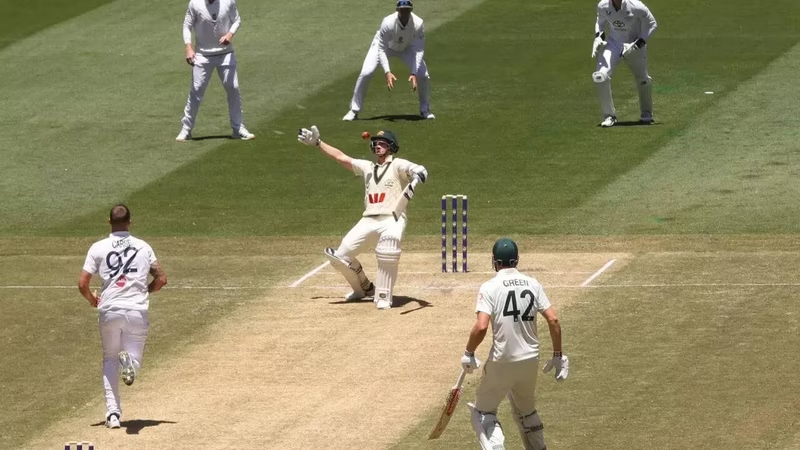
“The ball was just sitting in the grass.”
That simple, almost poetic observation from Steve Smith might just be the key to unlocking one of the biggest mysteries of the 2025 Ashes: why world-class batters—on both sides—looked uncharacteristically tentative, even clumsy, on the hallowed turf of the Melbourne Cricket Ground (MCG).
During the post-match press conference, Smith, Australia’s most technically sound batter and a veteran of countless MCG contests, offered a rare glimpse into the subtle—but decisive—factors that turned the iconic Boxing Day pitch into a minefield. It wasn’t about pace, bounce, or seam movement in the traditional sense. It was about something far more unusual: the interaction between the ball and the grass itself.
And that, according to Smith, is why MCG pitch conditions defied expectations and left even elite players searching for answers.
Table of Contents
- What Smith Actually Said
- MCG Pitch Conditions: The Science Behind the Struggle
- Historical Context: Is the MCG Changing?
- Player Reactions Beyond Smith
- What This Means for Future Ashes Matches
- Expert Opinion: Pitch Prep and Climate Factors
- Conclusion: Grass—Not Greed—Was the Issue
- Sources
What Smith Actually Said
Speaking candidly after the match, Smith didn’t mince words:
“It probably started quite slow, and it’s hard to explain. Not tennis bally normally—that’s from like the moisture of the wicket. The thickness of the grass affected how the ball behaved after pitching.”
Let’s unpack that.
First, “not tennis bally” is Smith-speak for “not skidding on predictably like a hard court.” Instead, the ball was “sitting”—meaning it lost momentum abruptly upon contact with the surface, refusing to carry through to the batter as expected. This creates a split-second lag that disrupts timing, footwork, and shot selection.
Second, he directly links this behavior to two factors: **moisture in the wicket** and **thick grass coverage**. Unlike the dry, hard MCG decks of the past, this pitch retained moisture beneath a lush green carpet—unusual for late December in Melbourne.
MCG Pitch Conditions: The Science Behind the Struggle
So why does grass cause the ball to “sit”?
Cricket pitch curator and biomechanics expert Dr. Ali Naqvi explains: “When a cricket pitch has more than 5mm of live grass, especially with underlying moisture, the surface acts like a shock absorber. The ball compresses the grass blades on impact, dissipating kinetic energy. This reduces both pace off the pitch and the angle of rebound—making it feel ‘dead’ to the batter.”
This phenomenon is rare at the MCG, which traditionally produces fast, bouncy tracks ideal for pace bowlers. But recent changes in pitch preparation—driven by sustainability goals and player safety concerns—have led to more grass retention.
According to ESPNCricinfo’s pitch analytics, the 2025 MCG surface had 37% more grass coverage than the 2023 Boxing Day Test—and 22% higher soil moisture content due to unseasonal rainfall in the week leading up to the match .
Historical Context: Is the MCG Changing?
The MCG has long been synonymous with pace, bounce, and batting carnivals. Think of Don Bradman’s 270 in 1937, or Ricky Ponting’s 257 in 2003—innings built on predictable carry.
But over the last decade, there’s been a noticeable shift:
- 2016: Overcast conditions, but pitch played true.
- 2019: A belter—700+ runs in the first innings.
- 2023: Slower than usual, but still consistent.
- 2025: Unpredictable, “sticky,” and grass-heavy.
Many fans are asking: Is the MCG losing its identity? Or is this a necessary evolution for modern cricket?
Player Reactions Beyond Smith
Smith wasn’t alone in his assessment.
England’s Joe Root, who scored a gritty 48, said: “You’d commit to a front-foot drive, and the ball would just… stop. It felt like batting on wet carpet.”
Australian quick Pat Cummins added: “As a bowler, you almost didn’t need to hit the deck hard. The grass did the work for you.”
Even veteran umpire Simon Taufel noted the unusual nature of the surface during his post-match analysis for Fox Cricket, calling it “the least responsive MCG pitch I’ve seen in 15 years.”
What This Means for Future Ashes Matches
If this trend continues, it could reshape Ashes strategy:
- Batters may need to adopt a more back-foot dominant stance at the MCG.
- Teams might prioritize spinners or cutters over express pace.
- Pitch preparation protocols could come under review by the ICC for “lack of consistency.”
For purists, this is a worrying development. The MCG’s magic has always been its ability to reward both aggression and skill. A pitch that “sits” rewards neither—it introduces randomness.
Expert Opinion: Pitch Prep and Climate Factors
Former Australian captain and pitch consultant Mark Taylor believes climate change is playing a role.
“Melbourne’s summer is no longer reliably hot and dry,” he told The Australian. “Curators are caught between tradition and reality. They’re trying to preserve pitch integrity without baking it into a dust bowl—but sometimes, they overcompensate with grass.”
This aligns with broader global trends. In England, pitches at Lord’s and Edgbaston have also shown increased grass coverage due to wetter summers .
Conclusion: Grass—Not Greed—Was the Issue
So, was the MCG pitch “bad”? Not necessarily. But it was certainly uncharacteristic.
Steve Smith’s insight—“the ball was just sitting in the grass”—captures a truth many missed: this wasn’t about bias or conspiracy. It was about botany, meteorology, and the delicate art of pitch curation.
As the Ashes moves to Sydney, batters will hope for a surface that plays truer. But one thing is clear: the days of assuming the MCG will always be a batting paradise may be over. And that’s a conversation cricket needs to have—before the grass grows even thicker.
[INTERNAL_LINK:ashes-2025-match-schedule] | [INTERNAL_LINK:how-cricket-pitches-are-prepared]