Table of Contents
- The Scandal That Shook Delhi
- A Surprising Return to Power
- MCD Chief Sanjeev Khirwar and His New ‘Pet Project’
- Delhi’s Stray Dog Crisis: By the Numbers
- Can Redemption Be Managed Like a Municipal Portfolio?
- Sources
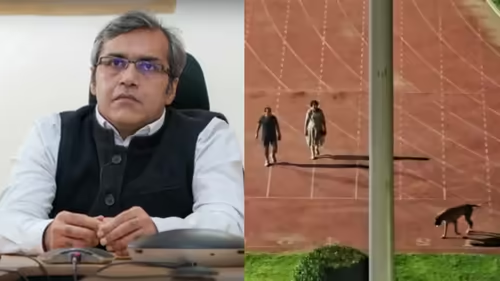
In a twist that feels ripped from a political satire, **MCD chief Sanjeev Khirwar** is back in charge of Delhi’s civic affairs—three years after a bizarre controversy over his personal dog walks forced him out of the capital. But this time, the very symbol of his past misstep has become his official mission: managing Delhi’s exploding stray dog population is now his self-declared “pet project.”
For residents who remember the headlines, it’s hard not to raise an eyebrow. Yet for governance watchers, Khirwar’s return raises deeper questions: Can a bureaucrat tarnished by privilege truly lead on an issue as sensitive and urgent as animal welfare and public safety? And more importantly—can he deliver results where others have failed?
The Scandal That Shook Delhi
Back in late 2022, Sanjeev Khirwar—a 1994-batch IAS officer then serving as South Delhi Municipal Corporation (SDMC) commissioner—became the center of a firestorm. Athletes training at the prestigious Thyagraj Stadium alleged that Khirwar routinely forced them to end their evening sessions early so he could walk his pet dog in peace .
The incident sparked national outrage. Critics slammed it as a glaring example of bureaucratic entitlement—where a public servant prioritized his pet’s leisure over elite athletes preparing for national and international competitions. The backlash was swift and severe. Within weeks, Khirwar was transferred out of Delhi, his reputation in tatters.
At the time, it seemed like a career-ending misstep. Few expected him to return to such a high-profile role in the capital. Yet here we are.
A Surprising Return to Power
In January 2026, the Government of India appointed Khirwar as the new Municipal Commissioner of the unified Municipal Corporation of Delhi (MCD)—one of the most powerful civic posts in the country. The move came after months of administrative reshuffling and growing pressure to address Delhi’s crumbling urban infrastructure.
Observers note that Khirwar brings decades of administrative experience to the table. Before the scandal, he was known as a no-nonsense officer with a track record in urban planning and public health. His supporters argue that one lapse shouldn’t define his entire career—and that his technical expertise is precisely what Delhi needs now.
MCD Chief Sanjeev Khirwar and His New ‘Pet Project’
Perhaps in a deliberate act of irony—or strategic rebranding—Khirwar has publicly embraced the stray dog issue as his top priority. In his first press interaction since taking office, he referred to animal management as his “pet project,” signaling both accountability and ambition .
This isn’t just symbolic. Delhi’s stray dog crisis has reached alarming levels:
- Over 300,000 stray dogs roam the city’s streets, according to MCD estimates.
- Rabies cases linked to dog bites remain a persistent public health threat.
- Residents in colonies across East, North, and South Delhi report daily confrontations, especially involving children and elderly citizens.
Khirwar’s plan reportedly includes reviving the Animal Birth Control (ABC) program, increasing sterilization drives, and improving coordination between MCD, NGOs, and veterinary services. He’s also hinted at stricter enforcement against illegal dumping of pets—a key driver of the stray population boom.
Delhi’s Stray Dog Crisis: By the Numbers
To understand the scale of Khirwar’s challenge, consider these facts:
| Metric | Figure | Source |
|---|---|---|
| Estimated stray dog population | 300,000+ | MCD Annual Report 2025 |
| Dog bite cases (annual) | ~25,000 | Delhi Health Department |
| Sterilizations performed (2024) | 42,000 | MCD Animal Welfare Wing |
| Target needed for population control | 150,000+/year | World Health Organization guidelines |
The gap is staggering. Even with goodwill, bridging it requires massive logistical coordination, funding, and public trust—none of which come easily in a city as complex as Delhi.
Can Redemption Be Managed Like a Municipal Portfolio?
Khirwar’s comeback is more than a personnel decision—it’s a test of institutional memory and public forgiveness. Can a leader associated with elitism now champion inclusive, humane urban policies?
His success hinges on transparency and tangible outcomes. Simply talking about “pet projects” won’t cut it. Residents need to see sterilization vans in their neighborhoods, responsive grievance cells for dog-related complaints, and data-driven progress reports.
Moreover, this is an opportunity to reframe the narrative. Instead of viewing stray dogs as a nuisance, Khirwar could position Delhi as a model for compassionate urban coexistence—aligning with global best practices from cities like Chennai and Jaipur, which have reduced rabies deaths through sustained ABC programs .
If he succeeds, Khirwar won’t just solve a civic problem—he’ll rewrite his own legacy. If he fails, the ghost of that dog-walking scandal may haunt him forever.
Sources
- Times of India: Dog-walking row behind him: IAS officer Khirwar returns as MCD chief; strays now his ‘pet project’
- World Health Organization (WHO): Rabies Fact Sheet – WHO Guidelines on Dog Population Management
- Internal Link: [INTERNAL_LINK:delhi-stray-dog-policy-analysis]
- Delhi Government Health Bulletin, 2025
- MCD Unified Annual Administrative Report, 2025