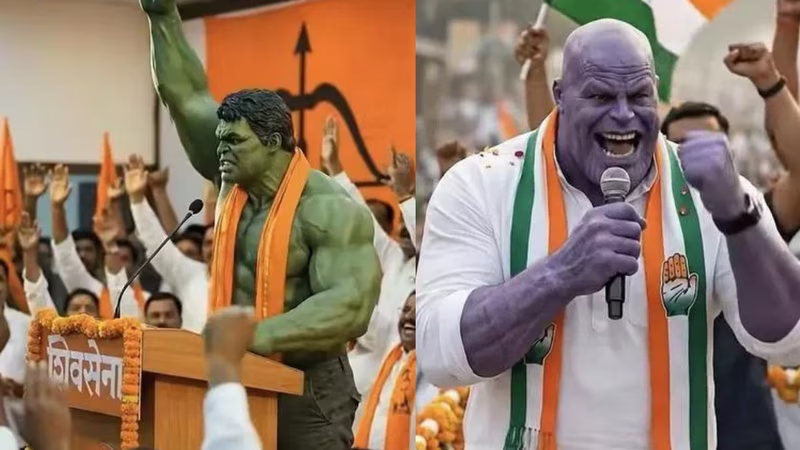
Imagine this: Thanos, the Mad Titan, isn’t snapping his fingers to erase half the universe. Instead, he’s standing in front of a pothole-ridden road in Pune, promising to “balance the civic budget” with his signature gravitas—all while speaking perfect Marathi. Welcome to the wild, wonderful, and wildly popular world of Maharashtra civic polls satire, where AI has turned Marvel superheroes into unlikely municipal candidates .
This isn’t a fever dream. It’s a digital phenomenon sweeping across Instagram and WhatsApp, where AI-generated videos of Tony Stark, John Wick, and the Hulk are “campaigning” for ward-level positions in cities like Pune and Mumbai. These aren’t just memes; they’re high-quality, emotionally resonant mini-dramas that tap into the everyday frustrations of urban Indian life—water cuts, garbage piles, and unresponsive local representatives—with a hefty dose of superhero flair .
Table of Contents
- The AI Campaign: When Superheroes Go Local
- Why This Satire Resonates So Deeply
- The Technology Behind the Scenes
- Impact on Public Discourse and Voter Engagement
- Ethical Considerations and the Future of AI in Politics
- Conclusion: A Mirror Held Up to Democracy
- Sources
The AI Campaign: When Superheroes Go Local
The core of this trend is a series of short, AI-generated Reels that place global pop culture icons directly into the heart of Maharashtra’s local political landscape. In one video, Tony Stark, clad in a crisp white kurta, uses his arc reactor to power a neighborhood during a load-shedding crisis. In another, the Hulk smashes a mountain of uncollected garbage, roaring about civic accountability .
These characters don’t just look the part; they sound it too. The AI voiceovers are in fluent, colloquial Marathi, complete with local slang and references to specific ward issues. This hyper-localization is key to their success. They’re not foreign imports; they’ve been digitally naturalized as your friendly neighborhood (super) candidate .
Why This Satire Resonates So Deeply
The reason these videos have garnered millions of views and are being shared like wildfire is simple: they speak a truth that many feel but can’t articulate. The Maharashtra civic polls often feel distant and disconnected from the daily realities of citizens. These AI satires bridge that gap by using universally recognized symbols of power and justice to highlight very specific, local failures.
It’s a form of catharsis. When a citizen sees Thanos solemnly pledge to “bring order to the chaos of our water supply,” it’s funny, yes, but it also validates their own sense of helplessness and desire for a powerful, decisive solution . The satire works because it’s rooted in genuine public anxiety, making the humor both relatable and poignant.
The Technology Behind the Scenes
This phenomenon is a testament to the rapid advancement of generative AI. Tools for deepfake video, AI voice cloning, and real-time language translation have become sophisticated enough to create content that is not only convincing but also emotionally engaging. Creators are using a mix of open-source and commercial AI platforms to generate these videos, often spending hours fine-tuning the lip-sync and intonation to achieve that authentic Marathi delivery .
Impact on Public Discourse and Voter Engagement
While purely created for entertainment and explicitly labeled as satire , these videos are having a tangible impact on public discourse. They are sparking conversations in homes, offices, and online forums about the actual performance of local corporators and the promises of real candidates. In a way, they’re acting as an unconventional form of voter education, reminding people of the issues that matter most at the ward level.
For younger voters who might be disillusioned with traditional politics, this digital-native format is a powerful entry point into civic engagement. It makes the dry, bureaucratic world of municipal governance feel dynamic and relevant .
Ethical Considerations and the Future of AI in Politics
Of course, this trend raises important questions. While these current videos are clearly satirical, the same technology could be used to create deepfakes of real politicians, spreading misinformation. The line between parody and deception is thin, and as these tools become more accessible, the potential for misuse grows.
Regulatory bodies like the Ministry of Electronics and Information Technology (MeitY) are already grappling with the challenges of AI-generated content. This viral trend serves as a timely case study in the need for clear guidelines and digital literacy to help the public discern fact from fiction.
Conclusion: A Mirror Held Up to Democracy
The AI-generated campaign of Thanos, Tony Stark, and the Hulk in the Maharashtra civic polls is far more than just a viral internet joke. It’s a cultural artifact that reflects the public’s yearning for effective, responsive, and almost superhuman leadership at the most local level of government. It’s a reminder that even in the age of advanced technology, the core desires of citizens—for clean streets, reliable water, and accountable leaders—remain unchanged. Whether this trend will inspire real-world change or remain a brilliant piece of digital theatre is yet to be seen, but its impact on the election conversation is undeniable. For more on how technology is reshaping democracy, explore our feature on [INTERNAL_LINK:ai-and-the-future-of-indian-elections].
Sources
- Times of India. “Thanos, Tony Stark, John Wick jump into Maha civic poll race, only on AI reels though.” https://timesofindia.indiatimes.com/…
- Various reports on AI-generated superhero reels for BMC and Pune elections [[1], [5], [6], [7], [8], [9]].
- Ministry of Electronics and Information Technology (MeitY). https://www.meity.gov.in/