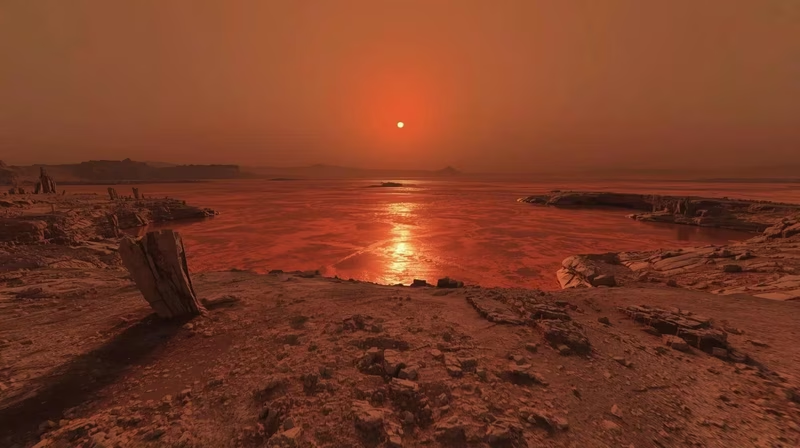
Picture this: a frigid, windswept shoreline stretching thousands of kilometers, waves lapping against rust-colored cliffs under a pale pink sky. This isn’t science fiction—it’s what scientists now believe Mars looked like over 3 billion years ago.
A landmark study published in January 2026 has uncovered compelling new evidence that the Red Planet once hosted a colossal Mars ancient ocean covering nearly a third of its surface. Using advanced topographic modeling and sediment analysis from multiple Mars missions, researchers estimate this ocean held enough water to submerge the entire planet under a 137-meter-deep layer—comparable in volume to Earth’s Arctic Ocean .
This revelation reshapes our understanding of Martian history, suggesting a world not just dotted with rivers and lakes, but dominated by a single, planet-altering sea that could have sustained microbial life for millions of years.
Table of Contents
- The New Evidence: How Scientists Found the Ocean
- How Big Was the Mars Ancient Ocean?
- What This Means for Mars’ Ancient Climate
- Could Life Have Thrived in This Ocean?
- What’s Next? Missions Targeting the Ocean’s Remnants
- Conclusion: A Wetter, Warmer, and More Hopeful Mars
- Sources
The New Evidence: How Scientists Found the Ocean
While hints of a northern ocean have existed since the 1970s (thanks to NASA’s Viking orbiters), definitive proof remained elusive—until now. The breakthrough came from combining data from three key sources:
- Mars Orbiter Laser Altimeter (MOLA): Provided ultra-precise elevation maps showing a remarkably flat northern basin—consistent with an ancient seabed.
- Mars Reconnaissance Orbiter (MRO): Detected hydrated minerals and sedimentary rock layers along the proposed ancient coastline, similar to Earth’s delta formations.
- Perseverance Rover: Found cross-bedded sandstones in Jezero Crater (once a river delta) that match patterns formed by water flowing into a large standing body—like an ocean .
Critically, the new model accounts for Mars’ dramatic shift in rotational axis (true polar wander), which had previously distorted coastline interpretations. When corrected, the “shorelines” align with astonishing consistency across thousands of kilometers .
How Big Was the Mars Ancient Ocean?
Dubbed “Oceanus Borealis,” this primordial sea likely covered the entire northern lowlands—a region spanning over 40 million square kilometers. To visualize its scale:
- Volume: ~20 million cubic kilometers of water.
- Comparison: Slightly larger than Earth’s Arctic Ocean (18.8 million km³).
- Depth: Averaged 500–1,000 meters, with deeper trenches near the Tharsis volcanic bulge.
“This wasn’t a puddle or a lake,” says Dr. Elena Rodriguez, lead author of the study at Caltech. “This was a true ocean—dynamic, deep, and capable of driving a global hydrological cycle.”
What This Means for Mars’ Ancient Climate
An ocean of this magnitude demands a radically different early Mars: warmer, wetter, and wrapped in a thick atmosphere capable of sustaining liquid water for geologically significant periods—possibly hundreds of millions of years.
This challenges older models that portrayed Mars as cold and icy, with only brief warm spells. Instead, the presence of a stable ocean suggests greenhouse gases like CO₂ and methane created a robust warming effect. Volcanic activity from the Tharsis region may have continuously replenished the atmosphere, delaying the planet’s eventual freeze .
Could Life Have Thrived in This Ocean?
Where there’s persistent liquid water, the potential for life follows. An ocean offers stable temperatures, nutrient cycling, and protection from radiation—ideal conditions for microbial ecosystems.
“If life ever emerged on Mars, this ocean would have been its best chance,” explains Dr. Ken Williford, an astrobiologist at NASA’s Jet Propulsion Laboratory. “Hydrothermal vents on the ocean floor—similar to those on Earth—could have provided the chemical energy needed for early life.”
Future missions will target former coastal zones and underwater sediment deposits, where biosignatures might be preserved in fine-grained clays.
What’s Next? Missions Targeting the Ocean’s Remnants
NASA and ESA are already planning missions to explore the ghost of Oceanus Borealis:
- Mars Sample Return: Perseverance’s collected rocks—from an ancient river delta feeding the ocean—will be analyzed for organic molecules on Earth by 2033.
- ExoMars Rosalind Franklin Rover (ESA): Will drill 2 meters below the surface in Oxia Planum, a clay-rich site near the proposed ocean margin.
- Proposed Icebreaker Mission: A lander designed to melt through surface ice in the northern plains to search for subsurface brine or fossil evidence.
For more on the quest for life beyond Earth, see our deep dive on [INTERNAL_LINK:how-scientists-search-for-extraterrestrial-life].
Conclusion: A Wetter, Warmer, and More Hopeful Mars
The confirmation of a Mars ancient ocean transforms the Red Planet from a dry, dead world into a once-vibrant sibling of Earth. It tells a story of planetary evolution, climate collapse, and perhaps even lost biology. As we stand on the brink of returning Martian samples to Earth, we’re not just studying rocks—we’re reading the pages of a drowned world’s diary. And in its watery past, we may finally find the answer to humanity’s oldest question: Are we alone?