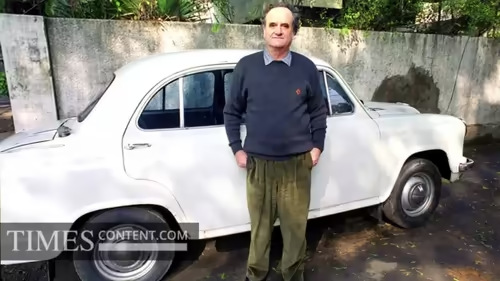
Sir Mark Tully Dies at 90: A Farewell to the Voice of India
The news that Mark Tully dies at the age of 90 has sent ripples of sorrow through the global journalism community and across the length and breadth of India. On Sunday, January 25, 2026, the man who was often called the BBC’s ‘voice of India’ passed away at Max Hospital in New Delhi, a city he had called home for most of his remarkable life . His close friend and former colleague, Satish Jacob, confirmed the news, marking the end of an era for a journalist whose calm, measured tones narrated the tumultuous story of modern India to the world .
Table of Contents
- Early Life and an Unlikely Destiny
- The BBC Years: Defining a Nation Through Radio
- Covering India’s Most Pivotal Moments
- A Prolific Author and His Enduring Books
- Awards, Recognition, and a Legacy of Trust
- Conclusion: The Man Who Was More Indian Than Many Indians
Early Life and an Unlikely Destiny
Born William Mark Tully on October 24, 1935, in Kolkata (then Calcutta) to British parents, his connection to the subcontinent was forged from birth . He was sent to England for his education, attending boarding school and later studying theology at Cambridge. This path seemed to lead him towards a life in the church, but fate had other plans. In 1964, he joined the BBC as a radio producer for the World Service, and just a year later, in 1965, he was posted to India as a correspondent—a decision that would define his life’s work .
The BBC Years: Defining a Nation Through Radio
Tully’s rise within the BBC was meteoric. By 1971, he was appointed the BBC’s New Delhi correspondent, and soon after, he became the Chief of Bureau, a position he held for an impressive twenty-two years [[12], [15]]. From this perch, he didn’t just report the news; he interpreted it, providing context and nuance that was often missing from the headlines. His voice, calm and authoritative, became a trusted companion for millions of Indians during times of both celebration and crisis. He worked with the BBC for three decades before resigning in July 1994, but his association with India’s story never ceased .
Covering India’s Most Pivotal Moments
Sir Mark Tully’s career was a front-row seat to history. He reported on some of the most defining and traumatic events in India’s post-independence journey. His coverage was not without personal risk. During the anti-Sikh riots that followed the assassination of Prime Minister Indira Gandhi in 1984, Tully found himself trapped and threatened by a mob chanting “Death to Mark Tully,” locked in a room for hours before being rescued by local officials .
He also covered the 1971 India-Pakistan war, the Bhopal gas tragedy, and the assassination of Rajiv Gandhi. His ability to remain objective while demonstrating deep empathy for the people of India earned him a unique place in the nation’s heart. He wasn’t seen as a foreign correspondent, but as a chronicler who understood the country’s complexities from within.
A Prolific Author and His Enduring Books
After leaving the BBC, Tully channeled his deep understanding of India into a successful writing career. He authored nine acclaimed books that continue to be essential reading for anyone seeking to understand the nation’s soul . His works are not dry historical accounts but vibrant, insightful explorations of India’s culture, politics, and spirit.
Some of his most notable publications include:
- Amritsar: Mrs Gandhi’s Last Battle: A powerful account of Operation Blue Star and its tragic aftermath.
- No Full Stops in India: A collection of essays that capture the chaotic, resilient, and endlessly fascinating nature of the country.
- Non Stop India: An exploration of a rapidly changing India in the new millennium.
- India From Within: A guide to India’s history, religion, and arts for a global audience.
Awards, Recognition, and a Legacy of Trust
Tully’s immense contribution to journalism and to Indo-British relations was widely recognized. He was knighted in 1992 for his services to broadcasting. His accolades include the prestigious RedInk Award for Lifetime Achievement in 2018, which honored his “long and outstanding contribution to Indian journalism” . In 2019, he was conferred the ‘Lifetime Achievement Award’ at the UK-India Awards in London for his role in strengthening the cultural and journalistic ties between the two nations .
His legacy is not just in the awards he won, but in the trust he built. He was a rare foreign journalist who was embraced by India, not as an outsider looking in, but as one of its own. His integrity and wide vision made him a leading figure in global broadcasting .
Conclusion: The Man Who Was More Indian Than Many Indians
The passing of Sir Mark Tully marks the end of a golden chapter in journalism. He was a bridge between cultures, a storyteller who chose depth over speed, and a man who, despite his British passport, found his true home in the heart of India. His life’s work stands as a testament to the power of empathetic, thoughtful reporting. For generations to come, his voice—both on the airwaves and in his books—will continue to guide us through the intricate, beautiful, and often contradictory journey of modern India. To learn more about other influential figures in media, check out our piece on [INTERNAL_LINK:influential-journalists-of-the-20th-century].
Sources
- Veteran journalist Mark Tully dies at 90. Confirmed by Satish Jacob.
- Veteran BBC journalist Mark Tully, who covered… died at a hospital in New Delhi.
- Trapped and threatened by the mob chanting “Death to Mark Tully”…
- Mark Tully was born in Kolkata on 24 October 1935.
- Tully joined the BBC in 1964… posted to India as a correspondent in 1965.
- In 1971, Tully was appointed BBC correspondent in New Delhi…
- Sir Mark Tully was born in Calcutta… Chief of Bureau, BBC, New Delhi for twenty-two years.
- The recipient of several awards, Tully authored nine books.
- He worked with the BBC for 30 years before resigning in July 1994.
- Veteran British journalist Sir Mark Tully was conferred with ‘Lifetime Achievement Award’ at UK-India Awards.
- RedInk Award for Lifetime Achievement goes to Mark Tully.
- Former BBC journalist and Chief of Bureau for India. Sir Mark Tully is a leading British broadcaster…