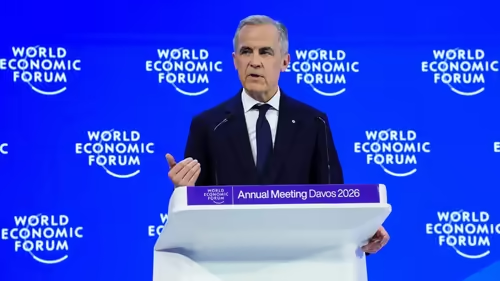
The gilded halls of Davos were shaken this week—not by another billionaire’s pronouncement, but by a stark, urgent warning from an unexpected source. On January 20, 2026, Canada’s new Prime Minister, Mark Carney, delivered a speech that has instantly become the talk of the global elite, declaring that the post-war rules-based international order isn’t merely evolving—it’s actively breaking apart .
Carney, who only assumed office in March 2025 after succeeding Justin Trudeau as leader of the Liberal Party , used his debut at the World Economic Forum to lay out a bold new doctrine for Canada and its allies. His message was clear: appeasement is over. The era of great power rivalry demands a new strategy built on collective resilience, and he’s calling on middle powers, especially India, to step up and lead.
Table of Contents
- Carney’s Davos Doctrine: A World Order in Crisis
- The Unmistakable Target: A Warning Against Nationalism
- India’s Pivotal Role in Carney’s New Coalition
- What Comes Next for Middle Powers?
- Conclusion: A Call to Arms for the Democratic World
- Sources
Carney’s Davos Doctrine: A World Order in Crisis
In his address titled “Principled and pragmatic: Canada’s path,” Carney painted a grim picture of the current geopolitical landscape . He argued that we are not witnessing a simple transition but a fundamental fracture. The institutions and norms that have underpinned global peace and prosperity since 1945 are being systematically undermined by a potent mix of authoritarianism, economic coercion, and a retreat into isolationist nationalism.
“This is not evolution; it is disintegration,” Carney stated, according to reports from the event . His diagnosis is that the old playbook—relying on multilateral institutions alone or hoping that economic interdependence would prevent conflict—is obsolete. The world, he insists, needs a new operating system.
The Unmistakable Target: A Warning Against Nationalism
While Carney never uttered the name “Donald Trump,” his speech was a direct and powerful rebuke of the political philosophy the former U.S. President represents. He warned against the dangers of “politics of grievance” and leaders who seek to build walls—both physical and economic—rather than bridges .
His critique centered on the idea that such an approach doesn’t make a nation stronger; it makes it weaker and more vulnerable. By turning inward and abandoning alliances, a country forfeits its influence and its ability to shape the global rules that ultimately affect its own citizens. This was a clear message aimed at a potential second Trump term, urging the world to prepare for a future where the United States might once again be an unreliable partner in upholding the liberal order.
India’s Pivotal Role in Carney’s New Coalition
The most intriguing and geopolitically significant part of Carney’s Mark Carney Davos speech was his direct appeal to India. He positioned the world’s largest democracy not just as a regional player, but as a critical linchpin in a new coalition of “middle powers.”
Carney’s logic is strategic. Nations like Canada, India, Germany, Japan, and others possess significant economic clout, democratic values, and a shared interest in a stable, rules-based system. Alone, they can be pressured or coerced by larger powers. But together, they form a formidable bloc capable of defending their interests and promoting a positive global agenda.
He urged India to move beyond non-alignment and embrace a more proactive, coalition-based foreign policy. This is a subtle but significant shift in how Western leaders are now viewing India—not just as a counterweight to China, but as a co-author of the next chapter of international relations. For India, this presents both a massive opportunity for global leadership and a complex challenge in balancing its strategic autonomy with the need for deeper alliances.
What Comes Next for Middle Powers?
Carney’s vision goes beyond mere rhetoric. He outlined a practical framework for action, which he calls “strategic autonomy through collective resilience” . This involves several key pillars:
- Economic Diversification: Reducing reliance on single sources for critical minerals, energy, and technology to avoid being held hostage by coercive economic policies.
- Supply Chain Alliances: Building trusted networks among democratic nations to ensure the secure flow of goods and services, a concept already being explored in initiatives like the Indo-Pacific Economic Framework.
- Democratic Solidarity: Creating formal and informal mechanisms to support each other when facing political or economic pressure from authoritarian states.
- Investing in Innovation: Doubling down on R&D in clean tech, AI, and biotech to maintain a competitive edge and drive sustainable growth.
This new doctrine signals a major shift in Canadian foreign policy, moving from a traditional peacekeeper role to that of a proactive networker and coalition-builder in a fractured world.
Conclusion: A Call to Arms for the Democratic World
Mark Carney’s debut on the world stage at Davos 2026 was nothing short of a clarion call. His Mark Carney Davos speech was a masterclass in diagnosing a complex global crisis and offering a concrete, albeit challenging, path forward. By directly confronting the forces of division and placing his faith in a coalition of middle powers led by nations like India, Carney has thrown down a gauntlet.
The question now is whether other leaders will answer the call. The success of his vision depends on a level of trust, coordination, and long-term commitment that has been sorely lacking in recent years. But if there’s one thing Carney’s background as a former central banker has taught him, it’s that systemic risks require systemic solutions. The old world order may be gone, but Carney is betting that a new, more resilient one can be built from the ground up. For more on the shifting dynamics of global power, see our deep dive on [INTERNAL_LINK:geopolitical-shifts-2026].
Sources
- Prime Minister of Canada. (2026). “Principled and pragmatic: Canada’s path” Prime Minister Carney addresses the World Economic Forum Annual Meeting. Retrieved from official government channels .
- The Associated Press. (2026, January 20). It’s a new dawn, it’s a new day: Carney turns the page on… .
- Liberal Party of Canada. (2025). About Mark Carney. .
- World Economic Forum. (2026). Annual Meeting 2026. https://www.weforum.org/meetings/world-economic-forum-annual-meeting-2026/ .