Introduction
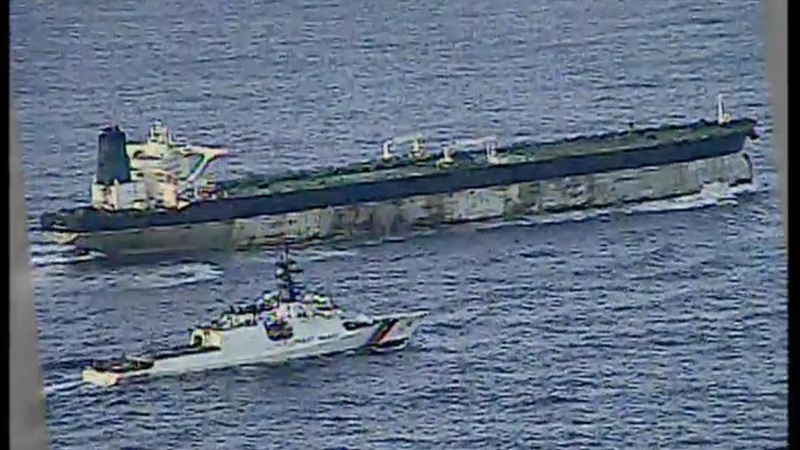
In a dramatic escalation of geopolitical friction, Russia has formally accused the United States of committing a maritime law breach by allegedly carrying out a “forceful seizure” of a Russian-flagged vessel. The incident, which reportedly occurred in international waters, has ignited a fierce diplomatic row and raised urgent questions about the boundaries of enforcement at sea .
Moscow claims the U.S. action violated core principles of the United Nations Convention on the Law of the Sea (UNCLOS), while Washington remains tight-lipped or cites national security concerns. As rival narratives collide, the world watches a high-stakes legal and strategic confrontation unfold—one that could set a dangerous precedent for freedom of navigation and state sovereignty on the high seas.
Table of Contents
- What Happened? The Vessel Seizure Incident
- Russia’s Claim: A Clear Maritime Law Breach
- The US Position: Security or Overreach?
- What Does International Maritime Law Say?
- Historical Precedents and Geopolitical Context
- Global Reactions and Diplomatic Fallout
- Conclusion: Navigating a New Era of Maritime Tension
- Sources
What Happened? The Vessel Seizure Incident
According to Russian officials, a Russian commercial vessel was intercepted and boarded by U.S. authorities—likely the U.S. Coast Guard or Navy—in waters beyond any nation’s exclusive economic zone (EEZ) . The crew was detained, and the ship was towed to a U.S. port without prior notification or consent from Moscow.
While the exact location, vessel name, and cargo remain partially classified, reports suggest the seizure may be linked to alleged sanctions violations, such as transporting oil or goods restricted under U.S. export controls targeting Russia . The U.S. has not officially confirmed details but typically justifies such actions under its domestic laws like the Magnitsky Act or International Emergency Economic Powers Act (IEEPA).
Russia’s Claim: A Clear Maritime Law Breach
Russia’s Foreign Ministry has condemned the act as “unlawful” and “a gross violation of universally recognized norms of international maritime law” . Their core argument rests on Article 87 of UNCLOS, which guarantees the freedom of the high seas—including freedom of navigation—for all states.
Under UNCLOS, warships or coast guard vessels may only board foreign ships on the high seas under very limited circumstances:
- If the ship is engaged in piracy (Article 105)
- If it’s involved in slave trade (Article 99)
- If it’s stateless or falsely flying a flag (Article 110)
- If there’s hot pursuit from territorial waters (Article 111)
Russia asserts none of these conditions applied, making the U.S. boarding an illegal act of force against a sovereign-flagged vessel—a potential act of state aggression under customary international law.
The US Position: Security or Overreach?
Although the U.S. State Department has not issued a detailed public rebuttal, past precedents suggest Washington may argue the vessel was violating U.S. sanctions tied to national security threats—particularly regarding Russia’s war in Ukraine .
Notably, the U.S. has not ratified UNCLOS, though it claims to follow its provisions as customary international law. Instead, it often relies on domestic statutes and multilateral agreements (like G7 sanctions coalitions) to justify extraterritorial enforcement. Critics, however, call this “lawfare”—using legal mechanisms as tools of geopolitical coercion.
What Does International Maritime Law Say?
The cornerstone of ocean governance is the United Nations Convention on the Law of the Sea (UNCLOS), ratified by over 160 countries—including Russia, but not the U.S. . Despite non-ratification, U.S. courts and military manuals routinely cite UNCLOS as reflective of binding customary law.
Key principles relevant here:
- Flag State Jurisdiction: A ship on the high seas is subject only to the laws of its flag state (in this case, Russia).
- No Right of General Visit: There is no universal right for one country to stop and search another’s vessel without specific legal grounds.
- Proportionality and Due Process: Even in cases of legitimate boarding, force must be proportional, and crew rights must be respected.
Legal scholars are divided. Some argue sanctions enforcement can’t override sovereignty on the high seas; others contend that systemic violations of international peace (e.g., funding war via illicit trade) may justify exceptional measures.
Historical Precedents and Geopolitical Context
This isn’t the first time such tensions have flared:
- In 2022, the U.S. seized an Iranian oil tanker in the Gulf of Mexico under similar sanctions pretexts.
- During the Cold War, both superpowers occasionally shadowed or harassed each other’s vessels—but direct seizures were rare to avoid escalation.
- China has repeatedly accused the U.S. of violating maritime law during freedom of navigation operations (FONOPs) near its artificial islands.
Today’s incident occurs amid heightened Russia-U.S. hostility, with both nations testing the limits of gray-zone conflict—where actions fall short of war but erode legal norms.
Global Reactions and Diplomatic Fallout
So far, major powers have remained cautious. The European Union has not commented publicly, likely wary of alienating either side. However, neutral maritime nations—like Singapore and Panama (a major flag registry)—may voice concern if unilateral seizures become routine, as they threaten global shipping stability.
International bodies like the International Maritime Organization (IMO) lack enforcement power but could face pressure to clarify rules on sanctions-related interdictions.
Conclusion: Navigating a New Era of Maritime Tension
The alleged maritime law breach by the U.S. represents more than a bilateral spat—it’s a stress test for the entire rules-based order at sea. If powerful states increasingly bypass UNCLOS to enforce domestic agendas, the high seas could become a Wild West of competing claims and retaliatory seizures. For now, Russia’s protest serves as a warning: in an era of fractured diplomacy, even the oceans are no longer neutral ground. To understand how UNCLOS shapes global trade, see our explainer on [INTERNAL_LINK:unclos-and-global-shipping].
Sources
- Times of India: Russia accuses US of forceful seizure of vessel; calls it maritime law breach
- United Nations: UN Convention on the Law of the Sea (UNCLOS)
- Council on Foreign Relations: U.S. Sanctions on Russia
- International Maritime Organization (IMO): IMO Official Site
- Harvard Law Review: The Limits of Maritime Enforcement