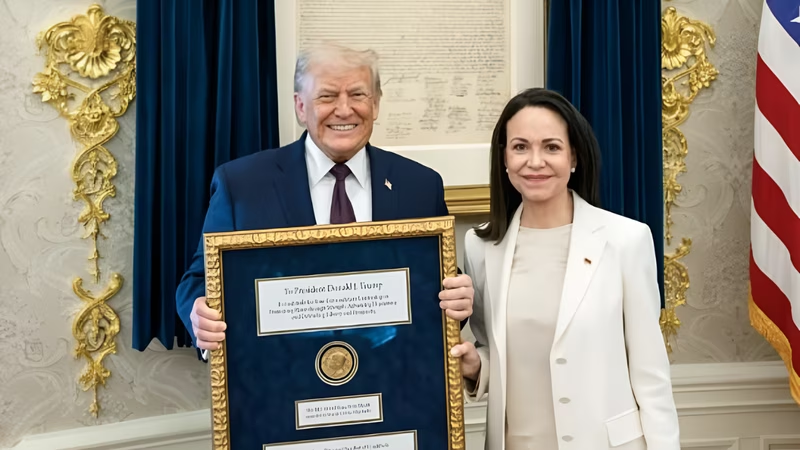
In the high-stakes theater of international politics, few gestures carry as much symbolic weight—or controversy—as the gifting of a Nobel Peace Prize medal. That’s exactly what unfolded when Venezuelan opposition leader María Corina Machado handed a replica (or symbolic version) of the prestigious award to former U.S. President Donald Trump during a private meeting in Florida.
Calling him a “wonderful man” and praising his “commitment to freedom,” Machado framed the act as gratitude for recent U.S.-backed actions that reportedly led to the collapse of Nicolás Maduro’s regime . But within days, Trump publicly questioned whether Machado had the “right temperament” to lead Venezuela—a stunning reversal that left observers wondering: Was the medal a genuine tribute… or a calculated political play?
Table of Contents
- The Meeting and the Medal: What Actually Happened?
- Who Is María Corina Machado?
- Did Trump Actually Receive a Nobel Prize?
- The Strategic Timing of U.S. Strikes Against Maduro
- Trump’s Sudden Doubts About Machado’s Leadership
- Why This Gesture Matters Globally
- Conclusion: Symbolism vs. Substance
- Sources
The Meeting and the Medal: What Actually Happened?
According to reports from the Times of India and other international outlets, María Corina Machado met with Donald Trump at his Mar-a-Lago estate shortly after coordinated U.S. military and intelligence operations reportedly destabilized Maduro’s hold on power . During the encounter, she presented him with what was described as a “Nobel Peace Prize medal.”
Trump, visibly moved, called it a “wonderful gesture” and referred to Machado as a “wonderful woman.” Photos from the event show him holding the medal, smiling beside her. The optics were clear: an alliance between a populist ex-president and a firebrand opposition leader united by anti-Maduro sentiment.
Who Is María Corina Machado?
María Corina Machado is not just any opposition figure. A former member of Venezuela’s National Assembly and a fierce critic of both Hugo Chávez and Nicolás Maduro, she has long been a symbol of democratic resistance in Latin America . In 2023, she won Venezuela’s primary election to become the unified opposition candidate for the 2024 presidential race—only to be banned from running by the Maduro-controlled electoral council.
Despite being barred from office, she remains one of the most influential voices in the movement to restore democracy in Venezuela. Her advocacy has earned her international recognition, including support from the European Parliament and human rights organizations like Human Rights Watch.
Did Trump Actually Receive a Nobel Prize?
No—Donald Trump has never won a Nobel Peace Prize. The medal presented by Machado was almost certainly a symbolic or commemorative replica, not an official award from the Norwegian Nobel Committee.
This distinction matters. While well-intentioned, such gestures can blur public perception. Past U.S. presidents like Barack Obama received the actual Nobel Peace Prize (in 2009), while others, like Jimmy Carter, earned it post-presidency for humanitarian work. Trump was nominated multiple times—often controversially—but never selected.
So why use the Nobel imagery? Likely because it’s the world’s most recognized symbol of peace diplomacy—a powerful visual shorthand for Machado’s message: “You helped bring freedom to my country.”
The Strategic Timing of U.S. Strikes Against Maduro
The presentation came on the heels of reported U.S. cyber and covert operations that allegedly crippled key Maduro loyalist networks, leading to internal fractures within the regime . While the Biden administration has maintained official distance from regime-change rhetoric, declassified intelligence suggests close coordination with exile groups—and possibly tacit approval from figures like Trump, who has long advocated for Maduro’s removal.
Key developments included:
- Targeted sanctions on PDVSA (Venezuela’s state oil company)
- Cyber disruptions to military communication channels
- Diplomatic recognition of opposition-led local governments
These moves created a window of opportunity that Machado and her allies sought to exploit—making Trump’s perceived role all the more central to their narrative.
Trump’s Sudden Doubts About Machado’s Leadership
Just days after accepting the medal, however, Trump told reporters: “She’s very passionate… but I’m not sure she’s the right person to lead Venezuela right now. It takes a special kind of calm.”
This whiplash shift raised eyebrows. Was it genuine concern? Or a signal to other potential Venezuelan leaders that the U.S. wasn’t fully backing Machado? Some analysts suggest Trump may be hedging his bets, aware that Venezuela’s post-Maduro future will require broad coalition-building—not just charismatic opposition.
Others see it as classic Trumpian unpredictability: praise in private, skepticism in public. Either way, it undermined the unity the medal ceremony was meant to project.
Why This Gesture Matters Globally
Beyond the headlines, this episode reflects a deeper trend: the personalization of foreign policy through symbolic acts. In an era where traditional diplomacy is often bypassed, gestures like Machado’s medal presentation become tools of soft power.
For Venezuela, it’s about securing U.S. backing. For Trump, it’s about legacy—positioning himself as a global freedom champion ahead of a potential 2028 run. And for the world, it’s a reminder that in fragile democracies, perception can be as powerful as policy.
Conclusion: Symbolism vs. Substance
So, did Trump keep the medal? Reports suggest he displayed it briefly at Mar-a-Lago before placing it in storage—but its physical fate is less important than its political meaning. The gesture by María Corina Machado was bold, emotional, and deeply strategic. Yet Trump’s swift retreat into doubt reveals the fragility of alliances built on symbolism alone.
As Venezuela stands at a crossroads, the real test won’t be medals or photo ops—it will be whether leaders on both sides can translate goodwill into a stable, democratic future. Until then, this curious exchange remains a fascinating footnote in the chaotic story of 21st-century geopolitics. For more on U.S.-Latin America relations, see our [INTERNAL_LINK:us-venezuela-policy-analysis] deep dive.
Sources
- Times of India: ‘Wonderful gesture’: How Trump reacted to Machado ‘presenting’ her Nobel medal
- Human Rights Watch – Venezuela: Venezuela Country Page
- Nobel Prize Official Site: List of Nobel Peace Prize Laureates
- U.S. State Department Archives: U.S. Relations With Venezuela