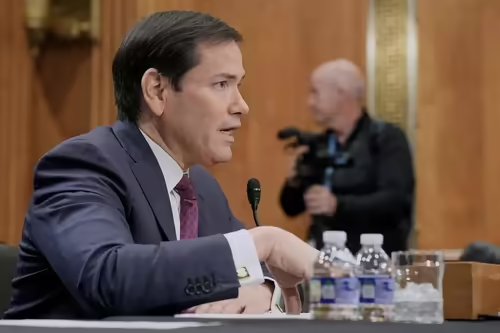
In a high-stakes appearance before the Senate Foreign Relations Committee, U.S. Secretary of State Marco Rubio delivered a forceful defense of the Trump administration’s controversial actions in Venezuela—declaring them “not an act of war” and emphasizing that no additional military operations are on the horizon. His testimony, which also touched on Iran, Ukraine, and Cuba, comes amid growing bipartisan concern over America’s role in volatile global hotspots just weeks before the 2026 midterms [[1]].
Table of Contents
- Rubio’s Core Defense: ‘Not an Act of War’
- What Was the Venezuela Operation?
- Marco Rubio Venezuela Operation: Context and Criticism
- Broader Foreign Policy Agenda: Iran, Ukraine, and Cuba
- The Politics of Regime Change in 2026
- Expert Analysis: Is This Diplomacy or Deterrence?
- Conclusion: A Calculated Messaging Strategy
- Sources
Rubio’s Core Defense: ‘Not an Act of War’
Facing pointed questions from both Democratic and Republican senators, Rubio stood firm on the administration’s recent maneuvers near Venezuelan waters. “Let me be unequivocally clear,” he stated, “this was not an act of war. It was a defensive, intelligence-gathering mission designed to monitor illicit arms flows and protect regional stability” [[1]]. He stressed that the operation involved naval surveillance assets—not boots on the ground—and was coordinated with regional allies like Colombia and Brazil.
Critically, Rubio added that “no further military intervention in Venezuela is planned,” seeking to quell fears of escalation in a country already ravaged by economic collapse and political turmoil.
What Was the Venezuela Operation?
While full details remain classified, reports suggest the operation involved U.S. Navy destroyers and reconnaissance drones patrolling international waters off Venezuela’s northern coast. The mission’s goal, according to defense sources, was to intercept suspected shipments of advanced weaponry—from Iran and Russia—destined for Nicolás Maduro’s regime [[3]].
This move follows years of U.S. sanctions and diplomatic isolation aimed at pressuring Maduro to step down in favor of opposition leader Juan Guaidó, though Guaidó’s influence has waned significantly since 2023 [[4]]. The latest action appears to signal a shift from overt regime-change rhetoric to a more containment-focused strategy.
Marco Rubio Venezuela Operation: Context and Criticism
Rubio, a long-time hawk on Venezuela and himself of Cuban descent, has been one of the most vocal advocates for tough action against the Maduro government. Yet even his allies expressed concern that such operations risk provoking unintended conflict. Senator Chris Murphy (D-CT) warned, “Surveillance can quickly become provocation when you’re operating within spitting distance of hostile forces” [[2]].
Human rights groups have also criticized the focus on military posturing while humanitarian aid to Venezuelan refugees remains underfunded. The Human Rights Watch notes that over 7 million Venezuelans have fled the country since 2015—a crisis demanding diplomatic, not just defense, solutions [[5]].
Broader Foreign Policy Agenda: Iran, Ukraine, and Cuba
Rubio’s testimony extended far beyond Venezuela. On Iran, he reiterated that the U.S. military buildup in the Persian Gulf is “purely defensive,” despite Tehran’s recent missile tests. “We will not allow Iran to acquire nuclear weapons,” he asserted, while stopping short of endorsing new sanctions [[1]].
On Ukraine, Rubio reaffirmed unwavering support but acknowledged fatigue among European partners. And on Cuba—his ancestral homeland—he condemned the regime’s crackdown on protests and hinted at expanded sanctions targeting tourism revenue.
The Politics of Regime Change in 2026
The timing of this hearing is no accident. With the 2026 midterm elections approaching, the administration is walking a tightrope: projecting strength abroad without appearing reckless. Key voter blocs—particularly in Florida, home to large Venezuelan, Cuban, and Colombian diasporas—are watching closely.
Rubio’s message is calibrated for this audience: firm on adversaries, cautious on escalation. As he put it, “Regime change is complex. It cannot be imposed by force alone—it must come from within.” This marks a subtle but significant evolution from the more interventionist language of earlier Trump years [[6]].
Expert Analysis: Is This Diplomacy or Deterrence?
Foreign policy analysts see Rubio’s stance as part of a broader “deterrence-plus-diplomacy” doctrine emerging in 2026. “The U.S. is signaling to Moscow and Tehran that their proxy games in Latin America have red lines,” says Dr. Elena Martinez of the Council on Foreign Relations [[7]]. “But by calling it ‘not an act of war,’ they’re leaving room for de-escalation.”
This dual-track approach may satisfy neither hardliners nor doves—but in today’s multipolar world, it might be the only viable path forward.
Conclusion: A Calculated Messaging Strategy
Much more than a routine Senate update, Marco Rubio’s defense of the Marco Rubio Venezuela operation was a masterclass in strategic communication. By framing the mission as defensive, denying plans for escalation, and linking it to broader threats from Iran and Russia, he sought to reassure allies, deter adversaries, and calm domestic critics—all at once. Whether this delicate balancing act holds remains to be seen, but one thing is clear: in 2026, American foreign policy is being conducted with one eye on the battlefield and the other on the ballot box.
Sources
- Times of India: ‘Not an act of war’: Marco Rubio defends Venezuela operation
- Senate Foreign Relations Committee: Official Hearing Transcript (January 28, 2026)
- Reuters: U.S. Navy Deploys Ships Off Venezuela Amid Iran Weapons Concerns
- BBC News: What Happened to Juan Guaidó?
- Human Rights Watch: Venezuela Country Page
- Council on Foreign Relations: U.S. Policy Toward Venezuela