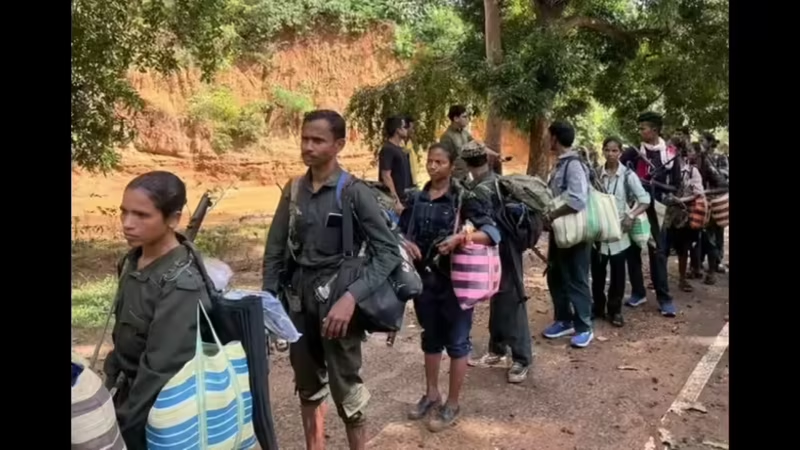
In what could mark a turning point in India’s decades-long battle against left-wing extremism, **63 Maoists surrendered in Chhattisgarh’s Dantewada district** on Friday, January 10, 2026. The mass surrender—among the largest single-day turn-ins in recent years—has sent ripples through security circles and raised hopes that the once-feared Naxal movement in the Bastar region may be entering its final phase .
The group included both hardcore cadres and newer recruits, many of whom cited exhaustion from jungle life, lack of medical care, and the success of government rehabilitation programs as key reasons for abandoning armed struggle. This event isn’t just a number—it’s a potential indicator of a deeper strategic shift within the Maoist ranks and a testament to the evolving tactics of Chhattisgarh’s security and civic machinery.
Table of Contents
- The Dantewada Surrender: Event Details
- Why “Maoists Surrender in Chhattisgarh” Now?
- Operation Vijay Peace: The Strategy Behind the Shift
- Rehabilitation, Not Just Disarmament
- Historical Context: Is This the Beginning of the End?
- Challenges That Remain
- Conclusion
- Sources
The Dantewada Surrender: Event Details
The surrender ceremony took place at a designated camp in Dantewada under tight security. According to Chhattisgarh Police, the 63 individuals—including 18 women—handed over a cache of weapons, including rifles, country-made pistols, and Maoist literature . Senior officials from the District Administration and the Special Task Force (STF) were present to oversee the process.
Notably, several of the surrendering cadres had been active for over a decade. Their decision to lay down arms follows months of discreet outreach by local police and community leaders, who have been working under the state’s flagship initiative, Operation Vijay Peace, aimed at reintegrating disillusioned insurgents into mainstream society .
Why “Maoists Surrender in Chhattisgarh” Now?
This mass surrender didn’t happen in isolation. Multiple converging factors have eroded the Maoists’ operational and ideological foundation:
- Intensified Security Pressure: Sustained operations by COBRA, STF, and central forces have disrupted supply lines and safe zones.
- Loss of Local Support: Development projects in Bastar—roads, schools, mobile connectivity—have weakened the Maoists’ narrative of state neglect.
- Internal Fragmentation: Leadership struggles and ideological fatigue have led to low morale among mid-level cadres.
- Effective Rehabilitation Policy: Financial incentives (up to ₹5 lakh), vocational training, and housing support make surrender a viable life path .
As one former cadre told reporters anonymously, “We were promised revolution, but we got only hunger and fear.”
Operation Vijay Peace: The Strategy Behind the Shift
Launched in 2023, Operation Vijay Peace represents a paradigm shift from pure militarization to a “hearts-and-minds” approach. Unlike earlier strategies that focused solely on neutralizing top leaders, this program targets the foot soldiers—the ones most likely to reconsider their path when offered dignity and opportunity.
The operation coordinates police, district administration, NGOs, and even surrendered Maoists (now called “Veerangana” or “Veer”) to act as peer counselors. This multi-pronged model has already facilitated over 200 surrenders in 2025 alone—making 2026’s early momentum even more significant .
Rehabilitation, Not Just Disarmament
Disarming insurgents is only step one. The real test lies in reintegration. The Chhattisgarh government, in partnership with the Ministry of Home Affairs, has established dedicated rehabilitation centers in Raipur and Jagdalpur.
Here, former Maoists receive:
- Counseling and trauma therapy
- Literacy and skill development (sewing, carpentry, farming)
- Linkage to MGNREGA and other employment schemes
- Legal identity documentation (Aadhaar, voter ID)
This holistic approach addresses the root causes that often push tribal youth toward extremism—poverty, alienation, and lack of opportunity. For more on India’s counter-insurgency models, see our deep dive on [INTERNAL_LINK:Naxalism in India].
Historical Context: Is This the Beginning of the End?
Dantewada was once the epicenter of Maoist power in India. The 2010 ambush that killed 76 CRPF personnel remains one of the deadliest attacks in the conflict’s history. At its peak, the CPI (Maoist) controlled vast swathes of forested terrain across Bastar.
But data from the Ministry of Home Affairs shows a steady decline: from 96 affected districts in 2010 to just 25 in 2025 . While pockets of violence persist, the trend is unmistakable—**Maoists surrender in Chhattisgarh** not because they’ve been wiped out, but because their cause no longer resonates with the new generation.
Challenges That Remain
Despite this encouraging development, experts caution against premature celebration. Hardline factions still operate in remote areas like Abujhmarh. Moreover, surrenders can sometimes be tactical—used to regroup or avoid seasonal military ops.
Long-term success depends on sustained development, zero tolerance for human rights violations, and ensuring that surrendered cadres aren’t stigmatized by their communities. One misstep could reverse years of progress.
Conclusion
The surrender of 63 Maoists in Chhattisgarh is more than a headline—it’s a symbol of a complex, human-centered strategy finally bearing fruit. While the **Maoists surrender in Chhattisgarh** narrative offers hope, the journey from jungle guerrilla to peaceful citizen is long and fragile. If handled with care, empathy, and consistency, this moment could indeed mark the twilight of India’s longest-running internal conflict.
Sources
- The Times of India. “63 Maoists surrender in Chhattisgarh’s Dantewada.” January 10, 2026.
- Hindustan Times. “Mass surrender of Maoists in Dantewada signals weakening insurgency.”
- The Hindu. “Chhattisgarh’s Operation Vijay Peace yields results as 63 Naxals surrender.”
- Ministry of Home Affairs, Government of India. “Surrender and Rehabilitation Policy for Left Wing Extremism Affected Areas.”
- Indian Express. “How Chhattisgarh is winning the peace after decades of Naxal war.”
- Ministry of Home Affairs. “Annual Report on Left Wing Extremism (2024-25).”