Table of Contents
- Beyond Medals: A New Mindset for Manu Bhaker
- The Evolution of Manu Bhaker
- Why Home Ground Is Her Happy Place
- Mental Resilience in Elite Shooting
- What to Watch at the Asian Championship
- Conclusion: Focus Over Fanfare
- Sources
Beyond Medals: A New Mindset for Manu Bhaker
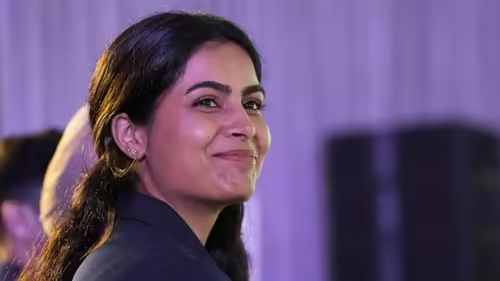
At just 23 years old, Manu Bhaker has already etched her name in Olympic history. But as she prepares to compete on home soil at the 2026 Asian Rifle/Pistol Championship in Delhi, she’s making headlines not for bold medal predictions—but for her remarkable composure. “Criticism doesn’t matter much now,” she recently told reporters, a statement that speaks volumes about her growth as an athlete and individual [[1]].
Unlike many athletes who set podium targets before major events, Bhaker is taking a different route. She’s deliberately avoiding external expectations—including her own—and instead focusing on hitting personal performance benchmarks. This shift isn’t born from lack of ambition; it’s a strategic recalibration rooted in experience, maturity, and hard-won self-awareness.
The Evolution of Manu Bhaker
Remember the 16-year-old sensation who dominated the 2018 Commonwealth Games? That was a different Manu Bhaker—talented, fearless, but still navigating the turbulent waters of elite sport. Fast forward to today, and the Paris 2024 bronze medalist carries herself with a quiet confidence that only comes after weathering both triumphs and setbacks [[2]].
Her journey hasn’t been linear. Between Tokyo 2020 and Paris 2024, Bhaker faced intense scrutiny—from equipment malfunctions to missed finals. Yet, those challenges forged her resilience. Now, she credits three key factors for her current mindset:
- Maturity: “I’ve learned to separate my self-worth from results,” she says.
- Experience: Competing at the highest level has taught her what truly matters in the moment.
- Public Support: The outpouring of love after her Paris medals reminded her she’s not alone [[1]].
This evolution reflects a broader trend in modern sports psychology: peak performance often stems not from chasing outcomes, but from mastering process-oriented goals [[3]].
Why Home Ground Is Her Happy Place
For many athletes, competing at home brings immense pressure—the weight of national expectation, the fear of disappointing a roaring crowd. But for Manu Bhaker, the upcoming championship in Delhi is a source of energy, not anxiety.
“It excites me more than it pressures me,” she shared. That sentiment is powerful. It suggests a deep internal alignment—where external noise fades, and the joy of competition takes center stage. Delhi’s Dr. Karni Singh Shooting Range, a venue she knows intimately, becomes less a battleground and more a familiar stage where she can express her craft.
This comfort could be a decisive advantage. Studies show that home-field familiarity can enhance focus and reduce cognitive load—critical in a sport where milliseconds and millimeters define success [[4]].
Mental Resilience in Elite Shooting
Shooting is often called a “mind sport.” Physical skill is essential, but mental fortitude is what separates good shooters from great ones. In a discipline where heart rate control, breath management, and emotional regulation are as vital as aim, Bhaker’s ability to dismiss criticism is not just admirable—it’s tactical.
Consider this: during the 10m air pistol event, athletes fire 60 shots in under 75 minutes. Each shot requires complete presence. A single intrusive thought—about past failures, online trolls, or future expectations—can derail an entire round.
Bhaker’s new philosophy—“I’m setting standards for myself, not for others”—is a masterclass in cognitive reframing. By anchoring her focus to controllable variables (technique, rhythm, recovery), she sidesteps the uncontrollable (judgment, results, narratives). This approach aligns with techniques used by elite performers worldwide, from Olympic archers to Formula 1 drivers [[5]].
What to Watch at the Asian Championship
The 2026 Asian Rifle/Pistol Championship isn’t just another tournament. It’s a crucial qualifier for future global events and a showcase of Asia’s shooting dominance. With powerhouses like China, South Korea, and India fielding full squads, every match will be fiercely contested.
For Indian fans, all eyes will be on Bhaker—not just for potential medals, but for how she embodies her new mindset under pressure. Will her process-first approach translate into consistent top-tier performances? And how will her presence inspire younger teammates like Esha Singh or Sarabjot Singh?
One thing is certain: if Bhaker shoots with the same calm clarity she’s describing in interviews, she’ll be a formidable force—medal or not.
Conclusion: Focus Over Fanfare
Manu Bhaker’s journey reminds us that true strength in sport isn’t always measured in gold, silver, or bronze. Sometimes, it’s found in the quiet confidence to ignore the noise, trust your training, and compete for yourself. As she steps onto the range in Delhi, she’s not carrying the burden of expectation—she’s bringing the freedom of focus. And in a high-stakes world of elite shooting, that might be the most powerful weapon of all. For more on India’s rising stars in precision sports, see our feature on [INTERNAL_LINK:indian-shooting-talent-next-generation].
Sources
- ‘Criticism doesn’t matter’: Bhaker not setting medal goals for Asian Championship. (2026). Times of India. Retrieved from https://timesofindia.indiatimes.com/sports/more-sports/shooting/criticism-doesnt-matter-much-now-manu-bhaker-not-setting-medal-goals-for-asian-championship/articleshow/127817479.cms
- Manu Bhaker wins two bronze medals at Paris 2024 Olympics. (2024). Olympics.com. Retrieved from https://olympics.com/en/news/manu-bhaker-paris-2024-bronze-medals
- Gould, D., & Maynard, I. (2009). Psychological preparation for the Olympic Games. Journal of Sports Sciences, 27(13), 1393–1408. https://doi.org/10.1080/02640410903155521
- Courneya, K. S., & Carron, A. V. (1992). The home advantage in sport competitions: A literature review. Journal of Sport and Exercise Psychology, 14(1), 28–39.
- International Shooting Sport Federation (ISSF). (2026). Competition Rules and Regulations. Retrieved from https://www.issf-sports.org