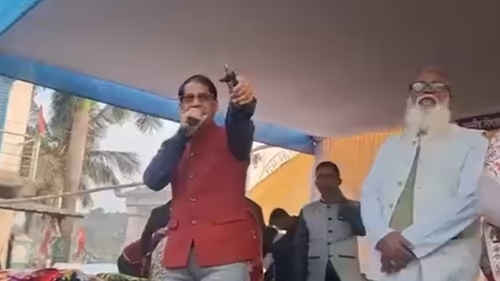
Political rhetoric in West Bengal has crossed a dangerous line. In a video that has since gone viral, Trinamool Congress (TMC) MLA Manirul Islam issued a chilling threat to the Election Commission of India (ECI), declaring, “We will hunt you down” over a Special Investigation Report (SIR) .
This isn’t just heated political banter—it’s a direct intimidation of a constitutional body tasked with upholding the integrity of India’s democratic process. And it’s not an isolated incident. The Farakka MLA’s history of alleged violence and inflammatory conduct paints a troubling picture of impunity and escalating tension in the state’s political landscape.
Table of Contents
- The EC Threat: A Chilling Public Outburst
- Manirul Islam Threatens EC—and His History of Violence
- The BDO Attack: What Really Happened in Farakka?
- BJP’s Response and the Mamata Banerjee Connection
- Why This Matters for Indian Democracy
- Conclusion: A Test for Institutions and Leadership
- Sources
The EC Threat: A Chilling Public Outburst
The controversy erupted after the ECI sought a Special Investigation Report (SIR) into alleged irregularities or misconduct in Manirul Islam’s constituency. Instead of cooperating or issuing a formal statement, the MLA took to a public platform and delivered a menacing warning: “If you file an SIR against me, I will teach you a lesson. We will hunt you down” .
Such language from an elected representative is not only unbecoming but also potentially criminal. Threatening a constitutional authority undermines the very foundation of electoral fairness and accountability. The ECI, as an independent body, must be able to function without fear of retribution from powerful political figures.
Manirul Islam Threatens EC—and His History of Violence
This outburst is far from Manirul Islam’s first brush with controversy. The Manirul Islam threatens EC incident is the latest in a string of alleged aggressive acts. Most notably, he stands accused of leading a mob that stormed the Block Development Office (BDO) in Farakka .
According to reports, the mob—allegedly incited by the MLA himself—ransacked the office, destroyed property, and physically assaulted government officials, leaving several injured . Such actions blur the line between political activism and outright criminality, especially when carried out under the banner of a ruling party.
The BDO Attack: What Really Happened in Farakka?
The Block Development Office is a critical local administrative unit responsible for rural development schemes. An attack on such an institution is an attack on governance itself. Eyewitnesses and local officials reported that the mob, led by individuals linked to the TMC, targeted the office over a dispute concerning fund allocation or administrative decisions .
Key details of the incident include:
- Government files and computers were damaged or destroyed.
- Multiple BDO staff members sustained injuries and required medical attention.
- Local police were reportedly slow to respond, raising questions about political interference in law enforcement.
While Manirul Islam has denied direct involvement, his public persona and past statements have done little to dispel suspicions. The incident reflects a broader pattern of using intimidation to settle administrative or political scores—a tactic that erodes public trust in democratic institutions.
BJP’s Response and the Mamata Banerjee Connection
Unsurprisingly, the opposition Bharatiya Janata Party (BJP) has seized on the controversy. BJP MLA Gouri Sankar launched a scathing attack on Chief Minister Mamata Banerjee, accusing her of fostering a culture of violence by “instigating her party cadres across the state to commit riots and violence” .
This accusation strikes at the heart of a long-standing criticism of the TMC regime: that it tolerates—or even encourages—aggressive tactics to maintain control. While political parties across the spectrum have faced similar allegations, the scale and frequency of such incidents in West Bengal have drawn national scrutiny.
Mamata Banerjee’s office has yet to issue a formal condemnation of Manirul Islam’s remarks, which many see as tacit approval. In a state preparing for crucial elections, the silence from the top is deafening—and deeply concerning.
Why This Matters for Indian Democracy
When an elected MLA threatens to “hunt down” members of the Election Commission, it’s not just a local scandal—it’s a national emergency for democratic norms. The ECI is one of India’s most respected constitutional bodies, and its independence is non-negotiable.
The United Nations and international watchdogs like Human Rights Watch have repeatedly emphasized that threats against electoral officials can lead to voter suppression, biased oversight, and ultimately, the erosion of free and fair elections .
Moreover, this incident highlights a dangerous trend: the normalization of violent political rhetoric. If unchecked, such behavior sets a precedent that power can override procedure, and intimidation can replace dialogue.
For more on how political violence impacts electoral integrity, see our analysis on [INTERNAL_LINK:impact-of-political-violence-on-indian-elections].
Conclusion: A Test for Institutions and Leadership
The “Manirul Islam threatens EC” episode is more than a headline—it’s a stress test for India’s democratic resilience. Will the ECI take strong disciplinary action? Will the TMC leadership distance itself from such conduct, or will it continue to enable it?
Citizens, civil society, and the media must hold both political parties and state institutions accountable. Democracy doesn’t just survive on election day—it thrives every day through respect for rules, institutions, and the rule of law. Anything less is a betrayal of the public trust.
Sources
- Times of India: ‘Will hunt you down’: TMC’s Manirul Islam threatens EC to ‘teach a lesson’ over SIR
- Election Commission of India: Official Website
- Human Rights Watch – India: Reports on Political Violence and Electoral Integrity